Proinflammatory Lipoproteins LOX-1 Mediates OxLDL-mediated - - PowerPoint PPT Presentation

proinflammatory lipoproteins lox 1
SMART_READER_LITE
LIVE PREVIEW

Proinflammatory Lipoproteins LOX-1 Mediates OxLDL-mediated - - PowerPoint PPT Presentation

3/11/2017 Current Therapy is Reactive : pulmonary vasodilation +/- anti-proliferative and anti- fibrotic effects LOX-1: A Therapeutic Target for Pulmonary Hypertension in Lung Microvascular Endothelium Proactive Therapy Focus on mechanisms of


slide-1
SLIDE 1

3/11/2017 1

March 11, 2017

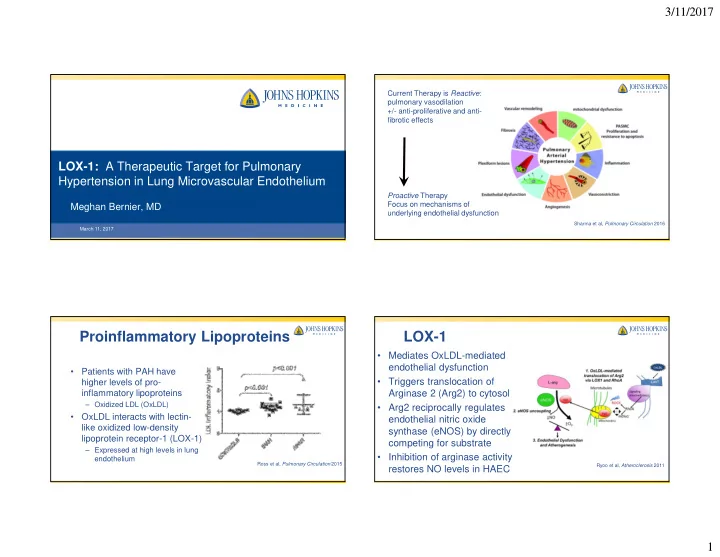
LOX-1: A Therapeutic Target for Pulmonary Hypertension in Lung Microvascular Endothelium

Meghan Bernier, MD

Sharma et al, Pulmonary Circulation 2016

Proactive Therapy Focus on mechanisms of underlying endothelial dysfunction Current Therapy is Reactive: pulmonary vasodilation +/- anti-proliferative and anti- fibrotic effects

Proinflammatory Lipoproteins

  • Patients with PAH have

higher levels of pro- inflammatory lipoproteins

– Oxidized LDL (OxLDL)

  • OxLDL interacts with lectin-

like oxidized low-density lipoprotein receptor-1 (LOX-1)

– Expressed at high levels in lung endothelium

Ross et al, Pulmonary Circulation 2015

LOX-1

  • Mediates OxLDL-mediated

endothelial dysfunction

  • Triggers translocation of

Arginase 2 (Arg2) to cytosol

  • Arg2 reciprocally regulates

endothelial nitric oxide synthase (eNOS) by directly competing for substrate

  • Inhibition of arginase activity

restores NO levels in HAEC

Ryoo et al, Atheroclerosis 2011

slide-2
SLIDE 2

3/11/2017 2

Aims

  • Define downstream signaling mechanisms by

which the LOX-1 receptor mediates pulmonary microvascular endothelial dysfunction and EndMT

  • Elucidate the role of LOX-1 signaling in the

development of PH in a transgenic mouse model

Hypoxia Induces Arg2 in HPMEC

  • Hypoxia causes oxidative

stress in HPMEC

  • LOX-1 protein levels remain

stable while Arg2 increases and eNOS decreases

  • Concomitant conditions to

examine: – OxLDL exposure – LOX-1 overexpression – LOX-1 knockout with siRNA

Inhibition of Formin mDia1 Causes Discontinuity of HPMEC VE-Cadherin

A control B 30m C 120m

Blue: DAPI; Green: VE-Cadherin; Red: F-actin

Animal Models of Vasculopathy

  • LOX-1 Murine Models:

– Overexpression and hypoxia: increased production of ROS, RV hypertrophy, and RVSP – Deletion/Inhibition: decreased inflammation, reduced atherosclerotic burden – Deficiency: Decreased arginase activity

slide-3
SLIDE 3

3/11/2017 3

LOX-1 KO May Attenuate SuHx Effects

  • Sugen-Hypoxia

Model

  • Young adult mice

(10 weeks)

  • 3 weekly Sugen

injections

  • Concomitant FiO2 10%

Next Steps

  • Hypoxia and HPMEC

– LOX-1 gain and loss of function – Arginase expression and activity – NO production/ ROS generation – EndMT, hypoxia, LOX-1 and the actin cytoskeleton

  • LOX-1 KO Mice and

SuHx Model

– Replicate findings – Hematologic samples – Histology – Arg2/eNOS expression via FACS – Arginase activity, NO production in EC from these mice

Funding

  • T32 training grant in Pediatrics

(NRSA 5T32HD044355-12)

  • The 2016 Christen White Cranford

Pediatric PH Research and Mentoring Grant

Acknowledgements

  • Mentors: Drs Lewis Romer and Larissa Shimoda
  • Colleagues:

– Shimoda Lab: Karthik Suresh, Jon Huetsch, Haiyang Jaing – Romer and Berkowitz Labs: Anil Bhatta, Deepesh Pandey, Thorsten Leucker, Andrea Wecker, Ariel Jacob, Max Rossberg – Johns Lab: Johns Skinner, Roger Johns

slide-4
SLIDE 4

3/11/2017 4

References

  • Ciuclan L, Bonneau O, Hussey M, et al. A novel murine model of severe pulmonary arterial hypertension.

Am J Respir Crit Care Med 2011;184:1171-82.

  • Gomez-Arroyo J, Saleem SJ, Mizuno S, et al. A brief overview of mouse models of pulmonary arterial

hypertension: problems and prospects. Am J Physiol Lung Cell Mol Physiol 2012;302:L977-91.

  • Jiang JX, Zhang SJ, Liu YN, et al. EETs alleviate ox-LDL-induced inflammation by inhibiting LOX-1

receptor expression in rat pulmonary arterial endothelial cells. Eur J Pharmacol 2014;727:43-51.

  • Nikitopoulou I, Orfanos SE, Kotanidou A, et al. Vascular endothelial-cadherin downregulation as a feature
  • f endothelial transdifferentiation in monocrotaline-induced pulmonary hypertension. Am J Physiol Lung

Cell Mol Physiol 2016;311:L352-63

  • Pandey D, Bhunia A, Oh YJ, et al. OxLDL triggers retrograde translocation of arginase2 in aortic

endothelial cells via ROCK and mitochondrial processing peptidase. Circ Res 2014;115:450-9.

  • Ross DJ, Hough G, Hama S, et al. Proinflammatory high-density lipoprotein results from oxidized lipid

mediators in the pathogenesis of both idiopathic and associated types of pulmonary arterial hypertension. Pulm Circ 2015;5:640-8.

  • Ryoo S, Lemmon CA, Soucy KG, et al. Oxidized low-density lipoprotein-dependent endothelial arginase II

activation contributes to impaired nitric oxide signaling. Circ Res 2006;99:951 60.

References

  • Ryoo S, Bhunia A, Chang F, Shoukas A, Berkowitz DE, Romer LH. OxLDL-dependent activation of

arginase II is dependent on the LOX-1 receptor and downstream Rho A signaling. Atherosclerosis 2011;214:279-87

  • Sharma S, Ruffenach G, Umar S, Motayagheni N, Reddy ST, Eghbali M. Role of oxidized lipids in

pulmonary arterial hypertension. Pulm Circ 2016;6:261-73.

  • Stenmark KR, Meyrick B, Galie N, Mooi WJ, McMurtry IF. Animal models of pulmonary arterial

hypertension: the hope for etiological discovery and pharmacological cure. Am J Physiol Lung Cell Mol Physiol 2009;297:L1013-32.

  • Touyz RM. Linking LOX-1 and arginase II through mitochondria: a novel paradigm in endothelial
  • dysfunction. Circ Res 2014;115:412-4.
  • Vitali SH, Hansmann G, Rose C, et al. The Sugen 5416/hypoxia mouse model of pulmonary hypertension

revisited: long-term follow-up. Pulm Circ 2014;4:619-29.

  • Xu X, Gao X, Potter BJ, Cao JM, Zhang C. Anti-LOX-1 rescues endothelial function in coronary arterioles

in atherosclerotic ApoE knockout mice. Arterioscler Thromb Vasc Biol 2007;27:871-7.

  • Zhang P, Liu MC, Cheng L, Liang M, Ji HL, Fu J. Blockade of LOX-1 prevents endotoxin-induced acute

lung inflammation and injury in mice. J Innate Immun 2009;1:358-65.