
MOL2NET, 2017, 3, doi:10.3390/mol2net-03-xxxx 1
MDPI
MOL2NET, International Conference Series on Multidisciplinary Sciences http://sciforum.net/conference/mol2net-03
Evaluating medicinal plants for anticancer properties: testing plant extracts for cytotoxicity.
Vadym Trokhymchuka, Carlos Plancharta, Andrea Petersona, Adriana Reytorb, Dora Pilar Maula, Maria Pinaa, Luis C. Fernandez-Torresa, Alexis Tapanes-Castilloa (E-mail: atapanes-castillo@stu.edu)
a School of Science, St. Thomas University, 16401 NW 37th Avenue, Miami Gardens, FL 33054 b InterAmerican Campus, Miami-Dade College, 627 SW 27th Avenue, Miami, FL 33135
. Graphical Abstract
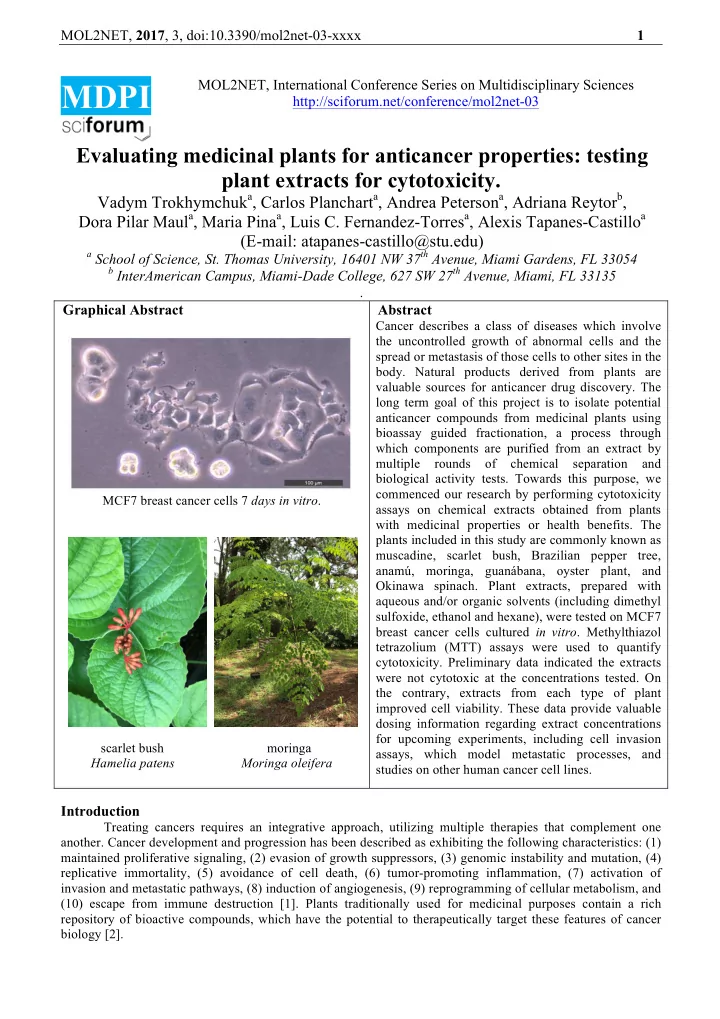
MCF7 breast cancer cells 7 days in vitro.
scarlet bush moringa
Hamelia patens Moringa oleifera
Abstract
Cancer describes a class of diseases which involve the uncontrolled growth of abnormal cells and the spread or metastasis of those cells to other sites in the
- body. Natural products derived from plants are
valuable sources for anticancer drug discovery. The long term goal of this project is to isolate potential anticancer compounds from medicinal plants using bioassay guided fractionation, a process through which components are purified from an extract by multiple rounds
- f
chemical separation and biological activity tests. Towards this purpose, we commenced our research by performing cytotoxicity assays on chemical extracts obtained from plants with medicinal properties or health benefits. The plants included in this study are commonly known as muscadine, scarlet bush, Brazilian pepper tree, anamú, moringa, guanábana, oyster plant, and Okinawa spinach. Plant extracts, prepared with aqueous and/or organic solvents (including dimethyl sulfoxide, ethanol and hexane), were tested on MCF7 breast cancer cells cultured in vitro. Methylthiazol tetrazolium (MTT) assays were used to quantify
- cytotoxicity. Preliminary data indicated the extracts
were not cytotoxic at the concentrations tested. On the contrary, extracts from each type of plant improved cell viability. These data provide valuable dosing information regarding extract concentrations for upcoming experiments, including cell invasion assays, which model metastatic processes, and studies on other human cancer cell lines.
Introduction
Treating cancers requires an integrative approach, utilizing multiple therapies that complement one
- another. Cancer development and progression has been described as exhibiting the following characteristics: (1)
maintained proliferative signaling, (2) evasion of growth suppressors, (3) genomic instability and mutation, (4) replicative immortality, (5) avoidance of cell death, (6) tumor-promoting inflammation, (7) activation of invasion and metastatic pathways, (8) induction of angiogenesis, (9) reprogramming of cellular metabolism, and (10) escape from immune destruction [1]. Plants traditionally used for medicinal purposes contain a rich repository of bioactive compounds, which have the potential to therapeutically target these features of cancer biology [2].