
MOL2NET, 2017, 3, doi:10.3390/mol2net-03-xxxx 1
MDPI
MOL2NET, International Conference Series on Multidisciplinary Sciences http://sciforum.net/conference/mol2net-03
Preliminary Antioxidant Activity Analysis of Brazilian Pepper Tree (Schinus terebinthifolius) Extracts via TLC, FRAP, and DPPH
Daniel Russo1 (drusso@stu.edu), Cristina Balistreri1 (cbalistreri@stu.edu), Alexis Tapanes- Castillo1 (atapanes-castillo@stu.edu), Maria Pina1, (mpina@stu.edu)
1 School of Science, Technology, and Engineering Management, St. Thomas University, Miami
Gardens, FL 33054, USA; E-Mail: mpina@stu.edu Graphical Abstract
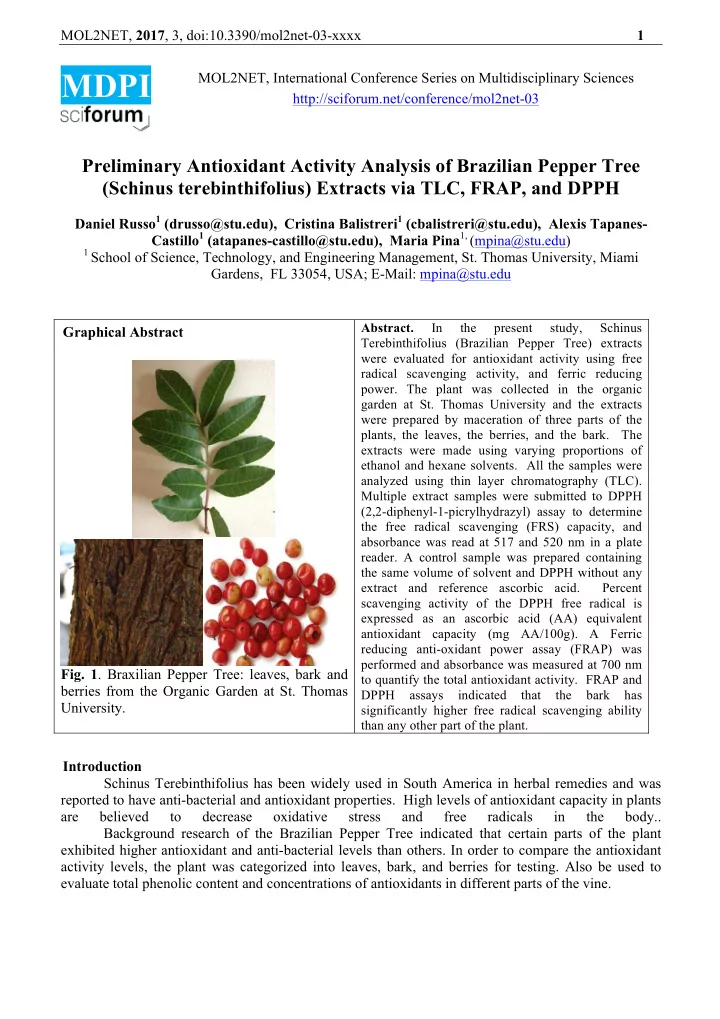
- Fig. 1. Braxilian Pepper Tree: leaves, bark and
berries from the Organic Garden at St. Thomas University.
Abstract. In the present study, Schinus Terebinthifolius (Brazilian Pepper Tree) extracts were evaluated for antioxidant activity using free radical scavenging activity, and ferric reducing
- power. The plant was collected in the organic
garden at St. Thomas University and the extracts were prepared by maceration of three parts of the plants, the leaves, the berries, and the bark. The extracts were made using varying proportions of ethanol and hexane solvents. All the samples were analyzed using thin layer chromatography (TLC). Multiple extract samples were submitted to DPPH (2,2-diphenyl-1-picrylhydrazyl) assay to determine the free radical scavenging (FRS) capacity, and absorbance was read at 517 and 520 nm in a plate
- reader. A control sample was prepared containing
the same volume of solvent and DPPH without any extract and reference ascorbic acid. Percent scavenging activity of the DPPH free radical is expressed as an ascorbic acid (AA) equivalent antioxidant capacity (mg AA/100g). A Ferric reducing anti-oxidant power assay (FRAP) was performed and absorbance was measured at 700 nm to quantify the total antioxidant activity. FRAP and DPPH assays indicated that the bark has significantly higher free radical scavenging ability than any other part of the plant.
Introduction Schinus Terebinthifolius has been widely used in South America in herbal remedies and was reported to have anti-bacterial and antioxidant properties. High levels of antioxidant capacity in plants are believed to decrease
- xidative
stress and free radicals in the body.. Background research of the Brazilian Pepper Tree indicated that certain parts of the plant exhibited higher antioxidant and anti-bacterial levels than others. In order to compare the antioxidant activity levels, the plant was categorized into leaves, bark, and berries for testing. Also be used to evaluate total phenolic content and concentrations of antioxidants in different parts of the vine.