
MOL2NET, 2017, 3, doi:10.3390/mol2net-03-xxxx 1
MDPI
MOL2NET, International Conference Series on Multidisciplinary Sciences http://sciforum.net/conference/mol2net-03
Standardization of the Safety Level of the Use of DMSO in Viability Assays in Bacterial Cells
Raquel Carlos de Brito (E-mail: quelbrito1987@gmail.com)a, Gildoberg Nunes da Silva (E-mail: bergnunes22@gmail.com)a, Ticiane Costa Farias (E-mail: ticiane_92@hotmail.com)a, Paula Benvindo Ferreira (E-mail: paulabenvindo92@hotmail.com)b, Sávio Benvindo Ferreira (E-mail: saviobenvindo@gmail.com)c.
a Graduate Student, Center for Teacher Training (CFP), Federal University of Campina Grande
(UFCG), Cajazeiras campus, Paraíba, Brazil.
b Master, Postgraduate Program in Natural and Synthetic Bioactive Products, Federal University of
Paraíba, João Pessoa, Paraíba, Brazil.
c Substitute Professor of Nursing Academic Unit, Center for Teacher Training (CFP), Federal
University of Campina Grande (UFCG), Cajazeiras campus, Paraíba, Brazil. . . . Graphical Abstract Abstract. The antibacterial potential of the most diverse medicinal plants has benefited humanity for centuries, and precisely because of this, the number of studies investigating the antimicrobial activity of essential oils and their components is
- increasing. However, the hydrophobic character
- f the essential oils has made the experiments
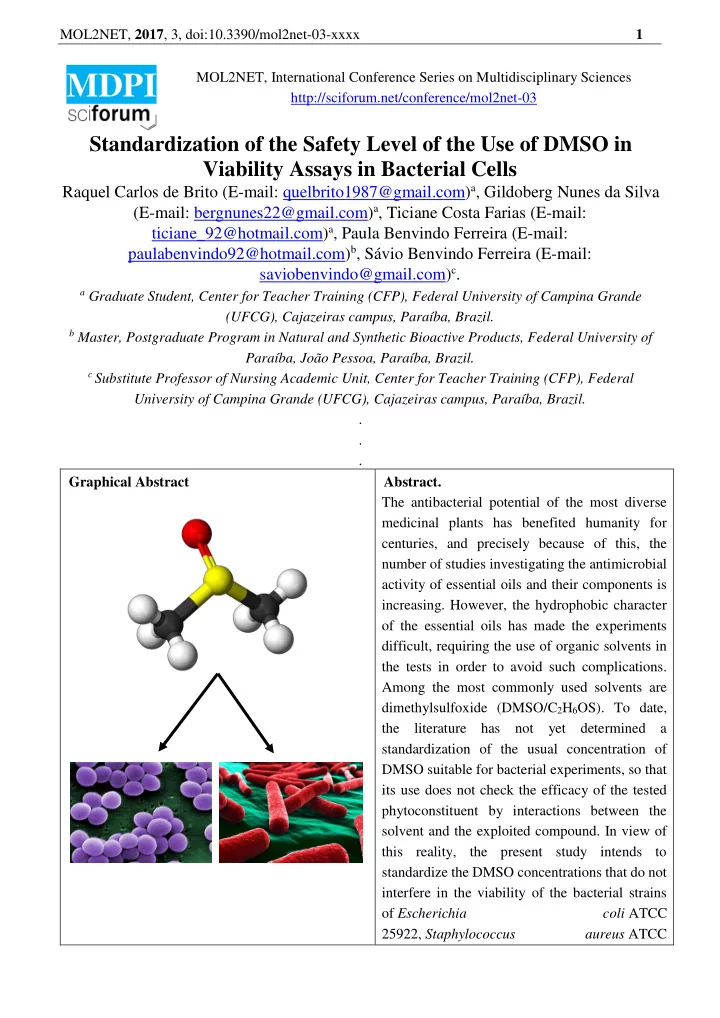
difficult, requiring the use of organic solvents in the tests in order to avoid such complications. Among the most commonly used solvents are dimethylsulfoxide (DMSO/C2H6OS). To date, the literature has not yet determined a standardization of the usual concentration of DMSO suitable for bacterial experiments, so that its use does not check the efficacy of the tested phytoconstituent by interactions between the solvent and the exploited compound. In view of this reality, the present study intends to standardize the DMSO concentrations that do not interfere in the viability of the bacterial strains
- f Escherichia
coli ATCC 25922, Staphylococcus aureus ATCC