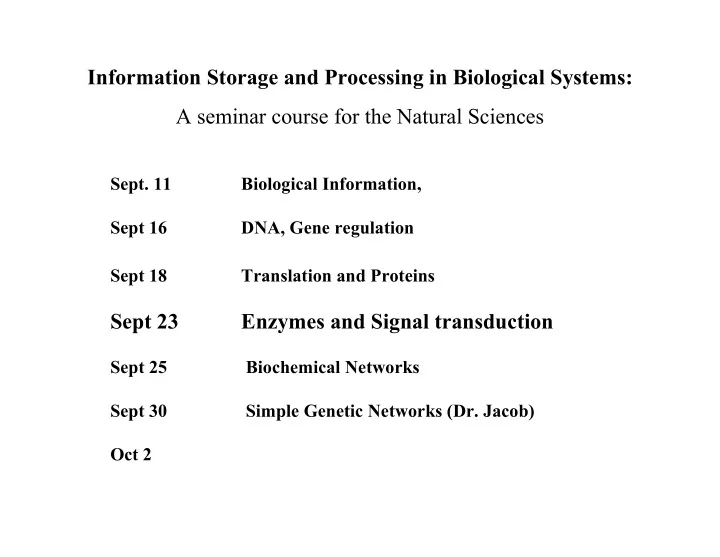
SLIDE 1 Information Storage and Processing in Biological Systems: A seminar course for the Natural Sciences
Biological Information, Sept 16 DNA, Gene regulation Sept 18 Translation and Proteins
Sept 23 Enzymes and Signal transduction
Sept 25 Biochemical Networks Sept 30 Simple Genetic Networks (Dr. Jacob) Oct 2
SLIDE 2 C - Introduction to Proteins / Protein Functions
Proteins carry out a wide variety of functions in, on and outside the cell. For the purpose of this course, we will generalize these functions into three
- categories. These are not mutually exclusive and many proteins fit into more
than one of these categories. 1 - Structural 2 - Enzymatic 3 - Signal Transduction (information processing)
SLIDE 3
C1 - Protein Functions: Structural
Proteins can form large complexes that function primarily as structural elements: Protein coats of viruses. These are large, regular repeating structures composed of 100-1000’s of protein subunits. (Figs 6-74 and 6-72, Alberts).
Electron micrographs of A) Phage T4, B) potato virus X, C) adenovirus, D) influenza virus. SV40 structure determined by X-ray crystallography.
SLIDE 4
Cytoskeleton in eukaryotic cells is responsible not only for determining shape but also in cell movement, mechanical sensing, intracellular trafficking and cell division. A human cell grown in tissue culture and stained for protein (such that only large regular structures are highlighted). Note the variety of structures (Fig 16-1, Alberts)
SLIDE 5
Microtubules form by the polymerization of tubulin subunits. Whether the polymer grows or shrinks is influenced conditions in the cell - Dynamic Instability
(Fig 16-33, Alberts; for discussion of dynamic instability see Flyvbjerg H, Holy TE, Leibler S. Stochastic dynamics of microtubules: A model for caps and catastrophes. Phys Rev Lett. 1994 Oct 24;73(17):2372-2375.
SLIDE 6 C2 - Protein Functions: Enzymatic
Enzyme: a protein* that catalyzes a chemical reaction, where a catalyst is defined as a substance that accelerates a chemical reaction without itself undergoing change.
* some RNA molecules can also be considered enzymes
A A + B B C + D X Y
- Specificity
- Accelerated reaction rates
- Control (regulation)
- Enzymes can only affect the rate (kinetics) of a reaction, they can not
make a reaction more energetically favorable.
- Enzymes can be saturated by substrate.
SLIDE 7
Basics of Enzyme Kinetics v = Vs (KM + s)
Michaelis-Menton Kinetics - for a simple enzyme reaction, the interaction of enzyme and substrate is considered an equilibrium and the overall reaction as follows: E + S ES E + P
k+1 k-1 k+2 v = velocity, reaction rate KM = Michaelis constant KM = k2 + k-1 k1
SLIDE 8 C3 - Protein Functions: Signal Transduction
Signal Transduction
- in general the relaying of a signal from one physical form to another
- in biological terms, the process by which a cell responds to signals (can be
intracellular, extracellular). Examples of ‘signals’ (inputs):
- chemicals
- light
- temperature
- electrical (ion gradients)
- other cells (cell-cell contact)
- mechanical sensing
Signal Transduction
Input Output
SLIDE 9 Generalized Model of Response to Extracellular Signal “Action”
Ligand Receptor Activated Receptor
- Ligand can activate or inactivate receptor
- Output (action) dependent on system and sometime cell type
- In metazoans (multi-cellular eukaryotes), there are about 16 intercellular
classes of signaling systems
SLIDE 10 “Action”
Ligand Receptor Activated Receptor ~P P~
Example 1: Transmembrane Tyrosine Kinase Receptors
- Ligand binding results in receptor dimerization
- The cytoplasmic (intracellular) domains are tyrosine kinases which
phosphorylate each other on Tyr residue side chains.
- This sets off a series of intracellular events
SLIDE 11 Ligand Receptor Activated Receptor
Example 2 : Steroid Receptors
nucleus
- The steroid binds to it’s receptor in the cytoplasm.
- The steroid-receptor complex but not the free receptor can move into the
nucleus .
- The steroid-receptor complex binds to specific binding site(s) on the DNA
to regulate gene expression.
SLIDE 12 Ligand Receptor Activated Receptor
Example 3. Heterotrimeric G-Proteins
GDP GTP GTP GTP GDP
- Ligand binding causes activation of the a subunit which promotes
exchange of GDP for GTP
- In the GTP form, the a subunit and the associated bg subunits dissociate
from the complex.
- Each subunit can go on to initiate a series of intracellular events.
(a b g (a b g complex)
SLIDE 13
D - Regulation of Protein Activity
Proteins are often regulated such that the ‘activity’ of a protein is not a constant function of its concentration. The concentration of a protein in the cell is a function of the rate of synthesis and the rate of degradation. Both these processes can be regulated.
DNA RNA Protein
Transcription Translation Degradation Synthesis Protein Active Protein Inactive
SLIDE 14
Regulation of Enzyme Activity A B X
Negative Feedback (Product Inhibition)
A B C D E F X
Mechanistically negative feedback can be by direct competition of the product with the substrate for the active site or it can be indirect through interaction wit the enzyme away from the active site (allosteric).
SLIDE 15
Regulation of Enzyme Activity A B X
Positive Feedback (Product Inhibition)
A B X
Positive Feedforward
SLIDE 16
Cooperativity / Allosteric Regulation + +
Hypothetical examples of binding of a ligand to a dimeric protein. The binding curve is very sensitive to the effects on one site on the other. Two independent sites
SLIDE 17
+ + Cooperativity / Allosteric Regulation + +
Hypothetical examples of binding of a ligand to a dimeric protein. The binding curve is very sensitive to the effects on one site on the other. Two independent sites Positive cooperativity
SLIDE 18
+ + Cooperativity / Allosteric Regulation + + + +
Hypothetical examples of binding of a ligand to a dimeric protein. The binding curve is very sensitive to the effects on one site on the other. Two independent sites Positive cooperativity Negative cooperativity
SLIDE 19 + + Cooperativity / Allosteric Regulation + + + +
Hypothetical examples of binding of a ligand to a dimeric protein. The binding curve is very sensitive to the effects on one site on the other. Two independent sites Positive cooperativity Negative cooperativity
n,1 0.25 0.5 0.75 1 0.01 1 100 10000
Fraction bound vs ligand concentration
SLIDE 20 + + Cooperativity / Allosteric Regulation + + + +
Hypothetical examples of binding of a ligand to a dimeric protein. The binding curve is very sensitive to the effects on one site on the other. Two independent sites Positive cooperativity Negative cooperativity
0.25 0.5 0.75 1 0.01 1 100 10000
Positive Cooperativity (n=2, n=3)
SLIDE 21 + + Cooperativity / Allosteric Regulation + + + +
Hypothetical examples of binding of a ligand to a dimeric protein. The binding curve is very sensitive to the effects on one site on the other. Two independent sites Positive cooperativity Negative cooperativity
0.25 0.5 0.75 1 0.01 1 100 10000
Negative Cooperativity (n= 0.5)
SLIDE 22
Allosteric protein: a protein that changes from one conformation to another upon binding a ligand or when it is covalently (chemically) modified. The change in conformation alters the activity of the protein. Historically considered with multi-meric proteins (e.g. hemoglobin).
Allosteric effector (positive)
Ligand
SLIDE 23 Regulation of Protein Activity by Covalent Modification
The activity of a protein can modified by addition or removal of a chemical group to an amino acid side chain (i.e. - as a substrate for another enzyme). The most common modifications are:
- Methylation (-CH3)
- Phosphorylation (-PO3)
- Nucleotidyl
- Fatty acid
- Myristol
note that many proteins are modified in other ways such as addition of sugar groups (glycosylation) but these are not ‘regulatory’ modifications.
Phosphorylation is the most common mechanism of regulation by covalent modification Kinase - an enzyme that phosphorylates Phosphatase - an enzyme that removes phosphate
SLIDE 24
Regulation by Localization
Protein activity can be regulated by changing the localization of the protein. This turns out to be a common theme in eukaryotic signal transduction. Localization can be altered allosterically or by covalent modification.
Addition of a fatty acid group can cause a cytoplasmic protein to associate with the cell membrane.
~P P~ ~P P~
Covalent modification of a protein can generate a binding site for another protein.
SLIDE 25 E - General Considerations
Proteins have a diverse range of functions and a variety of mechanisms
- f regulation. The ability to form networks of proteins acting on proteins,
the sharing of common reaction intermediates and forming multi-step chemical pathways allows for an endless number of possibilities. Some general considerations about protein systems:
- A reaction can behave as a step function (digital, boolean) if there is
significant cooperativity in the system or if there modifying enzyme that works near saturation.
- Since proteins can act in a catalytic manner, there can be signal amplification.
- Many systems are adaptive, in that the response to signal is not necessarily
constant over time (e.g. a signal transduction system may become desensitized and no loner respond to the presence of a ligand- c.f. heterotrimeric G protein).
SLIDE 26 Not all pathways will operate in a single cell.
Epidermal Growth Factor Signaling Pathway
http://www.grt.kyushu-u.ac.jp/spad/pathway/egf.html
- Protein interactions
- Protein modification
(Activation/inhibition)
- Protein re-localization
- Transcriptional regulation
SLIDE 27
Protein Stability: Robust to Site Mutations
Protein function sensitive to changes in active site residues but relative robust with respect to ransom mutations. Tolerance for random mutations in proteins in general ~ 8 - 30% In some studies as much as 25% increased protein stability How does nature select for robustness? Is there a connection between robustness and evolvability?
SLIDE 28 Protein Dynamics in Living Cells- the use of GFP fusions Cell Division in Bacteria
Time (30-40min)
- Single cell elongates
- At cell length = 2, divides at its midpoint
SLIDE 29 Protein Dynamics in Living Cells- the use of GFP fusions Cell Division in Bacteria
- Division ring is formed by FtsZ
- Positioning of FtsZ depends on Min proteins
- MinD oscillates in the cell, MinE localizes to
the division plane
SLIDE 30 Protein Dynamics in Living Cells- the use of GFP fusions
Time-lapse fluorescence micrographs showing the dynamic behaviour of Gfp-
- MinC. MinC is a division inhibitor which
associates, and co-oscillates, with MinD. Pole-to-pole oscillation of MinD, in turn, requires the activity of MinE Graphical view of dynamic Gfp-MinD distribution in cell
SLIDE 31 Time-lapse fluorescence micrographs showing the dynamic behavior
- f MinE-Gfp in normally dividing cells. Times are indicated in
- seconds. Note the accumulation of MinE-Gfp in the shape of a ring
(the E ring)
Protein Dynamics in Living Cells- the use of GFP fusions
SLIDE 32
Meinhardt and de Boer (2001) Proc. Natl. Acad. Sci. USA 98 (25), 14202-14207.
Protein Dynamics in Living Cells- the use of GFP fusions
SLIDE 33
SLIDE 34
Protein Dynamics in Living Cells- the use of GFP fusions The FtsZ ring
SLIDE 35
SLIDE 36
- D. discoideum amoebae chemotaxing toward cAMP
Cells are expressing a GFP-coronin fusion protein: coronin is a cytoskeletal protein that is localized in the extended pseudopods.
- G. Gerisch, Max Planck Institute, GDR