December 9, 2015 THE ITALIAN ACTIVITY ON SPACE HAS STRONG LINKS TO - - PowerPoint PPT Presentation

december 9 2015 the italian activity on space has strong
SMART_READER_LITE
LIVE PREVIEW

December 9, 2015 THE ITALIAN ACTIVITY ON SPACE HAS STRONG LINKS TO - - PowerPoint PPT Presentation

Lox/Methane Propulsion for Satellite and Spacecraft Manoeuvring Marcello Onofri, Director Mauro Valorani , Didactic and scientific coordinator December 9, 2015 THE ITALIAN ACTIVITY ON SPACE HAS STRONG LINKS TO THE SPACE ACTIVITY AT SAPIENZA


slide-1
SLIDE 1

Marcello Onofri, Director Mauro Valorani, Didactic and scientific coordinator

December 9, 2015

Lox/Methane Propulsion for Satellite and Spacecraft Manoeuvring
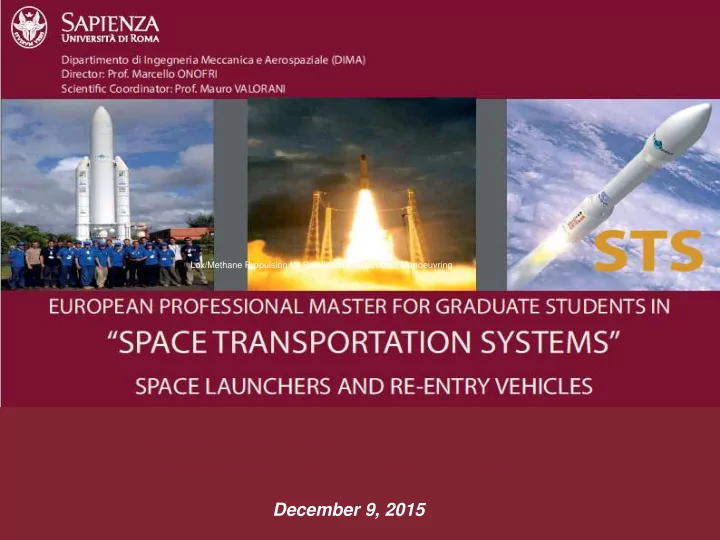
slide-2
SLIDE 2

Page 2/6

THE ITALIAN ACTIVITY ON SPACE HAS STRONG LINKS TO THE SPACE ACTIVITY AT SAPIENZA UNIVERSITY

  • ON 1964 THE ITALIAN SPACE ACTIVITY STARTED WITH THE FIRST LAUNCH OF A EUROPEAN

SCIENTIFIC SATELLITE FULLY DESIGNED, BUILT AND MANAGED BY A TEAM OF SAPIENZA UNIVERSITY.

  • THE TEAM LED BY PROF. LUIGI BROGLIO PERFORMED FIVE SUCCESSFUL LAUNCHES AND BECAME

WORLD FAMOUS TO BE THE THIRD, AFTER URSS AND USA, TO SHOW A CAPACITY TO HANDLE LAUNCH ACTIVITY, AND PUT SCIENTIFIC SATELLITES IN ORBIT.

  • SINCE

THAT TIME, SAPIENZA UNIVERSITY HAS BEEN PROVIDING MANY CONTRIBUTIONS TO INTERNATIONAL PROGRAMS, WITH STRONG LINKS TO ITALIAN INDUSTRY AND THE SUCCESSFUL PARTICIPATION TO INTERNATIONAL PROJECTS LIKE CASSINI, MARS EXPRESS, COSMO-SKYMED, VEGA…

The 60’s: The Team of the

  • S. Marco Project

15 December 1964

slide-3
SLIDE 3

EDUCATION Activity in Space Engineering

Motivated by the need to offer support to the VEGA Project with well trained engineers, the Sapienza University of Rome started in 2002 a post-graduate course devoted to Launchers and Re-entry Vehicles. The STS Master Course is a Professional Master Course of second level, for graduate students conceived as a service for industry. Indeed, Industries have a major role in making the selection of the applicant students, and guarantee to cover the fee and six months of stage in their premises. There are no other similar courses in Europe and in fact it has gained a firm reputation at international level: it is sponsored by ESA, CNES, ASI and the most important Italian and European Space Industries. Since 2006 ArianeSpace hosted the Master trainees to visit the Kourou Base and attend to the launch of one of the EU Launchers. Many students who attended the course are now the responsibles of major industrial activity related to VEGA.

slide-4
SLIDE 4

European Master Course in Space Transportation Systems

Sponsorhip

Agencies

  • ASI •CNES •ESA •DLR

Industries

  • AERO SEKUR •ARIANESPACE
  • ASTRIUM •AVIO • ELV
  • OHB CGS
  • THALES ALENIA SPACE
  • VITROCISET

Universities and organizations

  • Sapienza Università di Roma
  • Politecnico di Milano - Università di Pisa
  • ESA–HQ •ESA–ESRIN
  • ESA–ESTEC
  • CIRA •NASA •ONERA

December 2015 4

slide-5
SLIDE 5

Ottobre 2015 CRAS Sapienza Page 5/3

Nominated Honorary Research Fellow

  • On last July he left the position of DG ESA, after

12 years of activity, in which he become one of the most renowned person in the space sector.

  • After that he received a large number of

requests of collaboration from Industries and Universities.

  • On

September he decided to accept

  • ur

invitation and he is now Honorary Research Fellow at the Sapienza University and member of the SSAS (School for Advanced Studies) and of the CRAS (Center for Aerospace Research).

Jean-Jacques Dordain Chose Sapienza University

slide-6
SLIDE 6

European Master Course in Space Transportation Systems

Training Programme

The II°Level University Master’s degree in “Space Transportation Systems” (STS) has a duration of 12 months, and it awards 60 ECTS credits. It is carried out in English language and consists in an activity of 1.500 hours,

  • rganized in 3 phases, scheduled as follows:

1) Theoretical education. Frontal lectures, experimental activities, work projects, exercises, middle-term tests (500 hours – first 5 months). 2) Intensive programme. Training weeks in some of the best Research Centers in Europe; VKI–Bruxelles; ISAE/Toulouse. 3) Paid internships in European Aerospace Centers and EU space industries, with the possibility of practically implementing the skills learned during the theoretical course. During this phase a Master’s thesis is carried out by the students which will be evaluated as a final exam (800 hours – 6 months).

  • Passage from a phase to the following occurs after Verification Tests

December 2015 6

slide-7
SLIDE 7

TRAINING MODULES

Lecture given by well known European experts

MODULES Unit 1 Introduction Unit 2 Overview of Launcher Systems Unit 3 Space Program Management & Quality Certification Unit 4 Mission Analysis Unit 5 Combustion Modeling Unit 6 LRE Thrust Chamber Unit 7 Pump-fed Systems Unit 8 Rocket Nozzles Unit 9 Aero-thermo-dynamics of launchers and re-entry vehicles Unit 10 Solid Rocket Motors Unit 11 Launcher Design Unit 12 Structures Unit 13 Ground Segment Unit 14 Launcher System Management

slide-8
SLIDE 8

A unique training in European Centers

Residential weeks spent in European Research Centers offer the trainees a valuable

  • pportunity to experience studying and working in an international context, and become

acquainted with the capabilities of some of the main European Space Labs/Centers:

  • CIRA for High Enthalpy flows
  • DLR Lampoldshausen for Combustion and Engine validation tests,
  • CNES and Ecole Supérieure des Mines in Paris for GNC
  • ONERA Meudon for High speed flows / ONERA Palaiseau for Combustion
  • VON KARMAN INSTITUTE for Aero-thermo-dynamics
  • ESA-ESTEC for applications of Concurrent Engineering Design
  • ISAE-Toulouse for Structural Dynamics in Space

A SPECIFIC CONTRIBUTION BY ESA and ASI COVERS THE COST OF THE TRAINEES MOBILITY DURING THESE RESIDENTIAL WEEKS

slide-9
SLIDE 9
slide-10
SLIDE 10

USING MODEL ROCKETS TO PROMOTE EDUCATION IN SPACE ENGINEERING

  • The design, build and launch of a model rocket is a

great opportunity for students to get a first insight into rocketry activities

  • Model rocketry is a relatively safe and inexpensive way

for students to learn and be inspired by space technology

  • The low cost of implementation, short preparation time

and simplicity of design make of this concept an excellent practical opportunity for students

For the past 5 years, the Department of Mechanical and Aerospace Engineering of Sapienza has organized a model rocketry workshop and a rocketry challenge to introduce students in the practical launch activity

  • The

workshop, supported by AVIO Spa, is

  • rganized into theoretical lectures, short-courses

and practical classes

  • Students are responsible for the design of the

rocket, operation verification, launch preparation, data analysis and team organization

slide-11
SLIDE 11

USING MODEL ROCKETS TO PROMOTE EDUCATION IN SPACE ENGINEERING

learning how the nozzle geometry affect the motor performance learning how the aerodynamics mass affect the rocket performance learning how the propellant formulation affects the performance A model rocket engine is a scientific device. To produce thrust it operates the same way as a “real” rocket. This is why all model rocket engines are carefully tested in production as in professional rocketry

slide-12
SLIDE 12

USING MODEL ROCKETS TO PROMOTE EDUCATION IN SPACE ENGINEERING

Model rockets with electronic altimeters can report and

  • r

record electronic data such as maximum speed, acceleration, and altitude. Accelerometers can be also installed

Post flight analysis

is a fundamental tool for the students to compare their prediction with flight data for ”lessons learnt”

slide-13
SLIDE 13

USING MODEL ROCKETS TO PROMOTE EDUCATION IN SPACE ENGINEERING

WE WOULD LIKE TO PROPOSE HERE A EUROPEAN COLLABORATION AMONG UNIVERSITIES TO ORGANIZE EU COMPETITIONS WITH INTERNATIONAL GROUPS OF STUDENTS IN BUILDING INNOVATIVE SMALL LAUNCHERS AND COMPONENTS THE COMPETITIONS SHOULD BE SUPPORTED BY THE EU INDUSTRIES THE AWARD TO THE WINNERS SHOULD BE A POSITION IN THE INDUSTRIAL ACTIVITY

THANKS FOR THE ATTENTION