The Case for Lower is Better No randomized trial has established the - - PowerPoint PPT Presentation

the case for lower is better
SMART_READER_LITE
LIVE PREVIEW

The Case for Lower is Better No randomized trial has established the - - PowerPoint PPT Presentation

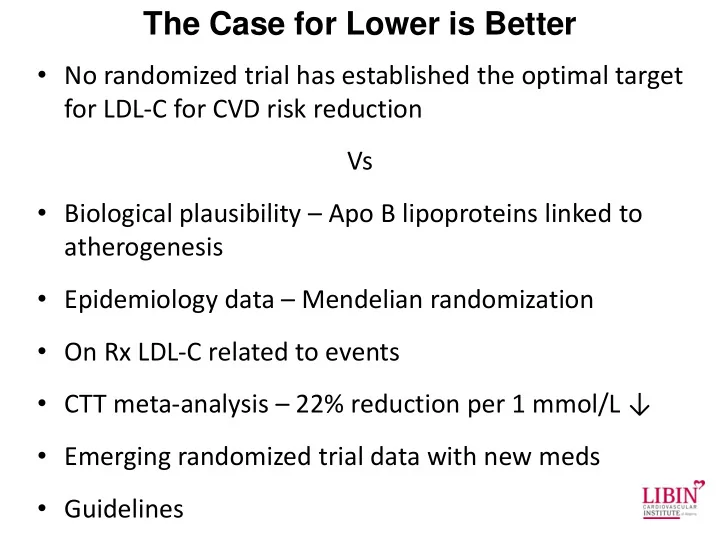
The Case for Lower is Better No randomized trial has established the optimal target for LDL-C for CVD risk reduction Vs Biological plausibility Apo B lipoproteins linked to atherogenesis Epidemiology data Mendelian


slide-1
SLIDE 1

The Case for Lower is Better

  • No randomized trial has established the optimal target

for LDL-C for CVD risk reduction Vs

  • Biological plausibility – Apo B lipoproteins linked to

atherogenesis

  • Epidemiology data – Mendelian randomization
  • On Rx LDL-C related to events
  • CTT meta-analysis – 22% reduction per 1 mmol/L ↓
  • Emerging randomized trial data with new meds
  • Guidelines
slide-2
SLIDE 2

CHD Reduction from Earlier LDL-C Lowering: Lifetime low LDL

Ferrence BA, et al. J Am Coll Cardiol. 2012;60(25):2631-9.

0.4 0.5 0.6 0.7 0.8 0.9 1

Genetic Studies Statin Trials 312,321 169,138 0.46 (0.41-0.51) 0.76(0.74-0.78) 54.5% 24% Meta-Analysis Sample Size (N) OR (95% CI) CHD RR Per mmol/L LDL reduction

Association between 1mmol/L lower LDL-C and risk of CHD

Lifetime lower LDL-C due to genetics resulted in a 3-fold greater reduction in the risk of CHD per unit lower LDL-C than that observed during treatment with a statin started later in life

slide-3
SLIDE 3

0.5 0.75 1 1.25 1.5

Statin/more better Control/less better <2.0 2,<2.5 2.5,<3.0 3,<3.5 3.5 Total 910 (14.7%) 1528 (14.0%) 1866 (12.4%) 2007 (12.3%) 4508 (13.0%) 10973 (13.0%) 1012 (16.4%) 1729 (15.9%) 2225 (14.7%) 2454 (15.2%) 5736 (16.5%) 13350 (15.8%) 0.78 (0.61 - 0.99) 0.77 (0.67 - 0.89) 0.77 (0.70 - 0.85) 0.76 (0.70 - 0.82) 0.80 (0.76 - 0.83) 0.78 (0.76 - 0.80)

  • No. of events (% pa)

Statin/more Control/less

<2.0 2,<2.5 2.5,<3.0 3,<3.5 3.5 Total 704 (17.9%) 1189 (18.4%) 1065 (20.1%) 517 (20.4%) 303 (23.9%) 3837 (19.4%) 795 (20.2%) 1317 (20.8%) 1203 (22.2%) 633 (25.8%) 398 (31.2%) 4416 (22.3%) 0.71 (0.52 - 0.98) 0.77 (0.64 - 0.94) 0.81 (0.67 - 0.97) 0.61 (0.46 - 0.81) 0.64 (0.47 - 0.86) 0.72 (0.66 - 0.78) <2.0 2,<2.5 2.5,<3.0 3,<3.5 3.5 Total 206 (9.0%) 339 (7.7%) 801 (8.2%) 1490 (10.8%) 4205 (12.6%) 7136 (11.0%) 217 (9.7%) 412 (9.1%) 1022 (10.5%) 1821 (13.3%) 5338 (15.9%) 8934 (13.8%) 0.87 (0.60 - 1.28) 0.77 (0.62 - 0.97) 0.76 (0.67 - 0.86) 0.77 (0.71 - 0.84) 0.80 (0.77 - 0.84) 0.79 (0.77 - 0.81)

More vs less statin Statin vs control All trials

Relative risk (CI) per mmol/L LDL-C reduction

99% or 95% CI

Proportional effects on MAJOR VASCULAR EVENTS per mmol/L LDL-C reduction, by baseline LDL-C

slide-4
SLIDE 4

GLAGOV: Objective

Objective

  • To test the hypothesis that LDL-C lowering with a monthly

subcutaneous injection of evolocumab 420 mg for 78 weeks will result in a significantly greater change from baseline in percentage atheroma volume (PAV) compared with placebo in subjects taking background statin therapy Design

  • A 78-week, randomized, double-blind, placebo-controlled,

multicenter, phase 3 study.

Nicholls SJ, et al. JAMA. [published online ahead of print November 15, 2016]. doi: 10.1001/jama.2016.16951. Puri R, et al. Am Heart J. 2016;176:83-92.

slide-5
SLIDE 5

Mean Absolute Change in LDL-C

Absolute change for evolocumab-statin group: -1.46 (-1.54 to -1.38); P < 0.001

Statin monotherapy Statin + evolocumab

80

LDL-C Absolute Change From Baseline, mmol/L

4 8 12 16 20 24 28 32 36 40 44 48 52 56 60 64 76

484 484 418 434

Study Week

  • No. of patients

Placebo Evolocumab 446 456 441 452 447 444 441 449 425 426

72 68

Mean LDL-C 2.41 mmol/L* Mean LDL-C 0.95 mmol/L* Change from baseline 3.9% Change from baseline -59.8%

0.2 –1.8 –0.2 –0.4 –0.6 –0.8 –1.0 –1.2 –1.4 –1.6

Data shown are Mean (95% CI) *Time-weighted LDL-C; LDL-C = low-density lipoprotein cholesterol Nicholls SJ, et al. JAMA. [published online ahead of print November 15, 2016]. doi: 10.1001/jama.2016.16951. Nissen SE, et al. American Heart Association Scientific Sessions, Nov 12 - 16, 2016, New Orleans, Louisiana. Oral Presentation.

slide-6
SLIDE 6

Primary Endpoint: Nominal Change in PAV From Baseline to Week 78

Difference between groups: -1.0% (-1.8 to -0.64); P < 0.001

Data shown are least-squares mean (95% CI). PAV = Percent Atheroma Volume *Comparison versus baseline Nicholls SJ, et al. JAMA. [published online ahead of print November 15, 2016]. doi: 10.1001/jama.2016.16951.

Change in % atheroma volume (%)

P = NS* P < 0.001*

slide-7
SLIDE 7

www.ccs.ca

Dyslipidemia Guidelines

Category Consider Initiating pharmaco-therapy if Target NNT Primary prevention High FRS (≥20%) all LDL-C < 2.0 mmol/L or > 50% ↓ Or Apo B < 0.8 g/L Or non-HDL-C < 2.6 mmol/L 35 Intermediate FRS (10- 19%) LDL-C ≥ 3.5 mmol/L

  • r Non-HDL ≥ 4.3

mmol/L

  • r Apo B ≥ 1.2 g/L
  • r Men ≥ 50 and

women ≥ 60 yrs and

  • ne additional CVD RF

40 Statin indicated conditions Clinical atherosclerosis* 20 Abdominal aortic aneurysm Diabetes mellitus >40 yrs 15 yrs duration for age >30 yrs (DM 1) Microvascular disease Chronic kidney disease (age ≥ 50 y) eGFR < 60 mL/min/1.73 m2 or ACR > 3 mg/mmol LDL-C ≥ 5. 0 mmol/L >50% ↓ in LDL-C FRS – modified Framingham Risk Score; ACR – albumin:creatinine ratio; * consider LDL-C < 1.8 mmol/L for subjects with ACS within last 3 months

slide-8
SLIDE 8