2019 Medical Care of Vulnerable and Underserved Populations CME - - PDF document

2019 medical care of vulnerable and underserved
SMART_READER_LITE
LIVE PREVIEW

2019 Medical Care of Vulnerable and Underserved Populations CME - - PDF document

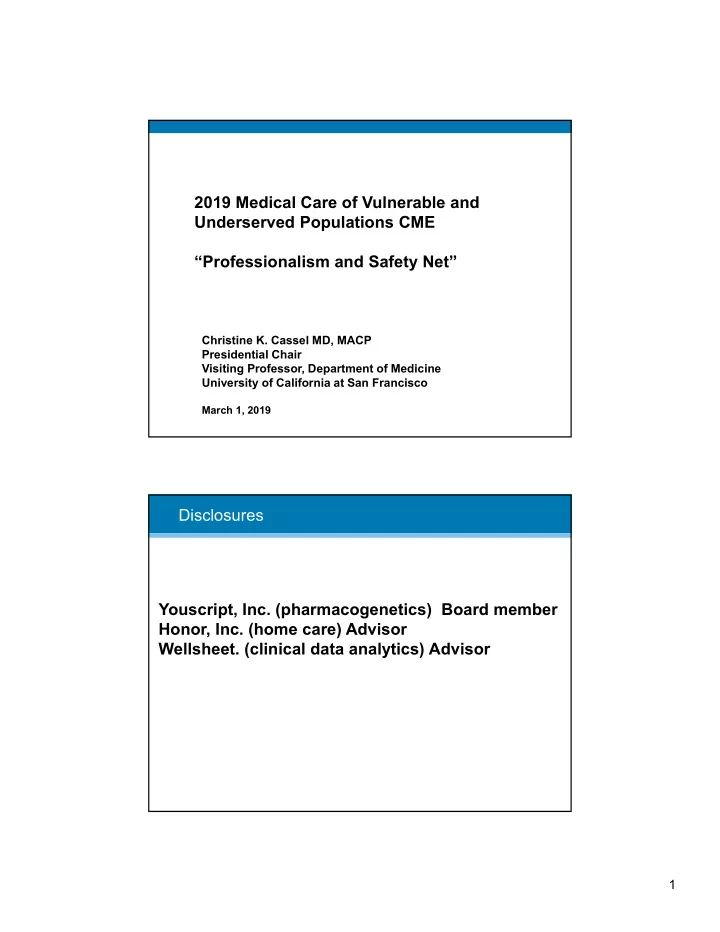
2019 Medical Care of Vulnerable and Underserved Populations CME Professionalism and Safety Net Christine K. Cassel MD, MACP Presidential Chair Visiting Professor, Department of Medicine University of California at San Francisco March 1,


slide-1
SLIDE 1

1

Christine K. Cassel MD, MACP Presidential Chair Visiting Professor, Department of Medicine University of California at San Francisco

March 1, 2019

2019 Medical Care of Vulnerable and Underserved Populations CME “Professionalism and Safety Net” Disclosures Y Youscript, Inc. (pharmacogenetics) Board member Honor, Inc. (home care) Advisor

  • Wellsheet. (clinical data analytics) Advisor
slide-2
SLIDE 2

2

Definition of professionalism

Professionalism is the basis of Medicine’s contract with

  • society. It demands placing the interests of patients above

those of the physician, setting and maintaining standards of competence and integrity, and providing expert advice to society on matters of health. Essential to this contract is public trust in physicians, which depends on the integrity of both individual physicians and the whole profession.

Physician Charter on Professionalism, ABIM Foundation- ACP Foundation—European Federation of Internal Medicine, 2002

Articles on Medicine and Professionalism

slide-3
SLIDE 3

3

Market Forces Payment Models and Incentives Consumerism Technology Social Determinants of Health Burnout

Challenges to Professionalism The Physician Charter on Professionalism

Fundamental Principles

  • patient welfare
  • patient autonomy
  • social justice

Professional Responsibilities Commitment to

  • professional competence
  • honesty with patients
  • patient confidentiality
  • maintaining appropriate relations with patients
  • improving quality of care
  • improving access to care
  • just distribution of finite resources
  • scientific knowledge
  • maintaining trust by managing conflicts of interest
  • professional responsibilities

Simultaneously published in The Lancet and Annals of Internal Medicine in February 2002. Republished on the Charter’s 10th anniversary in 2012 in Annals of Internal Medicine.

abimfoundation.org

slide-4
SLIDE 4

4

Healthcare Spending

OECD 2017

slide-5
SLIDE 5

5

Healthcare Squeezing Out Other Priorities Employees Face Rising Healthcare Costs

slide-6
SLIDE 6

6

Can we separate politics from healing? Not if we care about the vulnerable and underserved.

RUDOLF VIRCHOW Medicine is a social science, and politics nothing else but medicine on a large scale SOCIAL MEDICINE Diagnosing and treating the ills of sick societies

Ernest Amory Codman, MD (1869 – 1940)

“Every hospital should follow every patient it treats long enough to determine whether or not the treatment has been successful, and then to inquire, ‘If not, why not?’ with a view to preventing similar failures in the future.”

slide-7
SLIDE 7

7

Charles R. Drew, MD (1904 – 1950)

“There is no scientific basis for the separation of the bloods of different races except on the basis

  • f the individual blood

types or groups.”

This slide fulfills the AB 1195 requirement for incorporating cultural and linguistic competency into continuing medical education.

Sidney R. Garfield, MD (1906 – 1984)

Prepayment “brings the patient to the doctor earlier in his illness and more often, which is one of the most important effects … because it permits the practice of true preventive medicine.”

slide-8
SLIDE 8

8

  • H. Jack Geiger, MD (born 1926)

“The last time I checked my textbooks, the specific therapy for malnutrition was, in fact, food.”

This slide fulfills the AB 1195 requirement for incorporating cultural and linguistic competency into continuing medical education.

“Dr. Mona”

slide-9
SLIDE 9

9

  • Virchow—the challenges we face are not new, they are core

to the moral base of our profession

  • Codman—stay true to the public interest, and if your

institution betrays that trust find (or establish!) another one

  • Drew—Science is the core to effective advocacy, work within

influential organizations as much as possible, take the high road publicly.

  • Garfield—think outside the box, seek practical solutions for

families and workers that advantage their employers. Leverage power.

  • Geiger—use whatever government organizations you can

find, read the fine print, be strategic about going public, media can help your cause.

  • Hanna-Attisha—if you see something, say something!

Profiles in Professionalism

  • Systems science
  • Data analytics
  • Population health
  • Civic engagement
  • Government roles
  • Institutional Professionalism

Opportunities for Leadership

Professionalism is not only about individual heroism

slide-10
SLIDE 10

10

Promising Tools, Promising Futures: Delivery Systems Reform

  • Electronic health information
  • New teamwork models
  • New treatments
  • Systems engineering
  • Empowered consumers
  • Payment reform
  • Better data, better measures
  • Big data capabilities
  • Precision medicine
  • Palliative medicine
slide-11
SLIDE 11

11

  • Patient Partnerships: engagement, shared decision making,

collaboration, continuity and coordination, quality metrics

  • Organizational Culture: well-being of people, teamwork,

health/safety, inclusion/diversity, accountability

  • Community Partnerships: social determinants, access and

high value, community benefit

  • Operations and Business Practices: safeguard privacy,

ethical practices, manage conflicts of interest, align incentives with values, fair compensation, education and development, reduce waste, innovation, accounting standards, price transparency

Charter on Professionalism for Health Care Organizations

  • Professionalism may not be sufficient to drive the profound

and far-reaching changes needed in the health care system, but without it, the health care enterprise is lost.

  • — Lesser et al

The Future of Professionalism

slide-12
SLIDE 12

12

  • Professionalism needs to be recognized as a dynamic and

evolving concept with a past present and future. …..leading to these questions

  • What constitutes leadership in a world of teams and

systems?

  • What does digital professionalism look like?
  • Does professionalism require civil disobedience?
  • Is professionalism a cause of burnout, or an antidote?

How Professionalism will Survive

Understanding Medical Professionalism, Levinson, Ginsburg, Hafferty and Lucey, 2015

The Physician Charter on Professionalism

Fundamental Principles

  • patient welfare
  • patient autonomy
  • social justice

Professional Responsibilities Commitment to

  • professional competence
  • honesty with patients
  • patient confidentiality
  • maintaining appropriate relations with patients
  • improving quality of care
  • improving access to care
  • just distribution of finite resources
  • scientific knowledge
  • maintaining trust by managing conflicts of interest
  • professional responsibilities

Simultaneously published in The Lancet and Annals of Internal Medicine in February 2002. Republished on the Charter’s 10th anniversary in 2012 in Annals of Internal Medicine.

abimfoundation.org

Can this charter guide us? What’s missing?