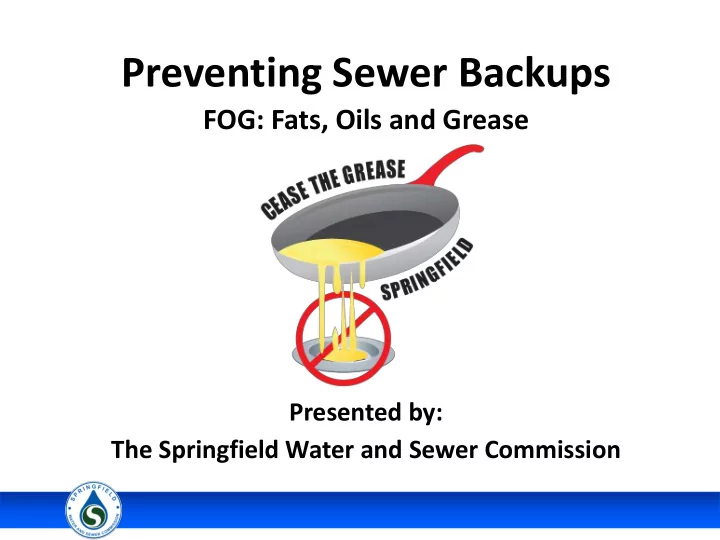
Preventing Sewer Backups FOG: Fats, Oils and Grease Presented by: - - PowerPoint PPT Presentation

preventing sewer backups
SMART_READER_LITE
LIVE PREVIEW

Preventing Sewer Backups FOG: Fats, Oils and Grease Presented by: - - PowerPoint PPT Presentation

Preventing Sewer Backups FOG: Fats, Oils and Grease Presented by: The Springfield Water and Sewer Commission What is FOG (Fats, Oils and Grease)? FOG is fats, oils, and grease that can build up in sewer lines. When grease is washed down the


slide-1
SLIDE 1

Preventing Sewer Backups

FOG: Fats, Oils and Grease

Presented by: The Springfield Water and Sewer Commission

slide-2
SLIDE 2

What is FOG (Fats, Oils and Grease)?

FOG is fats, oils, and grease that can build up in sewer lines. When grease is washed down the sink or toilet it sticks to the inside of sewer pipes. This can increase the chance of a sewer back up into homes, businesses, apartments and public spaces.

slide-3
SLIDE 3

Problems Caused By FOG (Fats, Oils and Grease)

A Residential Sewer Backup

Restoration Costs For Home and Business Owners

Home and business owners are responsible for clean up, damages and restoration caused by a sewer backup. Private companies charge several thousands of dollars for these services.

slide-4
SLIDE 4

Problems Caused By FOG (Fats, Oils and Grease)

  • Exposure to raw sewage is a public health concern and

has environmental impacts.

  • FOG related repairs increase the cost of maintaining of

sewer collection system.

slide-5
SLIDE 5

Obvious Sources of FOG

slide-6
SLIDE 6

Not So Obvious Sources of FOG

slide-7
SLIDE 7

Daily Kitchen Practices To Prevent Sewer Backups

NEVER

  • Never pour grease down sink drains or toilets
  • Never use the toilet for disposal of food scraps, sanitary items, cloths or

towels - these items should be placed in the trash

slide-8
SLIDE 8

Daily Kitchen Practices To Prevent Sewer Backups

ALWAYS

  • Dispose of cooled cooking grease into a container with a lid and throw it in

the garbage. For Example: a metal can or glass jar

  • Scrape food scraps from dirty dishes and pans into the trash can before

washing

  • Use a paper towel or a scraper to remove residual grease from dishes and

pans prior to washing

  • Use baskets or strainers in sinks to catch food scraps
  • Minimize the use of your garbage disposal – it does not eliminate grease
slide-9
SLIDE 9

Why Have A FOG (Fats, Oils and Grease) Program?

  • The Springfield Water and Sewer Commission owns, operates and

maintains the sanitary collection system. This includes sewer mains that are connected to the wastewater treatment plant at Bondi’s Island.

  • If sewer mains are clogged with FOG, the collection system will

become blocked and cannot operate at full capacity, which increases the chances of a sewer overflow.

slide-10
SLIDE 10

Preventing FOG (Fats, Oils and Grease) Saves Money

  • Sewer backups are unsanitary, unhealthy, and expensive to

clean up.

  • Costs include the expense of clearing the blockage and

replacing damaged property which may include: rugs, furniture, flooring, drywall and business equipment.

  • Less FOG in sewer mains reduces maintenance and repairs.

All these expenses are preventable! Don’t throw money down the drain. Help prevent sewer backups.

slide-11
SLIDE 11

Wipes Clog Pipes!

Do Flush

  • Toilet Paper
  • Human Waste

Don’t Flush

  • “Disposable” Wipes
  • Paper Towels
  • Feminine Products
  • Cotton Balls
  • Dental Floss
  • Diapers

YES NO

Did you know that most “disposable” wipes do not dissolve when flushed?

slide-12
SLIDE 12

Cease The Grease Springfield For More Information Contact:

Lori Belanger 413-787-6207 x202 lori.belanger@waterandsewer.org

  • r

Gail Colburn 413-787-6207 x244 gail.colburn@waterandsewer.org

slide-13
SLIDE 13

Other Requests

For General Information, Educational Information, or Public Presentation requests, contact: Joyce Mulvaney, Public Communications Manager 413-787-6256 x182 Joyce.Mulvaney@waterandsewer.org