
SLIDE 1
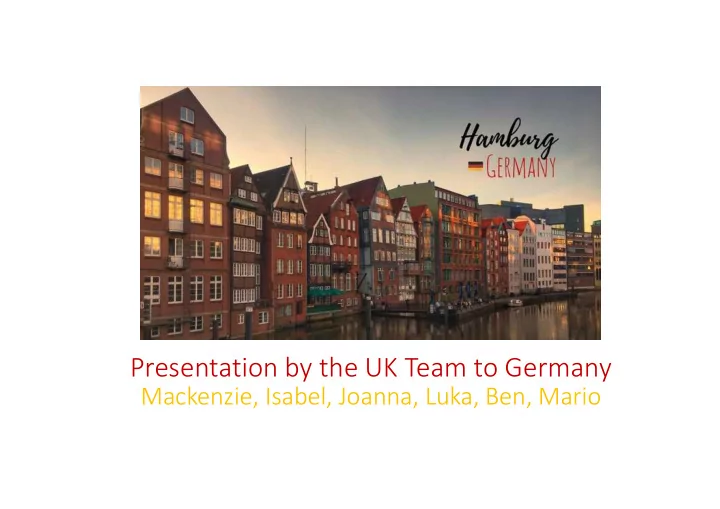
Presentation by the UK Team to Germany Mackenzie, Isabel, Joanna, - - PowerPoint PPT Presentation
Presentation by the UK Team to Germany Mackenzie, Isabel, Joanna, Luka, Ben, Mario OVERVIEW OF THE CITY OF HAMBURG HAMBURG CITY IS THE SECOND LARGEST CITY IN GERMANY AFTER BERLIN AND THE NINTH LARGEST IN THE EU (EUROPEAN UNION) IN TERMS OF
HAMBURG CITY IS THE SECOND LARGEST CITY IN GERMANY AFTER BERLIN AND THE NINTH LARGEST IN THE EU (EUROPEAN UNION) IN TERMS OF POPULATION. HAMBURG METROPOLITAN AREA INCLUDES SEVEN CITIES AND THE AREA’S ECONOMY ACCOUNTS FOR AROUND 4.0% OF THE NATIONAL ECONOMY. THE TERTIARY SECTOR CONTRIBUTED THE MOST TO THE AREA’S GVA IN 2017, ACCOUNTING FOR MORE THAN 80% SHARE.
Where is Hamburg?
Hamburg is located to the 160km north of Hanover and around 255km north-west of the German capitol Berlin.
Geography
Hamburg is placed by a natural harbour, the river Elbe that divides its self into two branches, the Norderelbe and the Süderelbe. However, the two branches meet again opposite
damming of Alter. It measures up at around 455 acres .
Main Transport Links
Two of the main transport links in Hamburg are the U- Bahn(Underground train system) and the S-Bahn (above ground train system). Another very popular transport link is by ferry along the river Elbe. Hamburg
Saint Michaels church is considered one of the most famous churches in Hamburg and is famed for its beautiful Baroque style. It was originally built between 1750 and 1762 but after being struck by lightening and a catastrophic fire centuries later, it was re-constructed in 1912. Through out world war
require re-construction. The top of the 132 meter high platform known as “Michel” boasts incredible views of the city and its ports. In the entrance to the church is a bronze statue, showing Saint Michael killing the Devil . Over 2425 people throughout history have been buried in its
high Alter.
The Hamburg Dom is held in Heiligengeistfeld fair ground in central Hamburg and is one of the largest and longest fun fairs in Germany . The fair comes only 3 times a year but during this time, attracts around 10 million visitors coming for the atmosphere, food and entertainment. The Speicherstadt is one of the largest warehouse districts in the world. This is due to the large amounts of goods being exported from Hamburg's ports. The district was built between 1883 and 1927 and is located in the Feihafen (Free Ports)
The Elbphilharmonie was designed by swiss architects Herzog and De Mueron and constructed in between 2016 and 2017. The construction of the concert hall coasted around 789 million EUR. The height and shape of the building create stunning views of Hamburg and allow unique acoustics to travel throughout the stunning hall. Due to this, The Elbphilharmonie has achieved the reputation of being one of the top 10 concert halls in the world.
Like elsewhere in Germany, Standard German is spoken in Hamburg, but like the north of Germany, the original language of Hamburg is Low German. Throughout the whole of Germany, the official language spoken is German, with over 95% of the population speaking German as their first language. Some minority languages in Germany include Sorbian, spoken by 0.09% in the east of Germany and North Frisian spoken in Nordfriesland by around 10,000 people, or 0.01%, who also speak German.
Rank Language Speakers (%of population)
1 2 3 4 5 6 7 8 9 10 11 German English French Russian Turkish Kurdish Upper Sorbian Lower Sorbian Romani Danish North Frisian 95 56 15 5 1.8 0.3 0.09 0.09 0.08 0.06 0.01
average.
This is a split of the citizenships of people living in Hannover:
Here is a split of religions in Hannover: Roman Catholic: 69,193 Protestant: 175,758 Other/no religion/unknown:261,465
I
Many sports are popular in Germany, including:
The team originated in the nearby city Burgdorf but in 2005 they moved to Hannover.
team who have won the world cup 4 times!
“Oberliga”.
Hannover” play in the first division and they also have second division teams.
sports such as sailing and water polo and it hosts the international dragon boat race.
The club was founded the 29 September 1887 ,so 131 years ago and it first came
the 2 June 1919, so 99 years ago it got the name Hamburger SV or HSV for short. They play in the Bundesliga.
These are the trophies that they have won: German Champions: Winners: 1922–23, 1927–28, 1959–60, 1978–79, 1981–82, 1982–83 DFB-Pokal: Winners: 1962–63, 1975–76, 1986–87 DFB-Ligapokal: Winners: 1972–73, 2003 European European Cup: Winners: 1982–83 European Cup Winners' Cup: Winners: 1976–77 UEFA Super Cup: Runners-up: 1977, 1983 UEFA Intertoto Cup: Winners: 2005, 2007 (Outright Winners) Group Winners: 1970, 1994 Runners-up: 1999 Worldwide Intercontinental Cup Runners-up: 1983 Regional Northern German football championship Winners (10): 1921, 1922, 1923, 1924, 1925, 1928, 1929, 1931, 1932, 1933 (record) Oberliga Nord Winners (15): 1948, 1949, 1950, 1951, 1952, 1953, 1955, 1956, 1957, 1958, 1959, 1960, 1961, 1962, 1963 (record) Gauliga Nordmark Winners: 1937, 1938, 1939, 1941 Gauliga Hamburg Winners: 1945 Stadtliga Hamburg Winners: 1946 British occupation zone championship Winners: 1947, 1948 (record)
Full name Hamburger Sport-Verein e.V. Nickname(s) Die Rothosen (The Red Shorts) Der Dino (The Dinosaur) Short name HSV Founded 29 September 1887; 131 years ago (as SC Germania) 2 June 1919; 99 years ago (as Hamburger SV) Ground Volksparkstadion Capacity 57,000 President Bernd Hoffmann Head coach Hannes Wolf League
Website https://www.hsv.de/en/overview/
We hope you enjoyed our presentation Mackenzie, Isabel, Joanna, Luka, Ben, Mario (UK Team to Germany)