Heatwaves in Germany 2008 2015 Outline - Questions 1. Is heatwave - - PowerPoint PPT Presentation

heatwaves in germany
SMART_READER_LITE
LIVE PREVIEW

Heatwaves in Germany 2008 2015 Outline - Questions 1. Is heatwave - - PowerPoint PPT Presentation

Heatwaves in Germany 2008 2015 Outline - Questions 1. Is heatwave a problem in Germany? 2. Why is it a problem? 3. What is scope of the problem? 4. What are the resilience mechanisms/strategies against heatwaves in Germany? 5. How is the


slide-1
SLIDE 1

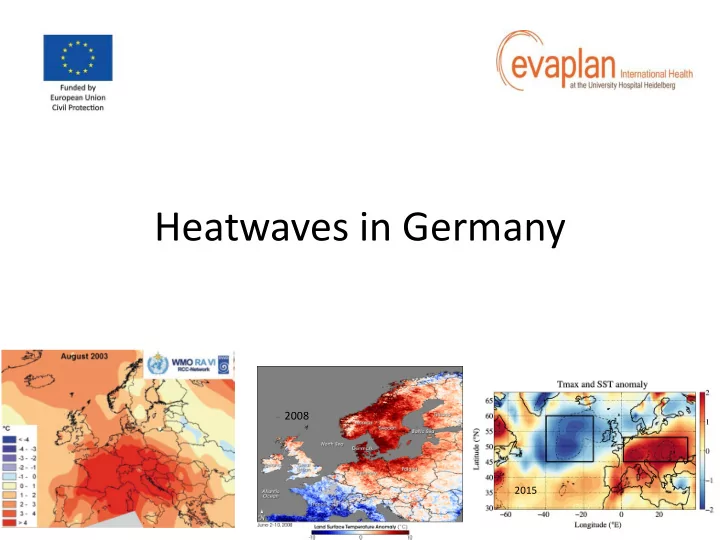
Heatwaves in Germany

2008

2015
slide-2
SLIDE 2

Outline - Questions

  • 1. Is heatwave a problem in Germany?
  • 2. Why is it a problem?
  • 3. What is scope of the problem?
  • 4. What are the resilience mechanisms/strategies

against heatwaves in Germany?

  • 5. How is the problem addressed and are there

successes or failures?

  • 6. Who are the main stakeholders in this field?

what are their roles? How they can be more effectively approached?

slide-3
SLIDE 3

Background – Heatwaves in Germany

slide-4
SLIDE 4

Emdat database – Germany Natural disasters - 1900-2019

Natural disasters N Deaths Injured Affected Home- less Damage (M. US$) Earthquake 3 1 60 1650 200 212 Epidemic 2 609 Extreme temperature 12 9420 165 2,030 Flood 24 74 120 547100 29,010 Landslide 1 5 6 Storm 57 710 755 30000 30,721 Wildfire 1 Grand Total 100 10210 1100 579359 200 61979 92% of deaths (mostly in 2003); 46 % of damage costs

Year N Deaths Injured Damage (M US$) 1979 1 80 1997 1 30 2003 1 9355 1,650 2005 1 1 165 300 2006 2 12 2009 2 15 2010 1 1 2012 2 6 2018 1 Total 12 9420 165 2,030

slide-5
SLIDE 5

Noteworthy heat waves

slide-6
SLIDE 6

Hot days and nights in Frankfurt-am-Main since 2001

slide-7
SLIDE 7

Trend per Region: Number of Hot Days

https://www.umweltbundesamt.de/daten/umwelt-gesundheit/gesundheitsrisiken-durch-hitze#textpart-3

slide-8
SLIDE 8

Hot days (≥ 30°C)

https://www.umweltbundesamt.de/daten/umwelt-gesundheit/gesundheitsrisiken-durch-hitze

2003 2015 2018

slide-9
SLIDE 9

Nuits tropicales (≥20°C)

2003 2015 2018

slide-10
SLIDE 10

Heat waves in Germany

  • Recurring more frequently
  • More hot days (≥ 30 °C) and tropical nights

(≥20°C)

  • More extreme (higher temperatures)
  • City Heat Island
slide-11
SLIDE 11

Scope & Impact (1)

  • Environmental impact:

– Fish mortality and discharge of power plant effluents into rivers – Eutrophication and blue-green algae danger – Danger for forest fires and tree dying is rising – Effects of drought and heat on biodiversity and endangered species

  • Economic impact:

– Drought in agriculture – …

slide-12
SLIDE 12

Scope & Impact (2)

  • Health impact: mortality and morbidity

– Direct heat effect – Mediated through worsened air quality

  • Heat and sunlight “cook” pollutants present in the air

(e.g. NOx) increasing the levels of ground-level ozone and

  • ther aerosols.
  • Meteorological conditions contributing to stagnating

poor-quality air: high temperatures, low precipitation, strong sunlight, and low wind speeds

  • Worse in urban areas (higher air pollution)
  • Increased risk of forest fires contributing to air pollution

(e.g. Russia, 2010)

slide-13
SLIDE 13

Nb of hot days with excess ozone level in Stuttgart

https://www.umweltbundesamt.de/daten/umwelt- gesundheit/gesundheitsrisiken-durch-ozon#textpart-1

slide-14
SLIDE 14
slide-15
SLIDE 15

The 27 examined European countries are severely affected by heat waves. Over 28,000 people die every year due to exposure to extreme heat. On average, 0.61% of all deaths are caused by extreme heat events.

slide-16
SLIDE 16

Responses

  • Ministry of health (BMG)
  • Ministry of environment (BMU)
  • Robert Koch Institute (RKI)

https://www.rki.de/DE/Content/Kommissionen/UmweltKommission/Stellun gnahmen_Berichte/Downloads/klimawandel_gesundheit_handlungsempfehl ungen_2013.pdf?__blob=publicationFile

slide-17
SLIDE 17

Resilience Mechanisms & Strategies Germany

  • Reduce air pollution

– keep NO2 and ozone levels down

  • “Since January 2010, one cubic meter (m³) of

air in an 8-hour-average may not contain more than 120 microgram (μg) of ozone. This value is allowed to be exceeded 25 times in one year.”

slide-18
SLIDE 18

Stakeholders

  • Government agencies

– Deutscher Wetterdienst (www.dwd.de): higher federal authority under the Federal Ministry of Transport and Digital Infrastructure. – Deutsche Klimadienst (DKD) (created Oct 2015); network of agrencies including Ministry of Env. and Federal Environmental Agency – CDC (Climate Data Center): weather and climate data + analysis – Umweltbundesamt (Federal environmental agency)

  • Ministry of health (BMG)
  • Ministry of environment (BMU)
  • Robert Koch Institute (RKI)
slide-19
SLIDE 19

Stakeholders

  • NGOs

– Bund – Friends of the Earth Germany (www.bund.net) – NABU-Projekt „ StadtKlimaWandel“: www.nabu.de/aktionenundprojekte/stadtklimawandel/ – GRaBS – Green and Blue Space Adaption for Urban Areas and Eco Towns: www.grabs-eu.org

  • Others

– Regionale Klimabüros der Helmholtz-Gemeinschaft: www.klimabuero.de – Regionaler Klimaatlas Deutschland: www.regionaler-klimaatlas.de – KlimaMORO – Raumentwicklungsstrategien zum Klimawandel: www.klimamoro.de – KlimaExWoSt – Urbane Strategien zum Klimawandel; StadtKlima – Kommunale Strategien und Potenziale – zum Klimawandel: www.klimaexwost.de – KLIMZUG – Klimawandel in Regionen zukunftsfähig gestalten: www.klimzug.de – Klimalotse – Leitfaden zur Anpassung an den Klimawandel: www.klimalotse.anpassung.net

slide-20
SLIDE 20

Summary / conclusions

  • Heatwaves: an actual and recurrent issue in

Germany (“new normal”)

  • Preparedness to adaptation
slide-21
SLIDE 21

Links/ references

Gesundheitliche Risiken von Ozon und hoher Lufttemperatur https://www.umweltbundesamt.de/daten/umwelt-gesundheit/gesundheitsrisiken-durch-ozon#textpart-1 https://www.umweltbundesamt.de/sites/default/files/medien/1410/publikationen/190211_uba_hg_luftqu alitaet_dt_bf.pdf#page=4&zoom=auto,-13,334 https://www.umweltbundesamt.de/sites/default/files/medien/4031/publikationen/uba_krug_muecke.pdf https://www.umweltbundesamt.de/themen/klimawandel-gesundheit-anpassungsmassnahmen-im https://www.umweltbundesamt.de/publikationen/klimawandel-gesundheit Steffen Merte: Estimating heat wave-related mortality in Europe using singular spectrum analysis. In: Climatic

  • Change. 2017, doi:10.1007/s10584-017-1937-9.
slide-22
SLIDE 22

regulations

Seit Januar 2010 darf ein Kubikmeter (m³) Luft im 8-Stunden-Mittel nicht mehr als 120 Mikrogramm (µg) Ozon enthalten. Dieser Wert durfte in einem Jahr 25-mal überschritten werden.

slide-23
SLIDE 23

Extra slides

slide-24
SLIDE 24

2018 - Hot Conditions

slide-25
SLIDE 25

2008 http://wiki.bildungsserver.de/klimawandel/ind ex.php/Hitzewellen_Europa 2003 2015

slide-26
SLIDE 26

Monthly trends

slide-27
SLIDE 27