Health Care Reform in Germany: Health Care Reform in Germany: - - PowerPoint PPT Presentation

health care reform in germany health care reform in
SMART_READER_LITE
LIVE PREVIEW

Health Care Reform in Germany: Health Care Reform in Germany: - - PowerPoint PPT Presentation

Health Care Reform in Germany: Health Care Reform in Germany: Assessing Severe Intergenerational Imbalances Assessing Severe Intergenerational Imbalances Bernd Raffelhschen Bernd Raffelhschen University of Freiburg Freiburg, Germany ,


slide-1
SLIDE 1

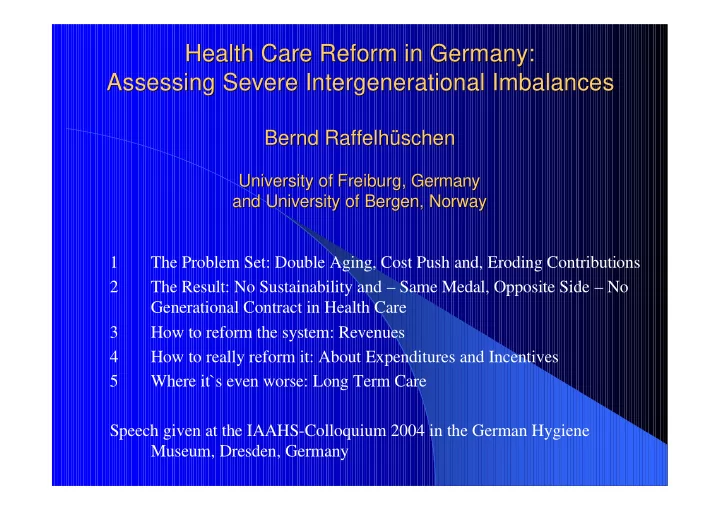
Health Care Reform in Germany: Health Care Reform in Germany: Assessing Severe Intergenerational Imbalances Assessing Severe Intergenerational Imbalances

Bernd Raffelhüschen Bernd Raffelhüschen

University of University of Freiburg Freiburg, Germany , Germany and University of Bergen, Norway and University of Bergen, Norway 1 The Problem Set: Double Aging, Cost Push and, Eroding Contributions 2 The Result: No Sustainability and – Same Medal, Opposite Side – No Generational Contract in Health Care 3 How to reform the system: Revenues 4 How to really reform it: About Expenditures and Incentives 5 Where it`s even worse: Long Term Care Speech given at the IAAHS-Colloquium 2004 in the German Hygiene Museum, Dresden, Germany

slide-2
SLIDE 2
slide-3
SLIDE 3

Health Care Reform in Germany: Health Care Reform in Germany: Assessing Severe Intergenerational Imbalances Assessing Severe Intergenerational Imbalances

Bernd Raffelhüschen Bernd Raffelhüschen

University of University of Freiburg Freiburg, Germany , Germany and University of Bergen, Norway and University of Bergen, Norway 1 The Problem Set: Double Aging, Cost Push and, Eroding Contributions

2 The Result: No Sustainability and – Same Medal, Opposite Side – No Generational Contract in Health Care

3 How to reform the system: Revenues 4 How to really reform it: About Expenditures and Incentives 5 Where it`s even worse: Long Term Care Speech given at the IAAHS-Colloquium 2004 in the German Hygiene Museum, Dresden, Germany

slide-4
SLIDE 4

Why Health Care should be a generational contract Why Health Care should be a generational contract taking from the working aged and giving to those older

  • r younger:

Age-specific Revenues and Expenditures of the Geman Health Care System

1000 2000 3000 4000 5000 6000 5 10 15 20 25 30 35 40 45 50 55 60 65 70 75 80 85 90 95 100

Age Euro in 2001

Contributions Expenditures

slide-5
SLIDE 5

Under unrealistic optimistic assumptions, the health care system is indeed a (minor) generational contract, taking from those aged 20 to 30 and giving to those older or younger!

Generational Accounting of the German Health Care System Without Cost Pusch

Base-year 2001, interest rate r=3%, GDP-growth rate g=1,5%

  • 60
  • 40
  • 20

20 40 60 80

  • 1

5 10 15 20 25 30 35 40 45 50 55 60 65 70 75 80 85 90 95 100

age Thousands Euro

slide-6
SLIDE 6

From a realistic viewpoint, there is no generational contract but a self service of the living to the burden of future generations!

Generational Accounting of the German Health Care System

Base-year 2001, interest rate r=3%, GDP-growth rate g=1,5%

  • 60
  • 40
  • 20

20 40 60 80

  • 1

5 10 15 20 25 30 35 40 45 50 55 60 65 70 75 80 85 90 95 100

Age Thousands Euro

Without With Cost-Push, 1%, 30 years

slide-7
SLIDE 7
slide-8
SLIDE 8

Sustainability Gap of the German Health Care System

Base-year 2001, interest rate r=3%, GDP-growth rate g=1,5% 83,8 232,2

50 100 150 200 250 300

Without With Cost-Push, 1%, 30 years

Percent of GDP

slide-9
SLIDE 9

Implicit Public Liabilities of the Implicit Public Liabilities of the German Health Care System German Health Care System amount to: amount to: 4,000,000,000,000 Euro 4,000,000,000,000 Euro

To compare:

GermanTelekom:

64,200,000,000

Public Sector:

1,200,000,000,000 (statistically documented)

slide-10
SLIDE 10

Contribution Rates for Health Care, Percent of Payroll

Base-year 2001, r=3%, g=1,5%

10 12 14 16 18 20 22 24 26 28 30 2000 2005 2010 2015 2020 2025 2030 2035 2040 2045 2050 2055 2060 2065

year Percent of Payroll, Employers and Employee

without with cost push, 1%, 30y

slide-11
SLIDE 11

Health Care Reform in Germany: Health Care Reform in Germany: Assessing Severe Intergenerational Imbalances Assessing Severe Intergenerational Imbalances

Bernd Raffelhüschen Bernd Raffelhüschen

University of University of Freiburg Freiburg, Germany , Germany and University of Bergen, Norway and University of Bergen, Norway 1 The Problem Set: Double Aging, Cost Push and, Eroding Contributions 2 The Result: No Sustainability and – Same Medal, Opposite Side – No Generational Contract in Health Care

3 How to reform the system: Revenues

4 How to really reform it: About Expenditures and Incentives 5 Where it`s even worse: Long Term Care Speech given at the IAAHS-Colloquium 2004 in the German Hygiene Museum, Dresden, Germany

slide-12
SLIDE 12

The Public Debate The Public Debate – – So Far So Far

“Bürgerversicherung”

  • Broadening Individual Eligibility
  • Raising Eligible Income
  • Widening Eligible Income
  • r

“Gesundheitsprämie”

Strengthen Individual Equivalence through lump- sum contributions

slide-13
SLIDE 13

Sustainability Gap of Status quo, actual reform (GMG), "Bürgerversicherung" and lump-sum contributions

Basisjahr 2001, r=3%, g=1,5%

475,8 411,5 405 414,8

50 100 150 200 250 300 350 400 450 500 550 600

Status quo GMG GMG + "Bürgerversicherung" GMG + Lump-sum payments

Percent of GDP

slide-14
SLIDE 14

Health Care Reform in Germany: Health Care Reform in Germany: Assessing Severe Intergenerational Imbalances Assessing Severe Intergenerational Imbalances

Bernd Raffelhüschen Bernd Raffelhüschen

University of University of Freiburg Freiburg, Germany , Germany and University of Bergen, Norway and University of Bergen, Norway 1 The Problem Set: Double Aging, Cost Push and, Eroding Contributions 2 The Result: No Sustainability and – Same Medal, Opposite Side – No Generational Contract in Health Care 3 How to reform the system: Revenues

4 How to really reform it: About Expenditures and Incentives

5 Where it`s even worse: Long Term Care Speech given at the IAAHS-Colloquium 2004 in the German Hygiene Museum, Dresden, Germany

slide-15
SLIDE 15

„ „Freiburg Freiburg Agenda“ for a Market Agenda“ for a Market-

  • rientated Reform Proposal:
  • rientated Reform Proposal:

1. Avoiding cost-push in hospital treatment through selective contracting, that is, introducing prices competition 2. Phasing in deductables of 900 € p.a. for ambulant treatment and pharmacy products 3. Phasing out dental care compensation

slide-16
SLIDE 16

Impact of the Freiburg Agenda on the Sustainability Gap

Base-year 2001, r=3%, g=1,5% 232,2 117,3 60,3 193,6

50 100 150 200 250 300

Without Reform

  • 1. Phasing out Dental care
  • 1. + 2. Deductables for ambulant

treatment and pharmaceutic products

  • 1. + 2. + 3. Selctive bargaining in

hospital care

Percent off GDP

slide-17
SLIDE 17

Generational Accounting of German Health Care, Status quo and Freiburg Agenda

Basisjahr 2001, r=3%, g=1,5%

  • 60
  • 40
  • 20

20 40 60 80

  • 1

5 10 15 20 25 30 35 40 45 50 55 60 65 70 75 80 85 90 95 100

Age Thousands Euro

With Cost-Push, 1%, 30 years Freiburg Agenda

slide-18
SLIDE 18

Contribution Rates for Health Care: Freiburg Agenda vs. Status quo

Base-year 2001, r=3%, g=1,5%

10 12 14 16 18 20 22 24 26 28 30 2000 2005 2010 2015 2020 2025 2030 2035 2040 2045 2050 2055 2060 2065

Jahr Percent of payroll

without with cost push, 1%, 30y Freiburg Agenda (with cost push)

slide-19
SLIDE 19

Health Care Reform in Germany: Health Care Reform in Germany: Assessing Severe Intergenerational Imbalances Assessing Severe Intergenerational Imbalances

Bernd Raffelhüschen Bernd Raffelhüschen

University of University of Freiburg Freiburg, Germany , Germany and University of Bergen, Norway and University of Bergen, Norway 1 The Problem Set: Double Aging, Cost Push, and Eroding Contributions 2 The Result: No Sustainability and – Same Medal, Opposite Side – No Generational Contract in Health Care 3 How to reform the system: Revenues 4 How to really reform it: About Expenditures and Incentives

5 Where it`s even worse: Long Term Care

Speech given at the IAAHS-Colloquium 2004 in the German Hygiene Museum, Dresden, Germany

slide-20
SLIDE 20

Age-specific Revenues and Expenditures of the German Long-term-care System

500 1000 1500 2000 2500 3000 3500 4000 4500 5 10 15 20 25 30 35 40 45 50 55 60 65 70 75 80 85 90 95 100

age Euro

Contributions Expenditures

slide-21
SLIDE 21

Generational Accounting of the German Long-term Care System

Base-year 2001, interest rate r=3%, GDP-growth rate g=1,5%

  • 25
  • 20
  • 15
  • 10
  • 5

5 10 15 20 25

  • 1

5 10 15 20 25 30 35 40 45 50 55 60 65 70 75 80 85 90 95 100

Alter Thousands Euro

Without With Cost push

slide-22
SLIDE 22

Sustainability Gap of the German Long-term Care System

Base-year 2001, interest rate r=3%, GDP-growth rate g=1,5% 35,9 67,4

0,0 10,0 20,0 30,0 40,0 50,0 60,0 70,0 80,0

Without With Cost push

Percent of GDP

slide-23
SLIDE 23

Contribution Rates for Health Care, Percent of Payroll

Base-year 2001, r=3%, g=1,5%

1 2 3 4 5 6 7 2000 2005 2010 2015 2020 2025 2030 2035 2040 2045 2050 2055 2060 2065

Jahr Percent of Payroll, Employers and Employee

Withouit Cost push With

slide-24
SLIDE 24

Conclusion Conclusion

Aging phenomenon is much more pronounced in the

Germany/Europe than in e.g. the US

Social protection via health and long-term care in

Germany is on a high level – but totally unsustainable

Appropriate reform proposals should include two

ingredients:

– 1) cutting back implicit demands in the medium and long-run

through incentive-orientated measures in public plans

– 2) immediate strengthening of funded private insurance

systems

No fun to be young in Germany!