We build Transport for the North John Cridland for a better - - PDF document

we build
SMART_READER_LITE
LIVE PREVIEW

We build Transport for the North John Cridland for a better - - PDF document

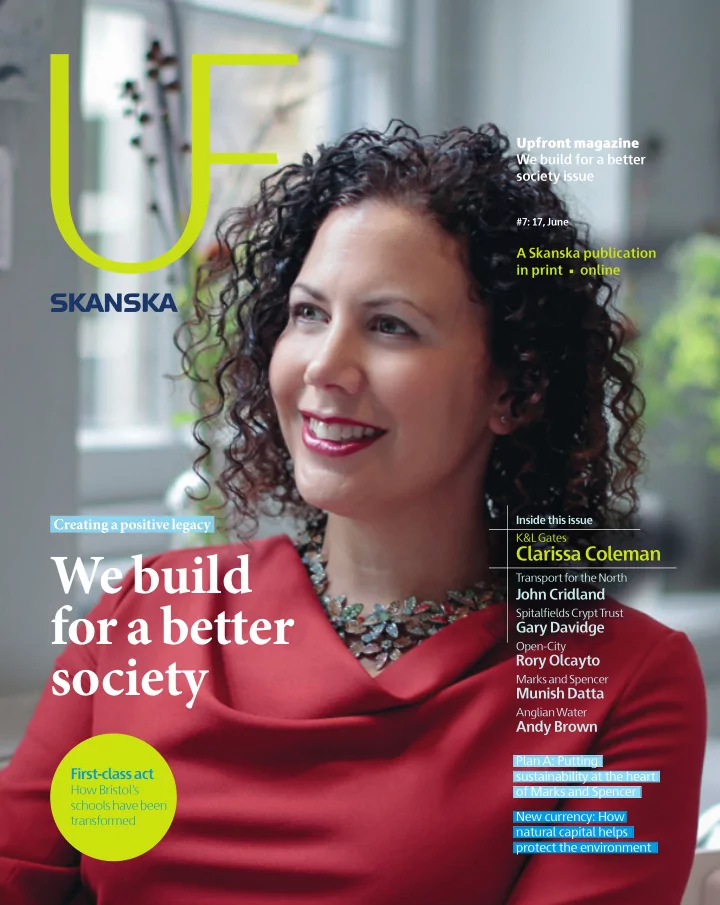
Upfront magazine We build for a better society issue #7: 17, June A Skanska publication in print online Inside this issue Creating a positive legacy K&L Gates Clarissa Coleman We build Transport for the North John Cridland for a


slide-1
SLIDE 1

A Skanska publication in print • online

#7: 17, June

Upfront magazine We build for a better society issue

First-class act

How Bristol’s schools have been transformed

Creating a positive legacy

We build for a better society

New currency: How natural capital helps protect the environment

Inside this issue K&L Gates

Clarissa Coleman

Transport for the North

John Cridland

Spitalfields Crypt Trust

Gary Davidge

Open-City

Rory Olcayto

Marks and Spencer

Munish Datta

Anglian Water

Andy Brown

Plan A: Putting sustainability at the heart

  • f Marks and Spencer
slide-2
SLIDE 2

[ 12 ] [ 13 ]

Tie ethical front line

Lawyer Clarissa Coleman believes that ethics really do matter in business

Photography The Fold London (thefoldlondon.com)
slide-3
SLIDE 3

larissa Coleman is a partner in the Litigation Department at the global law fjrm K&L Gates LLP. She has acted for several

  • rganisations that have been

investigated for misconduct, so knows more than most about the importance of ethics in business. Coleman says: “ A key factor in the long-term success and stability

  • f an organisation is its approach

to ethics. Honesty, integrity and professional conduct are basic behaviours that underpin business

  • reputation. And reputation is
  • ne of an organisation’s most

important assets in terms of driving profjtability and attracting and retaining employees, investors and business partners.” Coleman was Head of Litigation at Consensus Business Group, the property investment fjrm owned by businessman Vincent Tchenguiz, during a high-profjle investigation

[ 14 ]

C

by the Serious Fraud Offjce (SFO) in 2011, following the collapse of Kaupthing Bank in Iceland. Tchenguiz was arrested and his home and offjces searched in a dawn raid by the SFO. Coleman co-ordinated the immediate response on the morning of the dawn raid and then planned the subsequent judicial review against the SFO. In 2012, the High Court declared that the search warrants used in the dawn raid were unlawful and criticised the SFO’s handling of its investigation. Tie SFO admitted serious mistakes in its investigation, which was later dropped without any charges being pressed. Tchenguiz sued the SFO, resulting in an undisclosed settlement and a public apology. Coleman notes: “ An investigation can really take its toll on

  • individuals. Tiey are worried

about their jobs, about the long- term health of their company, and whether they may be found criminally liable.” In another high-profjle case, involving the FTSE 100 mining company ENRC plc, Coleman was drafued in to act as Deputy General Counsel to assist with an internal investigation into claims of fraud, bribery and corruption. “Tie fallout from an allegation or actual discovery of misconduct can be huge. Share price and balance sheet may be hit; business contracts withdrawn or rescinded; expensive, time-consuming and distracting internal and external investigations triggered; third-party legal actions commenced; the stress, worry and uncertainty will almost certainly impact productivity and stafg retention; and regulators may end up imposing crippling fjnes. “Put simply, the fjnancial, reputational and ofuen criminal consequences of failing to act in an ethical way can be enormous.”

Photography The Fold London (thefoldlondon.com)

[ 15 ]

Put simply, the fjnancial, reputational and ofuen criminal consequences of failing to act in an ethical way can be enormous.

“ ”

slide-4
SLIDE 4

[ 16 ] [ 17 ]

The price of dishonesty Corruption can cost companies eye-watering sums of money. An engineering company ended up losing $292 million, afuer paying a $1 million bribe to get a $1 billion contract. Tie company was fjned $18 million, had to pay $74 million in forensic accounting and compliance costs, and the contract value was reduced by $200 million. In August 2016, Barclays Bank was fjned another $100 million in the US, following the London inter-bank ofgered rate (LIBOR) fjxing scandal. Tiis was on top of earlier fjnes of $498 million and £59.5 million in the US and UK. Legality vs morality In April 2016, a spotlight was shone on the tax afgairs of the rich and famous by the release

  • f the Panama papers in the

world’s largest-ever leak of confjdential information. A total of 11.5 million documents from the database of the Panamanian law fjrm Mossack Fonseca were given to journalists. Tiese gave details about the use of tax havens and secretive

  • fgshore tax regimes, which drew

much criticism from the media. “Unlike tax evasion, tax avoidance is legal. Closing tax loopholes is the most efgective way to deal with tax avoidance. However, the basic point at issue here is whether tax-avoidance schemes are ethical in the fjrst place. Is it fair that the very rich can avoid paying tax when ordinary people cannot?” remarks Coleman.

Photography The Fold London (thefoldlondon.com)

Embedding business ethics into company culture is a fundamental aspect of responsible management.

“ ”

slide-5
SLIDE 5

[ 18 ] [ 19 ]

Fraud According to auditor KPMG’s six-monthly report into fraud in the UK, £328 million was stolen in the fjrst half of 2016. Areas such as London, the south-east of England and the midlands were hotspots. Businesses, particularly small and medium-sized ones, were cheated

  • ut of £95 million. In the midlands,

which accounts for 42 per cent

  • f UK fraud, managers were the

worst ofgenders. Tie scale of fraud can be enormous. In one case alone, a Dutch shipping company was conned into paying a gang £73 million by a man in London who posed as the Pope’s

  • banker. Tie fraudster was jailed

for 14 years. A 2015 report by the accountants PKF, together with the University

  • f Portsmouth’s Centre for Counter

Fraud Studies, suggested that fraud could be costing the NHS around £5.7 billion a year. Tie budget of the NHS in 2015 was just over £116 billion, which shows the size

  • f the problem.

“Individual cases of fraud can vary greatly in terms of scale and

  • sophistication. Implementing

comprehensive fraud prevention policies and controls could be the difgerence between success and failure of your business,” says Coleman. “Honest and vigilant employees are your best assets in the fjght against fraud. Training relevant employees in Whistle-blowing Tie importance of whistle-blowing has been recognised by the NHS. ‘Freedom to Speak Up’ , a report by Sir Robert Francis, took direct evidence from over 600 people, while over 19,500 took part in an

  • nline survey. It found that many

people were afraid to speak up about issues because they were afraid of victimisation. Tie NHS detection, encouraging them to proactively monitor for fraud and empowering them to take the initiative to follow up on concerns are important and highly efgective

  • measures. Communicating

internally and externally that your company takes fraud prevention seriously and has robust controls in place will also help deter fraudulent behaviour.” has now implemented a series

  • f measures to support whistle-

blowers and make it easier to raise concerns. “Confronting unethical or illegal behaviour takes courage. Organisations need to make sure that they create an environment where individuals feel that they will be taken seriously, supported and protected when reporting concerns. Senior management should demonstrate a commitment to whistle- blowing and this message must be communicated throughout the organisation. Company policy should require that all allegations are documented, promptly investigated and then reported at the highest levels within the organisation. Covering up wrongdoing should never be an option.” Corporate culture “Embedding business ethics into company culture is a fundamental aspect of responsible management and critical to long-term success. A top-down compliance culture is key to minimising risk. Senior management should be visibly engaged in promoting and reinforcing internal corporate

  • values. In fact, business leaders

should regularly assess the culture

  • f their organisation to ensure that

the right behaviours are playing

  • ut and messaging on ethics

remains powerful and fresh.”

Photography The Fold London (thefoldlondon.com)