
SLIDE 1
1
Associate Professor Paul Kenyon
What’s really involved in successful hogget mating? Potential reasons for breeding hoggets
- the production of a lamb within the first year of life
- more lambs produced on farm within a given year
- more efficient use of herbage in spring
- an increase in lifetime performance
- an early selection/screening tool
- more progeny born on farm therefore potentially more
selection pressure
- potential reduction in the generation interval if progeny born
to hoggets are selected as replacements
Potential limitations of breeding ewe hoggets
- low and variable reproductive performance
- increased feed requirements during their first year of life
- the need for adequately sized hoggets at 8 months of age
- potential for reduced 2-year-old live weight and
reproductive performance and decreased lifetime reproductive performance
- progeny born to hoggets are often smaller at weaning and
- f lower value
- hogget breeding is often associated with extra costs
- increased workload.
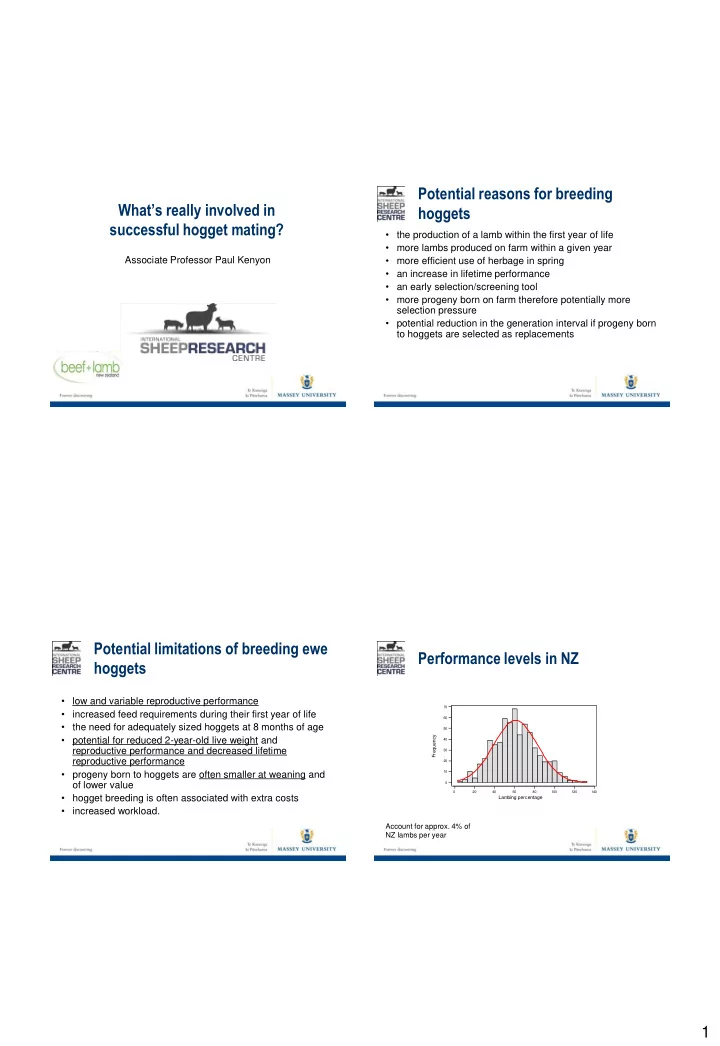
Performance levels in NZ
140 120 100 80 60 40 20 70 60 50 40 30 20 10
Lambing percentage Frequency
Account for approx. 4% of NZ lambs per year