Selecting hybrid pine clone/s for deployment the pointy end of - - PowerPoint PPT Presentation

selecting hybrid pine clone s for deployment the pointy
SMART_READER_LITE
LIVE PREVIEW

Selecting hybrid pine clone/s for deployment the pointy end of - - PowerPoint PPT Presentation

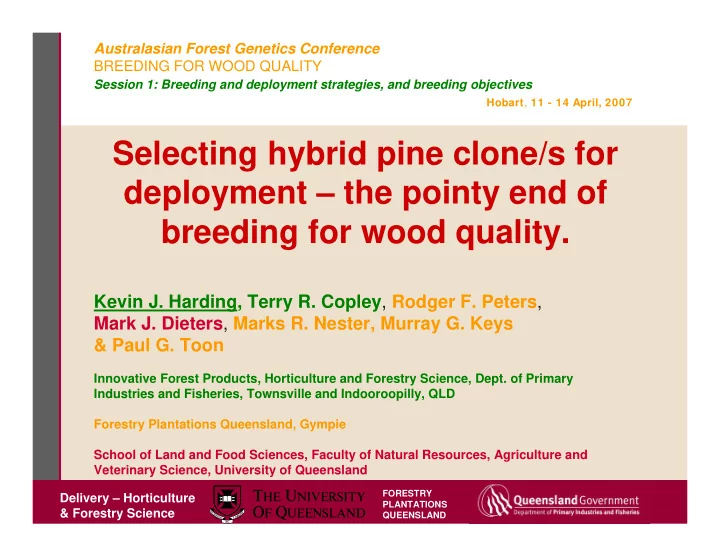
Australasian Forest Genetics Conference BREEDING FOR WOOD QUALITY Session 1: Breeding and deployment strategies, and breeding objectives Hobart , 11 - 14 April, 2007 Selecting hybrid pine clone/s for deployment the pointy end of breeding


slide-1
SLIDE 1

Delivery – Horticulture & Forestry Science

FORESTRY PLANTATIONS QUEENSLAND

Australasian Forest Genetics Conference BREEDING FOR WOOD QUALITY

Session 1: Breeding and deployment strategies, and breeding objectives

Hobart, 11 - 14 April, 2007

Selecting hybrid pine clone/s for deployment – the pointy end of breeding for wood quality.

Kevin J. Harding, Terry R. Copley, Rodger F. Peters, Mark J. Dieters, Marks R. Nester, Murray G. Keys & Paul G. Toon

Innovative Forest Products, Horticulture and Forestry Science, Dept. of Primary Industries and Fisheries, Townsville and Indooroopilly, QLD Forestry Plantations Queensland, Gympie School of Land and Food Sciences, Faculty of Natural Resources, Agriculture and Veterinary Science, University of Queensland

slide-2
SLIDE 2

Delivery – Horticulture & Forestry Science

FORESTRY PLANTATIONS QUEENSLAND

Why Clonal Forestry? Look what we started

with and where we’re heading …..

Natural grade (unimproved) Caribbean pine batch K60 (8.5 y.o) Vs Series I operational clone (4.5 y.o.)

slide-3
SLIDE 3

Delivery – Horticulture & Forestry Science

FORESTRY PLANTATIONS QUEENSLAND

Clonal Forestry & Clonal Foresters – a good match for improved quality

slide-4
SLIDE 4

Delivery – Horticulture & Forestry Science

FORESTRY PLANTATIONS QUEENSLAND

Series of Clonal Tests

Approx 5 years from field planting between test series Each series planted over 3-4 years and multiple sites Increasing genetic diversity

Clonal Test Series Planted Clones Test Sites I 1986 250 2 II 1994-97 480 20 III 1999-2001 1200 14 IV 2003 - 1950 10 V 2008 ? approx.2000

slide-5
SLIDE 5

Delivery – Horticulture & Forestry Science

FORESTRY PLANTATIONS QUEENSLAND

Q1 Q2 Q3 Q4 Q1 Q2 Q3 Q4 Q1 Q2 Q3 Q4 Q1 Q2 Q3 Q4 Q1 Q2 Q3 Q4 Q1 Q2 Q3 Q4 Q1 Q2 Q3 Q4 Q1 Q2 Q3 Q4 Q1 Q2 Q3 Q4 Q1 Q2 Q3 Q4 Q1 Q2 Q3 Q4 M MA N C M S 1 2 3 4 5 6 7 S P 1 2 P S S S S P P P P S S S S P P P P TC 2010 2011 2012 P 2006 2007 2008 2009 2002 2003 2004 2005

Ortet and ramet ortets micro-hedges Best 50 Series IV clones to be included in Series V tests as controls.

Cool Storage

Transfer all clones into tissue culture 6 ramets/clone Sow CP seed in heated glasshouse

Field Tests

1950 Clones, 9 sites STP design, 3 replications. 1730 Clones, 1site 5 tree line plots, 1 replicate.

Stage 1 Series V Production Hedges

Refine Selection of elite clones for deployment (10-15 clones)

S = Set cuttings P = Plant cuttings TC = Tissue culture A = Assess straightness, branching, wood properties in bark-windows, etc. C = Core samples (density & microfibral angle) N =Non destructive sampling (acoustics) M = Measure diameter and height

M.J. Dieters & R. Peters 16-August-2004

Planting Stock

(10 - 15 Clones)

Archive Hedges (4 hedges/clone) Select top 20 Clones Q4 2008

Multiply using tissue culture or microcuttings Maintain clones in cool storage during field testing Maintain clones in hedged archives during field testing Restore production hedges from tissue culture as required Note: Production hedges established from tissue culture or hedged archives

Series IV Clonal Tests

slide-6
SLIDE 6

Delivery – Horticulture & Forestry Science

FORESTRY PLANTATIONS QUEENSLAND

Weighed up – Growth & propagation traits Vs Wood property traits Growth & propagation traits

  • Height &Volume % advantage (BLUPs)
  • Straightness score
  • % of Double Leaders & Ramicorns
  • Branch Angle and Branch Diameter
  • Cutting strike rates – early, mid and late season rates

Series III Clones – Final Selections

slide-7
SLIDE 7

Delivery – Horticulture & Forestry Science

FORESTRY PLANTATIONS QUEENSLAND

Series III Clones – Final Selections Wood property traits:

  • Average extracted basic density (EBD)
  • std Dev’n of EBD (within clone uniformity)
  • Average, maximum and trend for grain angle

spirality

  • Estimated Stiffness

(acoustic /stress wave velocity tests): Ensis PaddlePop samples Fibregen ST300 Silviscan evaluation (ADD & MfA)

slide-8
SLIDE 8

Delivery – Horticulture & Forestry Science

FORESTRY PLANTATIONS QUEENSLAND

Standing tree NDE screening

Yes (with density from 12mm core) Yes Director ST 300 (FPQ) Yes Yes Yes 12mm Cores (Ensis Silviscan) Yes Yes Yes Wood strip (Ensis) – “PaddlePop stick” Yes (with ST 300) Yes Yes 12mm Cores (H&FS) Predict MOE Acoustic Velocity MfA Spiral Grain Density Standing Tree Sampling Method1

1 H & FS = Horticulture and Forestry Science, Queensland Department of Primary Industries and Fisheries;

FPQ = Forestry Plantations Queensland.

slide-9
SLIDE 9

Delivery – Horticulture & Forestry Science

FORESTRY PLANTATIONS QUEENSLAND

Series III Clones – Deployment Selections

Low Medium High Very high Vigour Strike rate Stem straightness Small branches Flat angled branches Low double leaders Low Ramicorn branches Low Spiral Grain angles SG Trend High EBD Std Dev'n EBD Estimated Stiffness Screening Importance TRAIT

slide-10
SLIDE 10

Delivery – Horticulture & Forestry Science

FORESTRY PLANTATIONS QUEENSLAND

NDE Sampling .... ST300 and 12mm Increment core

slide-11
SLIDE 11

Delivery – Horticulture & Forestry Science

FORESTRY PLANTATIONS QUEENSLAND

3m Butt Logs

slide-12
SLIDE 12

Delivery – Horticulture & Forestry Science

FORESTRY PLANTATIONS QUEENSLAND

Assessing taper & sawing

slide-13
SLIDE 13

Delivery – Horticulture & Forestry Science

FORESTRY PLANTATIONS QUEENSLAND

Adjacent PaddlePot stick and increment core wounds

slide-14
SLIDE 14

Delivery – Horticulture & Forestry Science

FORESTRY PLANTATIONS QUEENSLAND

Top 12 Vs Next 20

Clone Code Average of MOE (Gpa) Average of MOR (Mpa) Sample size (No. of sticks) Sample size (No. of ramets) 1 5.65 34.84 16 3 2 9.97 45.91 16 6 3 7.85 39.82 26 6 4 6.93 33.97 14 3 5 7.42 46.40 11 3 6 8.71 45.89 17 5 7 7.76 44.32 26 6 8 9.59 45.77 25 6 9 7.63 50.99 9 3 10 6.60 42.61 30 6 11 8.96 47.00 18 6 12 6.90 42.69 15 3

Mean (Top 12 clones)

7.83 43.35 Total: 223 56 13 7.23 38.30 16 3 14 5.93 38.82 19 3 15 6.69 42.05 13 3 16 7.50 39.84 12 3 17 6.52 39.58 14 3 18 7.70 43.88 27 6 19 8.14 45.81 6 3 20 8.04 49.54 8 3 21 6.83 43.64 21 6 22 7.52 46.77 11 3 23 6.88 39.45 16 6 24 6.74 41.52 12 3 25 8.83 46.95 23 6 26 5.37 40.96 11 3 27 5.16 35.47 28 6 28 6.43 44.31 24 5 29 6.91 40.93 16 3 30 6.29 44.44 17 3 31 5.97 39.99 15 3 32 5.32 35.20 26 6

Mean (Clones 13 to 32)

6.69 41.37 Total: 335 80

Average

  • f MOE

(GPa) Average

  • f MOR

(MPa) Sample size (No. of sticks) Sample size (No.

  • f

ramets) Mean (Top 12 clones) 7.83 43.35 Total: 223 56 Mean (Clones 13 to 32) 6.69 41.37 Total: 335 80

MOE 17% MOR 4.8% higher in Top 12 Some very vigorous &/or good wood clones included to compare sawn performance

slide-15
SLIDE 15

Delivery – Horticulture & Forestry Science

FORESTRY PLANTATIONS QUEENSLAND

ST 300 mean velocity Vs Board MOE

Average MOE for all 70x35mm boards cut from 3m long butt logs Vs ST300 mean velocity

y = 3.6413x - 3.8011 R

2 = 0.7692

0.0 2.0 4.0 6.0 8.0 10.0 12.0 2.000 2.500 3.000 3.500 4.000 ST300 mean velocity Average MOE of all 70x35mm recovery

slide-16
SLIDE 16

Delivery – Horticulture & Forestry Science

FORESTRY PLANTATIONS QUEENSLAND

PaddlePop & Silviscan predicted MOE Vs average board MOE

Average MOE for all 70x35mm recovery VS Paddle pop Average Predicted MOE (GPa)

y = 1.1835x - 0.6708 R2 = 0.7995 0.0 2.0 4.0 6.0 8.0 10.0 12.0 14.0 0.0 2.0 4.0 6.0 8.0 10.0 12.0 Paddle pop Predicted MOE Average MOE of 70x35mm recovery

Average MOE of 70x35mm recovery Vs Silviscan Average Predicted MOE

y = 1.0152x + 0.3427 R

2 = 0.7968

0.0 2.0 4.0 6.0 8.0 10.0 12.0 0.0 2.0 4.0 6.0 8.0 10.0 12.0 Silviscan predicted MOE Average MOE of 70x35mm recovery

slide-17
SLIDE 17

Delivery – Horticulture & Forestry Science

FORESTRY PLANTATIONS QUEENSLAND

Correlations – twist & spiral grain

0.52 ** 0.56 **

  • 0.39 *

0.50 ** Average MOR Small Clears 0.83 ** 0.89 **

  • 0.86 **

0.90 ** Average MOE Small Clears 0.43 * Average MOR OUTER Boards

  • 0.38 *

0.86 ** 0.84 **

  • 0.75 **

0.84 ** Average MOE OUTER Boards 0.56 ** 0.44 *

  • 0.37 *

0.43 * Average MOR All Boards

  • 0.42 *

0.89 ** 0.89 **

  • 0.81 **

0.88 ** Average MOE All Boards

  • 0.45 *
  • 0.58 **

0.64 **

  • 0.51 **

Average Bow Average Spring 0.7 ** Average Twist Average Spiral Grain (Absolute values) PaddlePop Average MOE Silviscan Average Predicted MOE Silviscan Average MfA ST300 Mean velocity

slide-18
SLIDE 18

Delivery – Horticulture & Forestry Science

FORESTRY PLANTATIONS QUEENSLAND

Density – Low and NS Correl’ns

0.19 NS 0.08 NS 0.22 NS 0.28 NS 0.56 ** Average MOR SmallClears

  • 0.14 NS

0.21 NS

  • 0.09 NS
  • 0.13 NS

0.89 ** Average MOE SmallClears 0.12 NS 0.38 * 0.03 NS 0.03 NS 0.31 NS Average MOR OUTERBoards 0.16 NS 0.16 NS 0.1 NS 0.1 NS 0.84 ** Average MOE OUTERBoards 0.24 NS 0.28 NS 0.14 NS 0.11 NS 0.44 * Average MOR AllBoards 0.11 NS 0.14 NS 0.1 NS 0.07 NS 0.89 ** Average MOE AllBoards

  • 0.02 NS

0.79 ** 0.86 **

  • 0.03 NS

PaddlePop Mean ADD

  • 0.1 NS
  • 0.04 NS

0.21 NS StdDev AdjEBD 12mmCore 0.93 **

  • 0.01 NS

Mean AdjEBD 12mmCore Silviscan Mean Density PaddlePop Mean ADD StdDev AdjEBD 12mm Core Average AdjEBD 12mm Core Silviscan Mean Density Silviscan Mean Predicted MOE

slide-19
SLIDE 19

Delivery – Horticulture & Forestry Science

FORESTRY PLANTATIONS QUEENSLAND

The future

  • Sonic tools should make it cost effective to

assess progenies of elite parents establish real breeding values for predicted stiffness

  • Strategically plan crossing programs for future

series of clonal tests and synthetic hybrid breeding to actively breed for juvenile wood quality

Produce a pool of elite, superior, first class,

top-shelf clones very profitable primary production for Queensland (…. and other deployment possibilities?)

slide-20
SLIDE 20

Delivery – Horticulture & Forestry Science

FORESTRY PLANTATIONS QUEENSLAND

Acknowledgements

  • Forestry Plantations Queensland funded the wood

quality assessments and clonal tests. Their ongoing support for this R&D programme is gratefully acknowledged.

  • The work presented represents the collective efforts of a

very large team from the Propagation, Genetics and

Wood Quality Improvement

groups within the Queensland Forestry Research Institute (now part of DPI&F Horticulture and Forestry Science) supported by staff of DPI Forestry (now Forestry Plantations QLD in regional centres.

  • Dr Mark Dieters (ex-DPI&F) now contributes to this

program as part of his research role at the University of Queensland.

slide-21
SLIDE 21

Delivery – Horticulture & Forestry Science

FORESTRY PLANTATIONS QUEENSLAND

The Search for Quality Continues .... Life is great in the Tropics!

slide-22
SLIDE 22

Delivery – Horticulture & Forestry Science

FORESTRY PLANTATIONS QUEENSLAND

Thanks for your interest!