Policy Scenario 1 Measures Philosophy: Continuation or Extension of - - PowerPoint PPT Presentation

policy scenario 1 measures
SMART_READER_LITE
LIVE PREVIEW

Policy Scenario 1 Measures Philosophy: Continuation or Extension of - - PowerPoint PPT Presentation

Policy Scenario 1 Measures Philosophy: Continuation or Extension of current programs Includes: Continued effort for energy efficiency in buildings Additional ZEV sales for light-duty transit Reduction in vehicle-miles traveled and


slide-1
SLIDE 1

3

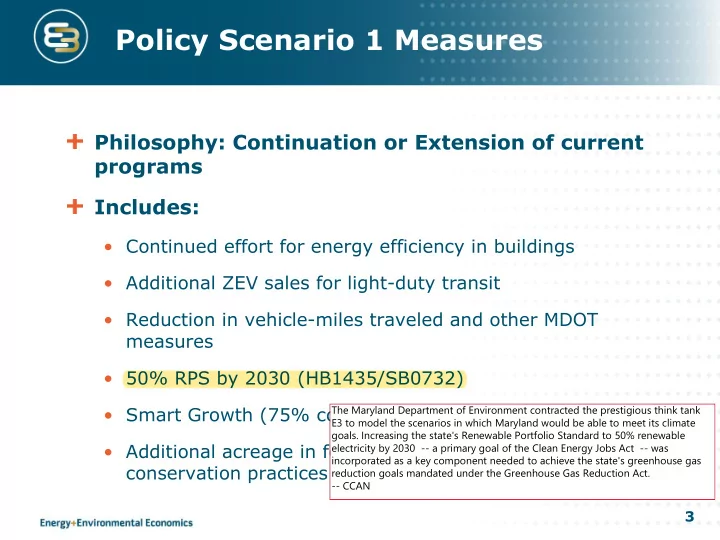
Policy Scenario 1 Measures

Philosophy: Continuation or Extension of current programs Includes:

  • Continued effort for energy efficiency in buildings
  • Additional ZEV sales for light-duty transit
  • Reduction in vehicle-miles traveled and other MDOT

measures

  • 50% RPS by 2030 (HB1435/SB0732)
  • Smart Growth (75% compact development goal)
  • Additional acreage in forest management and healthy soils

conservation practices

The Maryland Department of Environment contracted the prestigious think tank E3 to model the scenarios in which Maryland would be able to meet its climate

  • goals. Increasing the state's Renewable Portfolio Standard to 50% renewable

electricity by 2030 -- a primary goal of the Clean Energy Jobs Act -- was incorporated as a key component needed to achieve the state's greenhouse gas reduction goals mandated under the Greenhouse Gas Reduction Act.

  • - CCAN
slide-2
SLIDE 2

5

Policy Scenario 1 Measures

Increased Renewable Generation

50% RPS by 2030 (HB1435/SB0732) 25% RPS in 2020, 50% RPS in 2030, with solar (14.5%) and offshore wind (10%) carveouts Achieves solar (14.5%) and offshore wind (10%) carveouts, decreases proportion of RPS met by out-of- state RECs relative to 25% RPS

Electricity Generation by Resource

Imports Natural Gas Coal Nuclear Solar Offshore Wind

RPS Requirements

Tier 1 RECs In-State Offshore Wind In-State Solar The graph at the bottom of this page titled "RPS Requirements" shows how renewable energy would grow to 50% of the Maryland grid by the year 2030. This would include a dramatic increase in in-state solar and in-state

  • ffshore wind. -- CCAN

The graph at the top of this page titled "Electricity Generation by Resource" shows imported renewable energy -- in red -- would continue but at a lower rate than the dramatically growing in-state solar and offshore wind. -- CCAN

slide-3
SLIDE 3

6

Policy Scenario 1 total GHG emissions

Gap in 2020: 0.7 MMT (1% above goal) Gap in 2030: 2.4 MMT (5% above goal) Gap in 2050: 47.8 MMT

This graph shows past, current, and projected greenhouse gas emissions in Maryland between 2006 and 2050. The dark blue line represents the effects of policies -- including the Clean Energy Jobs Act -- under Policy Scenario 1 as modeled by E3. As you can see, by 2030, the state hits its 40% reduction goal. -- CCAN