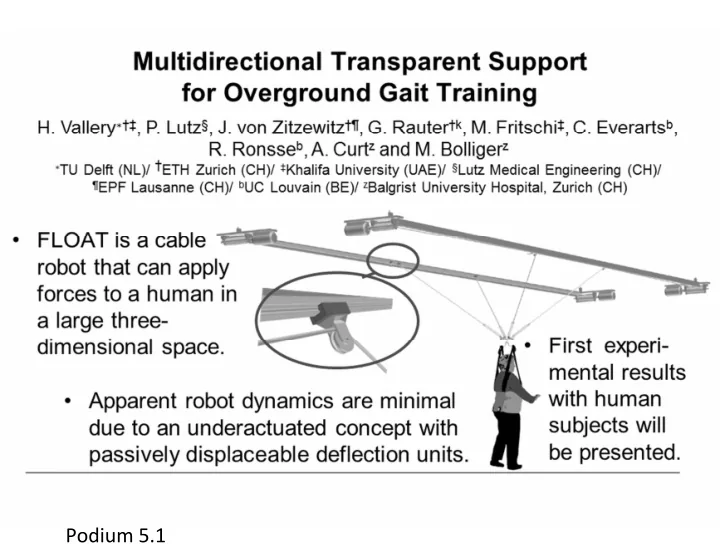
Podium 5.1 Improving Transparency of Powered Exoskeletons Using - - PowerPoint PPT Presentation

podium 5 1
SMART_READER_LITE
LIVE PREVIEW

Podium 5.1 Improving Transparency of Powered Exoskeletons Using - - PowerPoint PPT Presentation

Podium 5.1 Improving Transparency of Powered Exoskeletons Using Force/Torque Sensors on the Supporting Cuffs D. Zanotto: University of Delaware, Newark, DE, USA T. Lenzi: Rehabilitation Institute of Chicago, Chicago, IL, USA P. Stegall and S.


slide-1
SLIDE 1

Podium 5.1

slide-2
SLIDE 2

Improving Transparency of Powered Exoskeletons Using Force/Torque Sensors on the Supporting Cuffs

  • An "interaction-sensing-based" controller can

improve transparency compared to the traditional force-feedback controller which exploits collocated torque sensors.

  • Experimental results showed that:

– the traditional controller lets the wearer carry the inertial loads generated by the robot links; – the interaction-sensing-based controller substantially reduced the interaction torques, thereby inducing smaller changes in the user’s natural gait in terms gait kinematics, gait timing and muscle activations.

  • D. Zanotto: University of Delaware, Newark, DE, USA
  • T. Lenzi: Rehabilitation Institute of Chicago, Chicago, IL, USA
  • P. Stegall and S. K. Agrawal: Columbia University, NY, USA.

Podium 5.2

slide-3
SLIDE 3

Podium 5.3

slide-4
SLIDE 4

Biologically-inspired Soft Exosuit

  • A novel “exosuit” made of fabrics has

been developed that applies forces to the body during walking

  • Unlike traditional exoskeletons, the

exosuit contains no rigid framing elements, yet can apply moments at the ankle and hip with magnitudes of >20%

  • f those naturally generated in walking
  • Measurements were taken of the suit’s

stiffness and behavior during walking

A Asbeck, R Dyer, A Larusson, C Walsh: Harvard University, USA

Podium 5.4