From This does not mean that I hold my opinions to be all true. - - PowerPoint PPT Presentation

from
SMART_READER_LITE
LIVE PREVIEW

From This does not mean that I hold my opinions to be all true. - - PowerPoint PPT Presentation

From This does not mean that I hold my opinions to be all true. Conductor to I do not. Nor do I consider them to be permanent. I am Mentor: both submissive to facts and amenable to argument. And I consider my personal biases to be facts,


slide-1
SLIDE 1

From Conductor to Mentor:

Lessons from the podium on more effective teaching strategies

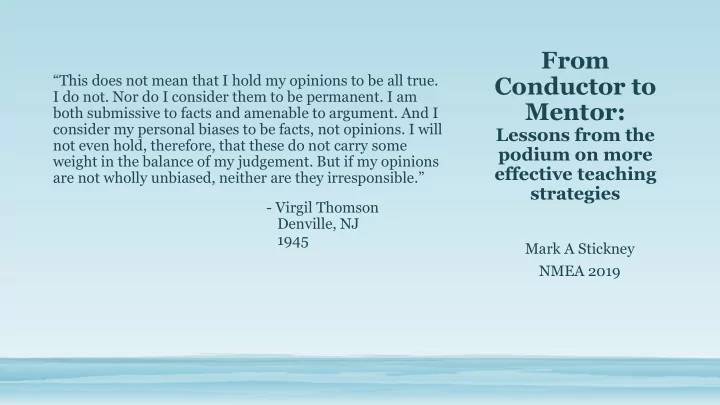
“This does not mean that I hold my opinions to be all true. I do not. Nor do I consider them to be permanent. I am both submissive to facts and amenable to argument. And I consider my personal biases to be facts, not opinions. I will not even hold, therefore, that these do not carry some weight in the balance of my judgement. But if my opinions are not wholly unbiased, neither are they irresponsible.”

  • Virgil Thomson

Denville, NJ 1945 Mark A Stickney NMEA 2019

slide-2
SLIDE 2

I might quote you to death…

Music education is the art of the journey and will never be complete. If you feel the journey is complete, you and your students will miss

  • ut on a wonderful education and adventure!
  • Me? Someone? I can’t remember…
slide-3
SLIDE 3

“Music education is the art of the journey and will never be complete. If you feel the journey is complete, you and your students will miss

  • ut on a wonderful education and adventure!” – Some Person

Before I began to practice, mountains were mountains and rivers were rivers. During many years of practice, mountains stopped being mountains and rivers stopped being rivers. Now as I understand things, mountains are mountains and rivers are rivers.

  • Zen Monk (from When Things Fall Apart, Pema Chödron)
slide-4
SLIDE 4

So what is our primary job?

LEARN!

slide-5
SLIDE 5

Create a Successful Environment

slide-6
SLIDE 6

Three Parts of Every Rehearsal

Beginning of Rehearsal (Arrival)

  • How Do Students

Arrive?

  • Seating?
  • Warm-up?
  • Tuning?
  • Announcements?

Rehearsal

  • Overall Goals?
  • Goal for each piece?
  • Sight-reading?
  • Singing?
  • Mix it up!

End of Rehearsal (Leave happy?)

  • How do students feel

when the leave?

  • How do you feel when it

is over?

slide-7
SLIDE 7

Right now we are creating our state of mind for tomorrow!

  • Pema Chödron
slide-8
SLIDE 8

Pay attention to how we are teaching!

slide-9
SLIDE 9

Why…?

  • Is my ensemble never starting together?
  • Does my ensemble never start strong?
  • Don’t they play what my gesture is telling them to play?
  • Will my ensemble not make decisions?
  • Is there no motion to the music?
slide-10
SLIDE 10

Motion and teaching music.

slide-11
SLIDE 11

TIME Past

Present

Future

Past

Present

Future

slide-12
SLIDE 12

Are you telling your ensemble how to play notes, or are you teaching your ensemble how to perform music?

slide-13
SLIDE 13

What do you see on the page? What do they see on the page? Is it the same thing for everyone? How do we come together – Interdependence

slide-14
SLIDE 14

What is more important than a note?

slide-15
SLIDE 15

What is the happening in this excerpt? What is the most “important” thing in each measure? Where is each note going? How do we teach what is in front of us?

slide-16
SLIDE 16

The bar line is the most disruptive force to the flow of music.

slide-17
SLIDE 17

Once in Royal David’s City, Anthony O’Toole Grade 4 Bandworks Publications 2017

slide-18
SLIDE 18

Sennet, Patrick Burns Grade 4+ Bandworks Publications, 2018

slide-19
SLIDE 19

Sennet, Patrick Burns Grade 4+ Bandworks Publications, 2018

slide-20
SLIDE 20

Simple Song, Patrick Burns Grade 3 Bandworks Publications, 2017

slide-21
SLIDE 21

My band has it all figured out!

slide-22
SLIDE 22

Check for understanding and retention

  • ften.

AND ADJUST!

slide-23
SLIDE 23

Expect, but don’t accept!