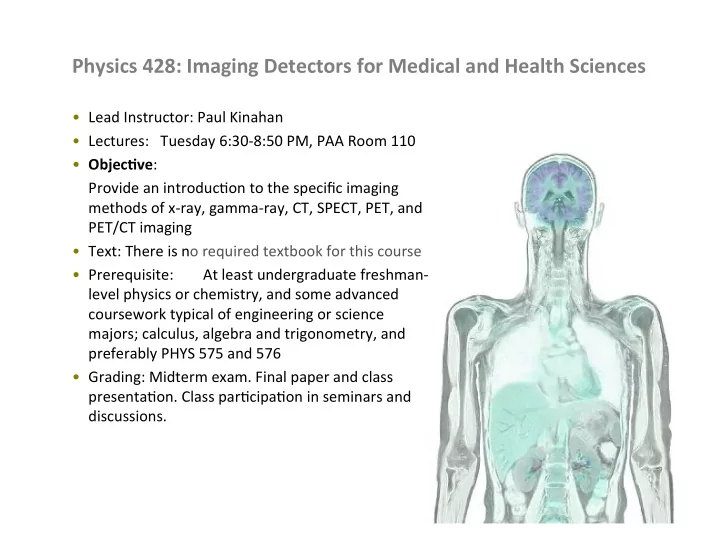
Physics 428: Imaging Detectors for Medical and Health - - PowerPoint PPT Presentation

physics 428 imaging detectors for medical and health
SMART_READER_LITE
LIVE PREVIEW

Physics 428: Imaging Detectors for Medical and Health - - PowerPoint PPT Presentation

Physics 428: Imaging Detectors for Medical and Health Sciences Lead Instructor: Paul Kinahan Lectures: Tuesday 6:30-8:50 PM, PAA Room 110 Objec?ve :


slide-1
SLIDE 1

Physics ¡428: ¡Imaging ¡Detectors ¡for ¡Medical ¡and ¡Health ¡Sciences

  • Lead ¡Instructor: ¡Paul ¡Kinahan
  • Lectures: ¡ ¡ ¡Tuesday ¡6:30-­‑8:50 ¡PM, ¡PAA ¡Room ¡110
  • Objec?ve:

Provide ¡an ¡introducDon ¡to ¡the ¡specific ¡imaging methods ¡of ¡x-­‑ray, ¡gamma-­‑ray, ¡CT, ¡SPECT, ¡PET, ¡and PET/CT ¡imaging

  • Text: ¡There ¡is ¡no ¡required ¡textbook ¡for ¡this ¡course
  • Prerequisite:

At ¡least ¡undergraduate ¡freshman-­‑ level ¡physics ¡or ¡chemistry, ¡and ¡some ¡advanced coursework ¡typical ¡of ¡engineering ¡or ¡science majors; ¡calculus, ¡algebra ¡and ¡trigonometry, ¡and preferably ¡PHYS ¡575 ¡and ¡576

  • Grading: ¡Midterm ¡exam. ¡Final ¡paper ¡and ¡class
  • presentaDon. ¡Class ¡parDcipaDon ¡in ¡seminars ¡and

discussions.

slide-2
SLIDE 2

Lecture ¡Sequence

* ¡dra[ ¡schedule Lecture Date Instructor Topic 1 April 2 PK

!"#$"%#&'()*+,%-,(#./+0%1-2(%-"#$3#(4$156#*2(789:;)(%*+,%-,(3<30#*3

2 April 9 PK

=9$+<(4><3%?3'(@1$*+0%1-(+-A(%-0#$+?0%1-

3 April 16 WH

=9$+<(A#0#?0%1-(+-A(%*+,%-,(3<30#*3

4 April 23 PK

=9$+<(?1*4/0#A(01*1,$+4><(BCDE(3<30#*3

5 April 30 AA

C1*4/0#A(01*1,$+4><'(F%1*#A%?+6(+446%?+0%1-3

6 May 7 PK

G%A0#$*(HI+*J(C1-0$+302(-1%3#2(+-A(%*+,#(./+6%0<

7 May 14 LM

K/?6#+$(A#?+<(3?>#*#3(+-A(%31014#3

8 May 21 RM

L+**+(?+*#$+3'(?1*41-#-03(+-A(3<30#*3

9 May 28 WH

D1*1,$+4><(%-(*16#?/6+$(%*+,%-,'(;MHCD(3?+--#$3

10 June 4 SB

M13%0$1-(#*%33%1-(01*1,$+4><(BMHDE(+-A(><5$%A(MHDNCD(3?+--#$3

11 June 11 WH/PK

L$1/4(4$1O#?0(4$#3#-0+0%1-3

PK ¡= ¡Paul ¡Kinahan WH ¡= ¡William ¡Hunter AA ¡= ¡Adam ¡Alessio LM ¡= ¡Larry ¡MacDonald RM ¡= ¡Robert ¡Miyaoka SB ¡= ¡Steve ¡Bowen

slide-3
SLIDE 3

Course ¡notes

  • Course ¡site: ¡h`p://courses.washington.edu/phys428/
  • Online ¡lecture ¡site: ¡h`p://uweoconnect.extn.washington.edu/phys428/
  • UW ¡Outreach ¡site ¡(for ¡lecture ¡recordings ¡etc):

h`p://moodle.extn.washington.edu/course/view.php?id=4008

  • Class ¡email: ¡TBD
  • All ¡students ¡must ¡take ¡the ¡midterm ¡exam ¡during ¡the ¡scheduled ¡Dme
  • No ¡course ¡incompletes ¡will ¡be ¡given, ¡except ¡per ¡UW ¡regulaDons
slide-4
SLIDE 4

Images

slide-5
SLIDE 5

Types of Images: 2D Images

René Magritte The Treachery of Images 1928

slide-6
SLIDE 6

Types of Images: Projection Imaging

slide-7
SLIDE 7

Types of Images: Tomography Imaging

basilar tip aneurysm tomographic acquisition reconstruction of multiple images form image volume image processing simple sophisticated transaxial or axial view coronal view sagittal view

slide-8
SLIDE 8

Two Types of Tomography

ʻTomoʼ + ʻgraphyʼ = Greek: ʻsliceʼ + ʻpictureʼ PET: Emission CT: Transmission source detector

slide-9
SLIDE 9

Major Modalities

  • X-ray Radiography and Computed Tomography (CT)
  • Nuclear Medicine (SPECT, PET)
  • Ultrasound
  • Magnetic Resonance Imaging
  • Optical Tomography

There are many other types of biomedical imaging Of interest are hybrid imaging methods – PET/CT, PET/MR – Photoacoustic

slide-10
SLIDE 10

Projection X-ray Imaging

  • Image records transmission of x-rays through object
  • The integral is a line-integral or a “projection” through obj
  • µ(x,y,z) – x-ray attenuation coefficient, a tissue property, a function
  • f electron density, atomic #, …

X-ray Source Object X-ray Detector µ(x,y,z) Ιd(x,y)

Id(x,y) = I0 exp(! µ(x,y,z)dl

"

)

slide-11
SLIDE 11

radiofrequency micro- wave

TV FM AM

IR UV Visible region (not to scale) X-ray gamma

  • ray

cosmic

  • ray

The Electromagnetic Spectrum Transmission through 10 cm of tissue (i.e. water)

0% 100% longer wavelength higher energy low resolution region (long wavelength) high resolution region

Physics of photon imaging

what is Transmission through 1 cm of tissue?

slide-12
SLIDE 12

X-ray Imaging Projection vs Tomographic

Projection Image Cross-sectional Image Chest Mass

slide-13
SLIDE 13

X-ray Computed Tomography

  • Uses x-rays, but exposure is limited to a slice (or “a couple of”

slices) by a collimator

  • Source and detector rotate around object – projections from many

angles

  • The desired image, I(x,y) = µ(x,y,z0), is computed from the

projections

X-ray Source Object X-ray Detector µ(x,y,z0) Collimator

slide-14
SLIDE 14

X-ray Computed Tomography

slide-15
SLIDE 15

PET/CT Scanner

All 3 (couch, CT and PET) must be in accurate alignment

slide-16
SLIDE 16

Commercial/Clinical PET/CT Scanner

PET detector blocks thermal barrier rotating CT system unit human

slide-17
SLIDE 17

Molecular imaging using PET/CT is a powerful tool for detection, diagnosis, and staging of cancer

PET Image of Function Function+Anatomy CT Image of Anatomy

slide-18
SLIDE 18

Ultrasound Imaging

High-Resolution Color Doppler

slide-19
SLIDE 19

cardiac cancer stroke neuro function joint lung

MRI

slide-20
SLIDE 20

Medical Imaging

  • Visualization of internal organs, tissue, organ function,

bio-physiological status, etc.

– Pathologies and diseases often have different imaging characteristics from normal states, either static (e.g. anatomy) or dynamic (functional) – Often pathologies are undetectable in one one approach and visible in another

  • Image: a 2D signal f(x,y) or 3D signal f(x,y,z)
  • Imaging provides localized information, unlike global or

systemic diagnostics

– i.e. where is the disease? – imaging can be more sensitive by providing a localized measurement

slide-21
SLIDE 21

Common themes in biomedical imaging

  • Where does the signal come from?

– This is modality specific – determines the quantity displayed in images

  • Contrast agents
  • The imaging equation: What is the mathematical description of the

acquisition of the raw data?

  • The inverse problem: How do we form an image from the raw data?
  • Signal to noise ratio
  • Safety
  • Cost versus usefulness
  • Clinical versus research applications
  • Diagnosis versus therapy
slide-22
SLIDE 22

Lung ¡images ¡with ¡different ¡modali?es

MRI CT PET US

What do the image values represent?

slide-23
SLIDE 23

Contrast / Contrast Agents / Tracers

  • To image inside the body we need something to provide a signal (i.e. a difference or

contrast) that we can measure

  • Contrast can be intrinsic or extrinsic

– Intrinsic: Already present, e.g. tissue density differences seen with x-ray imaging – Extrinsic: A contrast agent put into a patient (ingested, injected, etc.) to provide a signal. Acts as a signal amplification.

  • Targeted contrast agents use different mechanisms (e.g. antibodies) to attach to

specific objects or processes

  • Needed amount of contrast agent is a critical parameter

– Ideally, a contrast agent does not alter anything (i.e. a tracer) – Safety and toxicity are critical parameters

slide-24
SLIDE 24

Contrast / Contrast Agents / Tracers

microspheres, absorbing dyes, plasmon-resonant or magnetomotive nanoparticles Changes in scattering, absorption, polarization. Also time- or frequency-dependent modulation of amplitude, phase, or frequency Optical tomography chelated gadolinium and superparamagnetic iron oxide (SPIO) particles to alter magnetic relaxation times Radiofrequency (RF) signals generated by stimulated

  • scillating nuclear magnetic moments. RF signal

depends on density and magnetic relaxation time differences in local microenviroment MRI Micro-bubbles to enhance reflectance Vibrational wave reflectance due to tissues differences Ultrasound Iodine, barium to enhance photon absorption Photon absorption by Compton scattering (density) and photoelectric absorption x-ray, CT Radioisotope-labeled tracers (radiotracers) None Nuclear, SPECT, PET

Extrinsic (added) Intrinsic (already present) Modality

slide-25
SLIDE 25

Contrast Agent Example

slide-26
SLIDE 26

no contrast with contrast

slide-27
SLIDE 27
  • The attenuation of x-rays in the body depends
  • n material and energy
  • We can enhance attenuation by using 'contrast

agents', typically iodine (injected) or barium (ingested)

X-ray imaging system

slide-28
SLIDE 28

X-ray physics: Imaging equation

  • Attenuation µ of x-rays depends on material

(thus position of material) and energy

  • From x-ray tubes there is a weighted

distribution of energies S

  • X-ray imaging equation: Detector signal I at

position x

I(x) = ! E S0( ! E )e

" µ( ! x , ! E )d ! x

x

# d ! E

E=0 Emax

#

µ(E) S0(E)

x I(x) S0(E)

beam intensity along a line with µ = µ (x)

what we want to know what we measure

detector source (x-ray tube)

slide-29
SLIDE 29

Biomedical Imaging Systems

  • To estimate an image of property of interest, e.g. µ(x,y), from the

raw data, we have to solve the inverse problem

data acquisition raw data forward model described by imaging equation scanner patient display image inverse problem

slide-30
SLIDE 30

Imaging Systems + Contrast Agents

  • The use of a contrast agent can amplify the signal of interest, e.g. µ

for iodine is much higher than µ for tissue.

data acquisition raw data forward model described by imaging equation scanner patient display image inverse problem accumulation of contrast agent

slide-31
SLIDE 31

Imaging Diagnostics vs. Therapy

  • What is the relation between diagnostics and therapy?
  • What are the major disease classes?
  • How can imaging interact with therapy?
slide-32
SLIDE 32

What is the relation between diagnostics and therapy?

  • A diagnosis may (we hope) help select of guide therapy

when we don't have enough information

  • Therapy should be making a change, diagnosis should

not make a change

  • Diagnostic procedures can provide feedback on

therapeutic effectiveness

  • Some tools for diagnosis can be used for therapy and

vice versa (or can occur at the same time)

  • Cost / resources / time are more readily used for therapy

than diagnosis

slide-33
SLIDE 33

What are the classes of major bad things?

  • Cancer
  • Viral Infection
  • Trauma
  • Bacterial infection
  • Cardiovascular
  • Autoimmune
  • Neurological
  • Fungal infection
  • Genetic abnormalities
  • Acute radiation effects
  • Stochastic radiation effects
  • Metabolic/endocrine disorders
slide-34
SLIDE 34

How can imaging interact with therapy?

  • Monitor progression or response
  • Guide surgery
  • Real-time feedback of therapy
  • Screening: simple, low FP & FN, safe, fast/easy, cheap,

detection

  • Diagnosis: what is it? where is it?
  • Peace of mind
  • Staging: How serious is it, what therapy do we use, what

is the prognosis

slide-35
SLIDE 35

Classifications in Biomedical Imaging

Projection Transmission Anatomical With contrast agents Clinical Therapeutic Tomographic Emission Functional Without contrast agents Non-clinical (Clinical trials) Diagnostic

Cost