Z-axis geometric efficiency in CT Characterises the extent of the - - PDF document

z axis geometric efficiency in ct
SMART_READER_LITE
LIVE PREVIEW

Z-axis geometric efficiency in CT Characterises the extent of the - - PDF document

Comparison of Definitions of Geometric Efficiency in Computed Tomography Scanners Sue Edyvean, Nicholas Keat ImPACT* (Imaging Performance Assessment of CT Scanners) London UK *An MHRA Evaluation centre for the UK Department of Health


slide-1
SLIDE 1

WC 2003 August 2003

Sue Edyvean, Nicholas Keat ImPACT* (Imaging Performance Assessment of CT Scanners) London UK *An MHRA Evaluation centre for the UK Department of Health (Medicines and Healthcare products Regulatory Agency) www.impactscan.org

Comparison of Definitions of Geometric Efficiency in Computed Tomography Scanners

WC 2003 August 2003

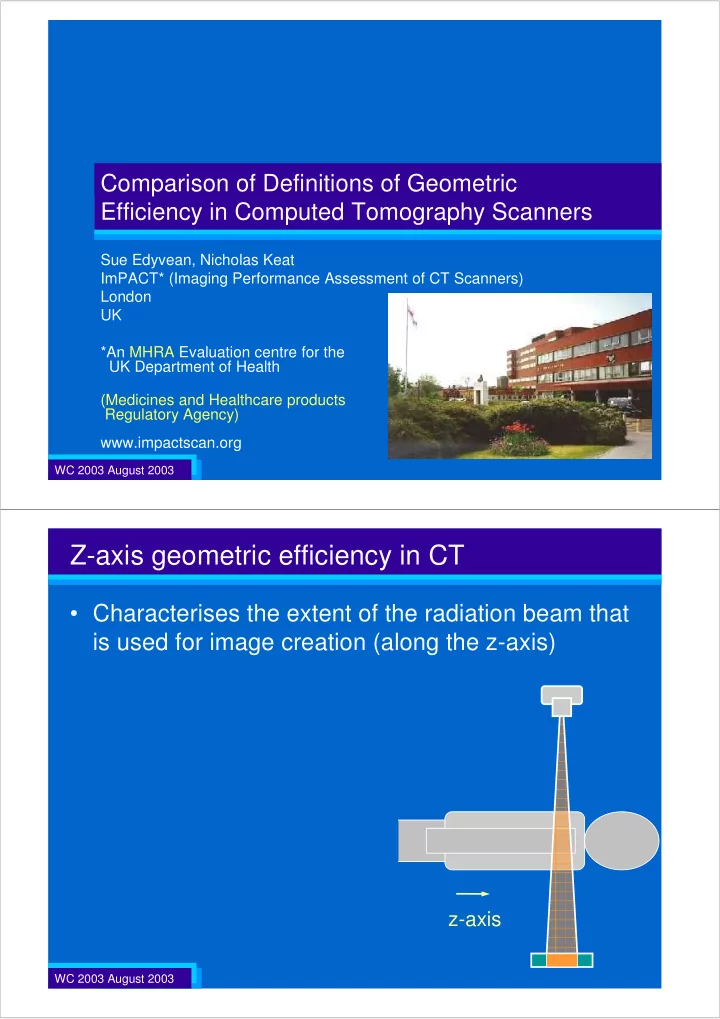
Z-axis geometric efficiency in CT

  • Characterises the extent of the radiation beam that

is used for image creation (along the z-axis)

z-axis

slide-2
SLIDE 2

WC 2003 August 2003

Geometric efficiency (g.eff.)

  • Single slice

– Usually little wasted dose, as all of beam is used for imaging, except for narrow slices where sometimes post-patient collimation is used

WC 2003 August 2003

Geometric efficiency (g.eff.)

  • Multi slice

– Usually more unused dose, as an even irradiation of slices is required – Penumbral region of the beam therefore can’t be used for imaging

slide-3
SLIDE 3

WC 2003 August 2003

  • IEC 60601- 2- 44 Ed. 1 1999: Original definition

– “the full width at half maximum of the sensitivity profile expressed as percentage of the full width at half maximum of the dose profile.”

  • IEC 60601- 2- 44 Ed. 2 Am.1 2003: New definition

– “the integral of the dose profile along the z-direction, integrated over the range subtended by the detector elements used during acquisition, expressed as a percentage of the total integral of the dose profile in the z-direction”

  • g.eff. to be displayed on scan console when less

than 70%

Definitions for z-axis geometric efficiency (g.eff.)

WC 2003 August 2003

  • Old definition:

– Ratio of the measured imaged width to the measured dose profile width (add imaged widths for multi-slice)

  • New definition:

– Integral of dose profile over range of nominal slice width divided by integral of whole dose profile

Definitions – paraphrased

measured imaged width dose profile width

integral of dose profile over range of nominal slice

nominal slice width z-axis

integral of whole dose profile add -> total imaged width total nominal acquisition width (nominal total collimation)

slide-4
SLIDE 4

WC 2003 August 2003

Purpose of this study

  • Identify problems associated with old g.eff.
  • Compare two calculation approaches for new g.eff.
  • Compare values between old and new

WC 2003 August 2003

Methods of measurement – dose profiles

  • Kodak X-Omat V Radiotherapy film
  • Scanned at iso-centre
  • Read out with scanning micro-densitometer
  • Optical density profile converted to dose profile

dose profile

1 2 3 4 5 6 7 8 5 10 15 20 25 30 35 40

distance along z-axis dose

fwhm

slide-5
SLIDE 5

WC 2003 August 2003

Methods of measurement – imaged slice width

  • Angled metal plates scanned in axial mode
  • Width projected into image → Z-sensitivity profile

WC 2003 August 2003

Problems with old g.eff.

  • Different measurement conditions (air vs phantom)
  • For multi slice scanners

– Many image width combinations for one beam width

  • Many measurements needed

– e.g. Philips Mx8000 four slice scanner 20 16 10 4 1 Beam width (mm) 2 x 10 4 x 5 20 2 x 8 16 1 x 10 2 x 5 4 x 2.5 10 1 x 4 2 x 2 4 x 1 4 1 x 1 2 x 0.5 1 Image width combinations

  • No. x slice (mm)

Beam width (mm)

slide-6
SLIDE 6

WC 2003 August 2003

Problems with old g.eff. (continued)

  • Different focal spots

– Potentially doubles the number of values

  • Sixteen slice scanners – narrow slices

– Need accurate measurement for imaged widths ~ < 1 mm – Not many existing test objects will do that

ImPACT’s ‘thin slice’ tool 50 µm Titanium plates 8° angle to scan plane

WC 2003 August 2003

Potential problems for calculation of new g.eff.

  • Dose profile

– ..‘integrated over the range subtended by detector elements used’ ( nominal total acquisition width) – Position of dose profile relative to detectors is not defined – Shape asymmetric assume a reference position

dose profile

1 2 3 4 5 6 7 8 5 10 15 20 25 30 35 40

distance along z-axis dose

slide-7
SLIDE 7

WC 2003 August 2003

Two approaches for new g.eff. calculation

  • Could either

– Centre integration range on centre of dose profile

  • Define as halfway between fwhm

– Position of range which gives maximum geometric efficiency

dose profile

1 2 3 4 5 6 7 8 5 10 15 20 25 30 35 40

distance along z-axis dose dose profile

1 2 3 4 5 6 7 8 5 10 15 20 25 30 35 40

distance along z-axis dose

A. B.

WC 2003 August 2003

Two approaches for new g.eff. calculation

dose profile

1 2 3 4 5 6 7 8 5 10 15 20 25 30 35 40

distance along z-axis dose dose profile

1 2 3 4 5 6 7 8 5 10 15 20 25 30 35 40

distance along z-axis dose

  • Comparison of two techniques

– Maximum difference = 0.04 % (ss), 0.6 % (ms) – Mean difference = 0.1% (ms)

  • 2. Maximum g.eff.

1: Centred on dose profile

A. B.

slide-8
SLIDE 8

WC 2003 August 2003

Results

  • Analysed data from 13 scanners (all manufacturers)

– 4 single slice – 5 four slice – 1 eight slice – 3 sixteen slice

  • Total of 123 different slice width combinations

– Old g.eff.

  • Compared new and old g.eff.

WC 2003 August 2003

Single slice - old g.eff. (imaged width / dose width)

– Most scanners have values of approximately 100% – Values higher than 100% probably due to scatter – Low for narrow slices using post patient collimation

20 40 60 80 100 120 1 2 3 4 5 6 7 8 9 10 Slice width (mm) Geometric Efficiency (%) Scanner A Scanner B Scanner C Scanner D

70%

slide-9
SLIDE 9

WC 2003 August 2003

Single slice - new g.eff. (dose in nominal width/whole

profile) – g.eff. values lower than 100% – Radiation falling outside the nominal width – Non rectangular dose profiles as widths gets thinner

20 40 60 80 100 1 2 3 4 5 6 7 8 9 10 Slice width (mm) Geometric Efficiency (%) Scanner A Scanner B Scanner C Scanner D

70%

WC 2003 August 2003

Slice width (mm) 1 slice 2 slice 3 slice 4 slice 6 slice 12 slice 0.6 71% 1 106% 0.75 77% 1.5 77% 88% 3 88% 76% 4.5 77% 87% 5 95% 6 87% 9 77% 88% 10 96%

Multi slice - old g.eff. (imaged width / dose width)

  • Unused penumbra – values less than 100%
  • Many values for each scanner

– e.g. Siemens Sensation 16 (small focus only)

Imaged width (mm)

slide-10
SLIDE 10

WC 2003 August 2003

Slice width (mm) 1 slice 2 slice 3 slice 4 slice 6 slice 12 slice 0.6 71% 1 106% 0.75 77% 1.5 77% 88% 3 88% 76% 4.5 77% 87% 5 95% 6 87% 9 77% 88% 10 96%

Multi slice - old g.eff. (continued)

  • Same beam width

– Different values

Imaged width (mm)

9 mm beam 18 mm beam

WC 2003 August 2003

Multi slice - new g.eff. (dose in nominal width/whole profile)

  • Values for each beam width only
  • Unused penumbra – values less than 100%

dose within nominal width equals total dose dose within nominal width less than total dose

Four slice scanners only

20 40 60 80 100 0 2 4 6 8 101214161820222426283032 Collimation (mm) Geometric Efficiency (%) Scanner A Scanner B Scanner C Scanner D

70%

slide-11
SLIDE 11

WC 2003 August 2003

20 40 60 80 100 120 20 40 60 80 100 120 Geometric efficiency (old) (%) Geometric Efficiency (new) (%)

Multi slice - new g.eff. versus old g.eff.

  • Mean ratio = 0.99, but standard deviation = 10%
  • Biggest differences at narrow collimations

– total measured imaged width matches dose width, but both greater than nominal

  • Some values

now below 70%

2 x 1 mm 2 x 0.63 mm 2 x 0.63 mm

70% old 70% new

WC 2003 August 2003

Conclusions

  • Old g.eff. definition

– Worked well enough for single slice systems – Drawback is many slice width combinations for multi slice

  • New g.eff. does not use imaged width; only the dose

profile and nominal width

– Two calculation techniques are comparable – Results for single slice are all generally lower

  • spread of dose outside of nominal width not always identified before

– Multi-slice new g.eff. values similar to old values

  • except for some thin slices where both imaged slice width and dose

width are > nominal Some values now below 70% threshold

slide-12
SLIDE 12

WC 2003 August 2003

Sue Edyvean, Nicholas Keat ImPACT* (Imaging Performance assessment of CT Scanners) London UK *An MHRA Evaluation centre for the UK Department of Health (Medicines and Healthcare products Regulatory Agency) www.impactscan.org

Comparison of Definitions of Geometric Efficiency in Computed Tomography Scanners