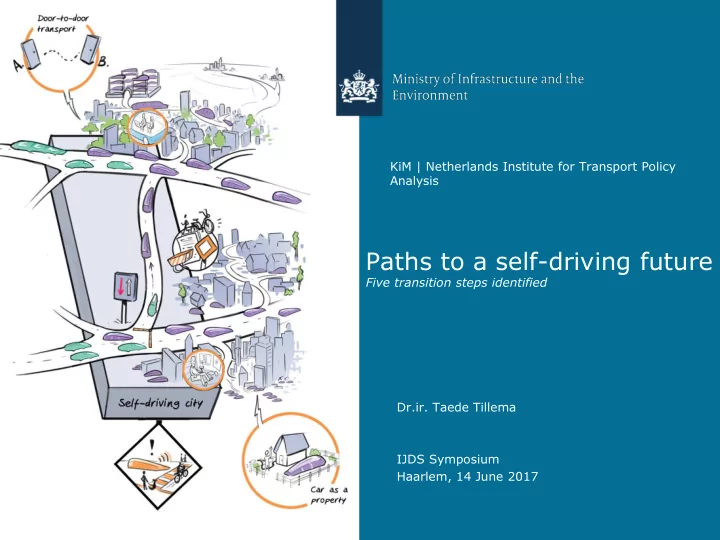
Paths to a self-driving future Five transition steps identified - - PowerPoint PPT Presentation
KiM | Netherlands Institute for Transport Policy Analysis Paths to a self-driving future Five transition steps identified Dr.ir. Taede Tillema IJDS Symposium Haarlem, 14 June 2017 Research programme 1.Driver at the wheel? Four scenarios
KiM | Netherlands Institute for Transport Policy Analysis
Research programme
1.Driver at the wheel? – Four scenarios for a future traffic and transport system with automated vehicles 2.Paths to a self-driving future – Transition paths towards the scenarios – Perspective on policy options
KiM | Netherlands Institute for Transport Policy Analysis
Definition: SAE-levels of automation
Level Name Example
Human driver monitors the driving environment No automation Lane Departure Warning 1 Driver assistance Adaptive Cruise Control 2 Partial automation Parking Assistance Automated driving system monitors the driving environment 3 Conditional automation Highway Chauffeur 4 High automation Parking Garage Pilot 5 Full automation Robot Taxi
KiM | Netherlands Institute for Transport Policy Analysis
Driver at the wheel? Uncertainties and scenarios
high low
automation
level 3,4 “Mobility as a service: any time, any place” “Fully automated private luxury” “Letting go on highways” “Multimodal & shared automation” level 5
sharing
KiM | Netherlands Institute for Transport Policy Analysis
Transition paths: the story line
KiM | Netherlands Institute for Transport Policy Analysis
the scenario worlds Two paths towards
KiM | Netherlands Institute for Transport Policy Analysis
Evolving cars, transition steps and a time line
KiM | Netherlands Institute for Transport Policy Analysis
Evolution of the private car
KiM | Netherlands Institute for Transport Policy Analysis
Sharing in bloom
KiM | Netherlands Institute for Transport Policy Analysis
Man and machine (l 1/2)
- Best of two worlds?
– human beings excel in complex unexpected circumstances – technology supports driver – higher traffic safety – improved traffic flow
- Or not?
– driver looses attention: accidents – trust in technology undermined
KiM | Netherlands Institute for Transport Policy Analysis
Cooperative driving (l 1/2)
- Holy grail?
– Efficient road use – Higher traffic safety – Less congestion – Less CO2
- Or bridge too far?
– Sensor and software reliability – Cyber security: hacks, privacy
KiM | Netherlands Institute for Transport Policy Analysis
Mixed traffic (l 3/4)
- Solves itself?
– consumers appreciate safer traffic and efficient road use – investments in transition zones between highway and city
- Or showstopper?
– consumer prefers to be in control – dangerous interaction
KiM | Netherlands Institute for Transport Policy Analysis
Urban dilemma (l 3/4)
- Separate modes?
– l5 technology far away – Adjust city infrastructure – l 3/4 lanes
- Or driver in control?
– l5 technology nearby – Separate modes too costly
KiM | Netherlands Institute for Transport Policy Analysis
Self driving city (l 5)
- Contested space?
– bikers and pedestrians take the road – car traffic comes to a standstill
- Or flexible interaction?
– physical separation – technology – ‘pushy’ automated vehicle – culture
KiM | Netherlands Institute for Transport Policy Analysis
Main conclusions
- On the long run automated vehicles yield many positive effects for society
- Highways and cities filled with fully automated vehicles are still rather far away
– Yet, first steps are already being taken
- Transition is crucial and determines how the future will look like
– Implications for society differ considerably in the two transition paths
- Transition consists of five major steps:
– man and machine, cooperative driving, mixed traffic, urban dilemma, self- driving city
- Transition in each step may progress smoothly or bumpy
- In each step adaptive policy is key
KiM | Netherlands Institute for Transport Policy Analysis