Overview Motivation Verifying Continuous-Time Markov Chains 1 - - PowerPoint PPT Presentation

overview
SMART_READER_LITE
LIVE PREVIEW

Overview Motivation Verifying Continuous-Time Markov Chains 1 - - PowerPoint PPT Presentation

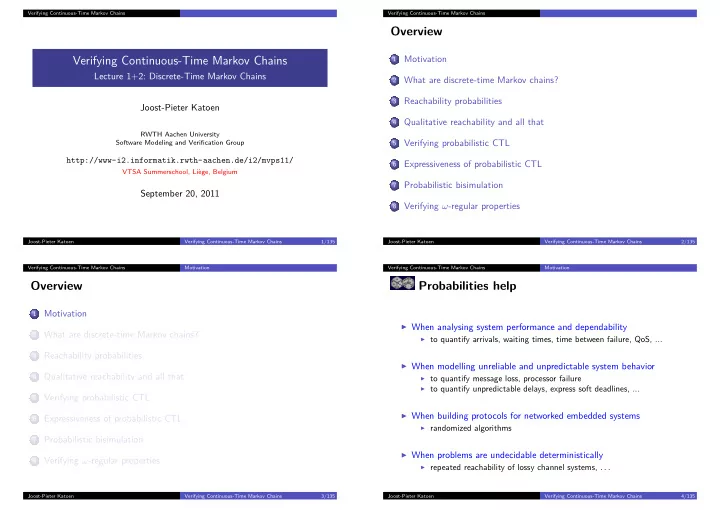
Verifying Continuous-Time Markov Chains Verifying Continuous-Time Markov Chains Overview Motivation Verifying Continuous-Time Markov Chains 1 Lecture 1+2: Discrete-Time Markov Chains What are discrete-time Markov chains? 2 Reachability


slide-1
SLIDE 1

logoRWTH Verifying Continuous-Time Markov Chains

Verifying Continuous-Time Markov Chains

Lecture 1+2: Discrete-Time Markov Chains Joost-Pieter Katoen

RWTH Aachen University Software Modeling and Verification Group

http://www-i2.informatik.rwth-aachen.de/i2/mvps11/

VTSA Summerschool, Liège, Belgium

September 20, 2011

Joost-Pieter Katoen Verifying Continuous-Time Markov Chains 1/135 Verifying Continuous-Time Markov Chains

Overview

1

Motivation

2

What are discrete-time Markov chains?

3

Reachability probabilities

4

Qualitative reachability and all that

5

Verifying probabilistic CTL

6

Expressiveness of probabilistic CTL

7

Probabilistic bisimulation

8

Verifying ω-regular properties

Joost-Pieter Katoen Verifying Continuous-Time Markov Chains 2/135 Verifying Continuous-Time Markov Chains Motivation

Overview

1

Motivation

2

What are discrete-time Markov chains?

3

Reachability probabilities

4

Qualitative reachability and all that

5

Verifying probabilistic CTL

6

Expressiveness of probabilistic CTL

7

Probabilistic bisimulation

8

Verifying ω-regular properties

Joost-Pieter Katoen Verifying Continuous-Time Markov Chains 3/135 Verifying Continuous-Time Markov Chains Motivation

Probabilities help

◮ When analysing system performance and dependability

◮ to quantify arrivals, waiting times, time between failure, QoS, ...

◮ When modelling unreliable and unpredictable system behavior

◮ to quantify message loss, processor failure ◮ to quantify unpredictable delays, express soft deadlines, ...

◮ When building protocols for networked embedded systems

◮ randomized algorithms

◮ When problems are undecidable deterministically

◮ repeated reachability of lossy channel systems, . . . Joost-Pieter Katoen Verifying Continuous-Time Markov Chains 4/135

slide-2
SLIDE 2

Verifying Continuous-Time Markov Chains Motivation

Illustrative example: Security

Security: Crowds protocol

[Reiter & Rubin, 1998]

◮ A protocol for anonymous web browsing (variants: mCrowds,

BT-Crowds)

◮ Hide user’s communication by random routing within a crowd

◮ sender selects a crowd member randomly using a uniform distribution ◮ selected router flips a biased coin: ◮ with probability 1 − p: direct delivery to final destination ◮ otherwise: select a next router randomly (uniformly) ◮ once a routing path has been established, use it until crowd changes

◮ Rebuild routing paths on crowd changes ◮ Property: Crowds protocol ensures “probable innocence”:

◮ probability real sender is discovered < 1

2 if N p p− 1

2 ·(c+1)

◮ where N is crowd’s size and c is number of corrupt crowd members Joost-Pieter Katoen Verifying Continuous-Time Markov Chains 5/135 Verifying Continuous-Time Markov Chains Motivation

Illustrative example: Leader election

Distributed system: Leader election

[Itai & Rodeh, 1990]

◮ A round-based protocol in a synchronous ring of N > 2 nodes

◮ the nodes proceed in a lock-step fashion ◮ each slot = 1 message is read + 1 state change + 1 message is sent

⇒ this synchronous computation yields a discrete-time Markov chain

◮ Each round starts by each node choosing a uniform id ∈ { 1, . . . , K } ◮ Nodes pass their selected id around the ring ◮ If there is a unique id, the node with the maximum unique id is leader ◮ If not, start another round and try again . . .

Joost-Pieter Katoen Verifying Continuous-Time Markov Chains 6/135 Verifying Continuous-Time Markov Chains Motivation

Properties of leader election

Almost surely eventually a leader will be elected P=1 (♦leader elected) With probability at least 0.8, a leader is elected within k steps P0.8

  • ♦kleader elected
  • Joost-Pieter Katoen

Verifying Continuous-Time Markov Chains 7/135 Verifying Continuous-Time Markov Chains Motivation

Probability to elect a leader within L rounds

Pq

  • ♦(N+1)·L leader elected
  • Joost-Pieter Katoen

Verifying Continuous-Time Markov Chains 8/135

slide-3
SLIDE 3

Verifying Continuous-Time Markov Chains Motivation

What is probabilistic model checking?

Joost-Pieter Katoen Verifying Continuous-Time Markov Chains 9/135 Verifying Continuous-Time Markov Chains Motivation

Probabilistic models

Nondeterminism Nondeterminism no yes Discrete time discrete-time Markov decision Markov chain (DTMC) process (MDP) Continuous time CTMC CTMDP Other models: probabilistic variants of (priced) timed automata, or hybrid automata

Joost-Pieter Katoen Verifying Continuous-Time Markov Chains 10/135 Verifying Continuous-Time Markov Chains Motivation

Probability theory is simple, isn’t it?

In no other branch of mathematics is it so easy to make mistakes as in probability theory

Henk Tijms, “Understanding Probability” (2004)

Joost-Pieter Katoen Verifying Continuous-Time Markov Chains 11/135 Verifying Continuous-Time Markov Chains What are discrete-time Markov chains?

Overview

1

Motivation

2

What are discrete-time Markov chains?

3

Reachability probabilities

4

Qualitative reachability and all that

5

Verifying probabilistic CTL

6

Expressiveness of probabilistic CTL

7

Probabilistic bisimulation

8

Verifying ω-regular properties

Joost-Pieter Katoen Verifying Continuous-Time Markov Chains 12/135

slide-4
SLIDE 4

Verifying Continuous-Time Markov Chains What are discrete-time Markov chains?

Geometric distribution

Geometric distribution Let X be a discrete random variable, natural k > 0 and 0 < p 1. The mass function of a geometric distribution is given by: Pr{ X = k } = (1 − p)k−1·p We have E[X] = 1

p and Var[X] = 1−p p2

and cdf Pr{ X k } = 1 − (1−p)k. Geometric distributions and their cdf’s

Joost-Pieter Katoen Verifying Continuous-Time Markov Chains 13/135 Verifying Continuous-Time Markov Chains What are discrete-time Markov chains?

Memoryless property

Theorem

  • 1. For any random variable X with a geometric distribution:

Pr{X = k + m | X > m} = Pr{X = k} for any m ∈ T, k 1 This is called the memoryless property, and X is a memoryless r.v..

  • 2. Any discrete random variable which is memoryless is geometrically

distributed.

Joost-Pieter Katoen Verifying Continuous-Time Markov Chains 14/135 Verifying Continuous-Time Markov Chains What are discrete-time Markov chains?

Joint distribution function

Joint distribution function The joint distribution function of stochastic process X = { Xt | t ∈ T } is given for n, t1, . . . , tn ∈ T and d1, . . . , dn by: FX(d1, . . . , dn; t1, . . . , tn) = Pr{ X(t1) d1, . . . , X(tn) dn } The shape of FX depends on the stochastic dependency between X(ti). Stochastic independence Random variables Xi on probability space P are independent if: FX(d1, . . . , dn; t1, . . . , tn) =

n

  • i=1

FX(di; ti) =

n

  • i=1

Pr{ X(ti) di }.

The next state of the stochastic process only depends on the current state, and not on states assumed previously. This is the Markov property.

Joost-Pieter Katoen Verifying Continuous-Time Markov Chains 15/135 Verifying Continuous-Time Markov Chains What are discrete-time Markov chains?

Markov property

Markov process A discrete-time stochastic process { X(t) | t ∈ T } over state space { d0, d1, . . . } is a Markov process if for any t0 < t1 < . . . < tn < tn+1 : Pr{ X(tn+1) = dn+1 | X(t0) = d0, X(t1) = d1, . . . , X(tn) = dn } = Pr{ X(tn+1) = dn+1 | X(tn) = dn } The distribution of X(tn+1), given the values X(t0) through X(tn), only depends on the current state X(tn).

The conditional probability distribution of future states of a Markov process only depends on the current state and not on its further history.

Joost-Pieter Katoen Verifying Continuous-Time Markov Chains 16/135

slide-5
SLIDE 5

Verifying Continuous-Time Markov Chains What are discrete-time Markov chains?

Invariance to time-shifts

Time homogeneity Markov process { X(t) | t ∈ T } is time-homogeneous iff for any t′ < t: Pr{ X(t) = d | X(t′) = d′ } = Pr{ X(t − t′) = d | X(0) = d′ }. A time-homogeneous stochastic process is invariant to time shifts. Discrete-time Markov chain A discrete-time Markov chain (DTMC) is a time-homogeneous Markov process with discrete parameter T and discrete state space.

Joost-Pieter Katoen Verifying Continuous-Time Markov Chains 17/135 Verifying Continuous-Time Markov Chains What are discrete-time Markov chains?

Discrete-time Markov chain

Discrete-time Markov chain A discrete-time Markov chain (DTMC) is a time-homogeneous Markov process with discrete parameter T and discrete state space S. Transition probabilities The (one-step) transition probability from s ∈ S to s′ ∈ S at epoch n ∈ N is given by: p(n)(s, s′) = Pr{ Xn+1 = s′ | Xn = s } = Pr{ X1 = s′ | X0 = s } where the last equality is due to time-homogeneity. Since p(n)(·) = p(k)(·), the superscript (n) is omitted, and we write p(·).

Joost-Pieter Katoen Verifying Continuous-Time Markov Chains 18/135 Verifying Continuous-Time Markov Chains What are discrete-time Markov chains?

Transition probability matrix

Discrete-time Markov chain A discrete-time Markov chain (DTMC) is a time-homogeneous Markov process with discrete parameter T and discrete state space S. Transition probability matrix Let P be a function with P(si, sj) = p(si, sj). For finite state space S, function P is called the transition probability matrix of the DTMC with state space S. Properties

  • 1. P is a (right) stochastic matrix, i.e., it is a square matrix, all its

elements are in [0, 1], and each row sum equals one.

  • 2. P has an eigenvalue of one, and all its eigenvalues are at most one.
  • 3. For all n ∈ N, Pn is a stochastic matrix.

Joost-Pieter Katoen Verifying Continuous-Time Markov Chains 19/135 Verifying Continuous-Time Markov Chains What are discrete-time Markov chains?

DTMCs — A transition system perspective

Discrete-time Markov chain A DTMC D is a tuple (S, P, ιinit, AP, L) with:

◮ S is a countable nonempty set of states ◮ P : S×S → [0, 1], transition probability function s.t. s′ P(s, s′) = 1 ◮ ιinit : S → [0, 1], the initial distribution with s∈S

ιinit(s) = 1

◮ AP is a set of atomic propositions. ◮ L : S → 2AP, the labeling function, assigning to state s, the set L(s)

  • f atomic propositions that are valid in s.

Initial states

◮ ιinit(s) is the probability that DTMC D starts in state s ◮ the set { s ∈ S | ιinit(s) > 0 } are the possible initial states.

Joost-Pieter Katoen Verifying Continuous-Time Markov Chains 20/135

slide-6
SLIDE 6

Verifying Continuous-Time Markov Chains What are discrete-time Markov chains?

Simulating a die by a fair coin [Knuth & Yao]

Heads = “go left”; tails = “go right”. Does this DTMC adequately model a fair six-sided die?

Joost-Pieter Katoen Verifying Continuous-Time Markov Chains 21/135 Verifying Continuous-Time Markov Chains What are discrete-time Markov chains?

Craps

Joost-Pieter Katoen Verifying Continuous-Time Markov Chains 22/135 Verifying Continuous-Time Markov Chains What are discrete-time Markov chains?

Craps

◮ Roll two dice and bet ◮ Come-out roll (“pass line” wager):

◮ outcome 7 or 11: win ◮ outcome 2, 3, or 12: lose (“craps”) ◮ any other outcome: roll again (outcome is “point”)

◮ Repeat until 7 or the “point” is thrown:

◮ outcome 7: lose (“seven-out”) ◮ outcome the point: win ◮ any other outcome: roll again Joost-Pieter Katoen Verifying Continuous-Time Markov Chains 23/135 Verifying Continuous-Time Markov Chains What are discrete-time Markov chains?

A DTMC model of Craps

◮ Come-out roll:

◮ 7 or 11: win ◮ 2, 3, or 12:

lose

◮ else: roll

again

◮ Next roll(s):

◮ 7: lose ◮ point: win ◮ else: roll

again

Joost-Pieter Katoen Verifying Continuous-Time Markov Chains 24/135

slide-7
SLIDE 7

Verifying Continuous-Time Markov Chains What are discrete-time Markov chains?

State residence time distribution

Let Ts be the number of epochs of DTMC D to stay in state s: Pr{ Ts = 1 } = 1 − P(s, s) Pr{ Ts = 2 } = P(s, s) · (1 − P(s, s)) . . . . . . . . . . . . . . . Pr{ Ts = n } = P(s, s)n−1 · (1 − P(s, s)) So, the state residence times in a DTMC obey a geometric distribution.

The expected number of time steps to stay in state s equals E[Ts] =

1 1−P(s,s).

The variance of the residence time distribution is Var[Ts] =

P(s,s) (1−P(s,s))2 .

Recall that the geometric distribution is the only discrete probability distribution that possesses the memoryless property.

Joost-Pieter Katoen Verifying Continuous-Time Markov Chains 25/135 Verifying Continuous-Time Markov Chains What are discrete-time Markov chains?

Determining n-step transition probabilities

n-step transition probabilities The probability to move from s to s′ in n ∈ N steps is inductively defined: ps,s′(0) = 1 if s = s′, and 0 otherwise, ps,s′(1) = P(s, s′), and for n > 1 by the Chapman-Kolmogorov equation: ps,s′(n) =

  • s′′

ps,s′′(l) · ps′′,s′(n−l) for all 0 < l < n For l = 1 and n > 0 we obtain: ps,s′(n) =

  • s′′

ps,s′′(1) · ps′′,s′(n−1)

P(n) = P(1) · P(n−1) = P · P(n−1) is the n-step transition probability matrix

Repeating this scheme: P(n) = P · P(n−1) = . . . = Pn−1 · P(1) = Pn.

Joost-Pieter Katoen Verifying Continuous-Time Markov Chains 26/135 Verifying Continuous-Time Markov Chains What are discrete-time Markov chains?

Transient probability distribution

Transient distribution Pn(s, t) equals the probability of being in state t after n steps given that the computation starts in s. The probability of DTMC D being in state t after exactly n transitions is: ΘD

n (t) =

  • s∈S

ιinit(s) · Pn(s, t) ΘD

n (t) is called the transient state probability at epoch n for state t. The

function ΘD

n is the transient state distribution at epoch n of DTMC D.

When considering ΘD

n as vector (ΘD n )t∈S we have:

ΘD

n

= ιinit · P · P · . . . · P

  • n times

= ιinit · Pn.

Joost-Pieter Katoen Verifying Continuous-Time Markov Chains 27/135 Verifying Continuous-Time Markov Chains Reachability probabilities

Overview

1

Motivation

2

What are discrete-time Markov chains?

3

Reachability probabilities

4

Qualitative reachability and all that

5

Verifying probabilistic CTL

6

Expressiveness of probabilistic CTL

7

Probabilistic bisimulation

8

Verifying ω-regular properties

Joost-Pieter Katoen Verifying Continuous-Time Markov Chains 28/135

slide-8
SLIDE 8

Verifying Continuous-Time Markov Chains Reachability probabilities

Paths in a DTMC

State graph The state graph of DTMC D is a digraph G = (V , E) with V are the states of D, and (s, s′) ∈ E iff P(s, s′) > 0. Paths Paths in D are maximal (i.e., infinite) paths in its state graph. Thus, a path is an infinite sequence of states s0s1s2 . . . . . . with P(si, si+1) > 0 for all i. Let Paths(D) denote the set of paths in D, and Paths∗(D) the set of finite prefixes thereof. Direct successors and predecessors Post(s) = { s′ ∈ S | P(s, s′) > 0 } and Pre(s) = { s′ ∈ S | P(s′, s) > 0 } are the set of direct successors and predecessors of s respectively. Post∗(s) and Pre∗(s) are the reflexive and transitive closure of Post and Pre.

Joost-Pieter Katoen Verifying Continuous-Time Markov Chains 29/135 Verifying Continuous-Time Markov Chains Reachability probabilities

Measurable space

Sample space A sample space Ω of a chance experiment is a set of elements that have a 1-to-1 relationship to the possible outcomes of the experiment. σ-algebra A σ-algebra is a pair (Ω, F) with Ω = ∅ and F ⊆ 2Ω a collection of subsets of sample space Ω such that:

  • 1. Ω ∈ F
  • 2. A ∈ F

⇒ Ω − A ∈ F

complement

  • 3. (∀i 0. Ai ∈ F)

  • i0 Ai ∈ F

countable union

The elements in F of a σ-algebra (Ω, F) are called events. The pair (Ω, F) is called a measurable space. Let Ω be a set. F = { ∅, Ω } yields the smallest σ-algebra; F = 2Ω yields the largest one.

Joost-Pieter Katoen Verifying Continuous-Time Markov Chains 30/135 Verifying Continuous-Time Markov Chains Reachability probabilities

Probabilities

Joost-Pieter Katoen Verifying Continuous-Time Markov Chains 31/135 Verifying Continuous-Time Markov Chains Reachability probabilities

Probability space

Probability space A probability space P is a structure (Ω, F, Pr) with:

◮ (Ω, F) is a σ-algebra, and ◮ Pr : F → [0, 1] is a probability measure, i.e.:

  • 1. Pr(Ω) = 1, i.e., Ω is the certain event
  • 2. Pr
  • i∈I

Ai

  • =
  • i∈I

Pr(Ai) for any Ai ∈ F with Ai ∩ Aj = ∅ for i=j, where { Ai }i∈I is finite or countably infinite.

The elements in F of a probability space (Ω, F, Pr) are called measurable events.

Joost-Pieter Katoen Verifying Continuous-Time Markov Chains 32/135

slide-9
SLIDE 9

Verifying Continuous-Time Markov Chains Reachability probabilities

Paths and probabilities

To reason quantitatively about the behavior of a DTMC, we need to define a probability space over its paths. Intuition For a given state s in DTMC D:

◮ Sample space := set of all infinite paths starting in s ◮ Events := sets of infinite paths starting in s ◮ Basic events := cylinder sets ◮ Cylinder set of finite path

π := set of all infinite continuations of π

Joost-Pieter Katoen Verifying Continuous-Time Markov Chains 33/135 Verifying Continuous-Time Markov Chains Reachability probabilities

Probability measure on DTMCs

Cylinder set The cylinder set of finite path ˆ π = s0 s1 . . . sn ∈ Paths∗(D) is defined by: Cyl(ˆ π) =

π ∈ Paths(D) | ˆ

π is a prefix of π

  • The cylinder set spanned by finite path ˆ

π thus consists of all infinite paths that have prefix ˆ π. Cylinder sets serve as basic events of the smallest σ-algebra on Paths(D). σ-algebra of a DTMC The σ-algebra associated with DTMC D is the smallest σ-algebra that contains all cylinder sets Cyl(ˆ π) where ˆ π ranges over all finite path fragments in D.

Joost-Pieter Katoen Verifying Continuous-Time Markov Chains 34/135 Verifying Continuous-Time Markov Chains Reachability probabilities

Probability measure on DTMCs

Cylinder set The cylinder set of finite path ˆ π = s0 s1 . . . sn ∈ Paths∗(D) is defined by: Cyl(ˆ π) =

π ∈ Paths(D) | ˆ

π is a prefix of π

  • Probability measure

Pr is the unique probability measure on the σ-algebra on Paths(D) defined by: Pr

Cyl(s0 . . . sn) = ιinit(s0) · P(s0 s1 . . . sn)

where P(s0 s1 . . . sn) =

  • 0i<n

P(si, si+1) for n > 0 and P(s0) = 1.

Joost-Pieter Katoen Verifying Continuous-Time Markov Chains 35/135 Verifying Continuous-Time Markov Chains Reachability probabilities

Some events of interest

Let DTMC D with (possibly infinite) state space S. (Simple) reachability Eventually reach a state in G ⊆ S. Formally: ♦G = { π ∈ Paths(D) | ∃i ∈ N. π[i] ∈ G } Invariance, i.e., always stay in state in G: G = { π ∈ Paths(D) | ∀i ∈ N. π[i] ∈ G } = ♦G. Constrained reachability Or “reach-avoid” properties where states in F ⊆ S are forbidden: F U G = { π ∈ Paths(D) | ∃i ∈ N. π[i] ∈ G ∧ ∀j < i. π[j] ∈ F }

Joost-Pieter Katoen Verifying Continuous-Time Markov Chains 36/135

slide-10
SLIDE 10

Verifying Continuous-Time Markov Chains Reachability probabilities

More events of interest

Repeated reachability Repeatedly visit a state in G; formally: ♦G = { π ∈ Paths(D) | ∀i ∈ N. ∃j i. π[j] ∈ G } Persistence Eventually reach in a state in G and always stay there; formally: ♦G = { π ∈ Paths(D) | ∃i ∈ N. ∀j i. π[j] ∈ G }

Joost-Pieter Katoen Verifying Continuous-Time Markov Chains 37/135 Verifying Continuous-Time Markov Chains Reachability probabilities

Measurability

Measurability theorem Events ♦G, G, F U G, ♦G and ♦G are measurable on any DTMC.

Proof: To show this, every event will be expressed as allowed operations (complement and/or countable unions) of the events — our cylinder sets!— in the σ-algebra on infinite paths in a DTMC. Note that G = ♦G and ♦G = ♦G. It remains to prove the measurability for the remaining three cases.

Joost-Pieter Katoen Verifying Continuous-Time Markov Chains 38/135 Verifying Continuous-Time Markov Chains Reachability probabilities

Proof for ♦G

Which event (in our σ-algebra) does ♦G formally mean?

the union of all cylinders Cyl(s0 . . . sn) where s0 . . . sn is a finite path in D with s0, . . . , sn−1 / ∈ G and sn ∈ G, i.e., ♦G =

  • s0...sn∈Paths∗(D)∩(S\G)∗G

Cyl(s0 . . . sn)

Thus ♦G is measurable. As all cylinder sets are pairwise disjoint, its probability is defined by:

Pr(♦G) =

  • s0...sn∈Paths∗(D)∩(S\G)∗G

Pr

  • Cyl(s0 . . . sn)
  • =
  • s0...sn∈Paths∗(D)∩(S\G)∗G

ιinit(s0) · P(s0 . . . sn) A similar proof strategy applies to the case F U G.

Joost-Pieter Katoen Verifying Continuous-Time Markov Chains 39/135 Verifying Continuous-Time Markov Chains Reachability probabilities

Reachability probabilities: Knuth’s die

◮ Consider the event ♦4 ◮ Using the previous theorem we obtain:

Pr(♦4) =

  • s0...sn∈(S\4∗)4

P(s0 . . . sn)

◮ This yields:

P(s0s2s54) + P(s0s2s6s2s54) + . . . . . .

◮ Or:

  • k=0

P(s0s2(s6s2)ks54)

◮ Or: 1

8

  • k=0

1 4 k

◮ Geometric series: 1

8· 1 1 − 1

4

= 1 8·4 3 = 1 6 There is however an simpler way to obtain reachability probabilities!

Joost-Pieter Katoen Verifying Continuous-Time Markov Chains 40/135

slide-11
SLIDE 11

Verifying Continuous-Time Markov Chains Reachability probabilities

Reachability probabilities in finite DTMCs

Problem statement Let D be a DTMC with finite state space S, s ∈ S and G ⊆ S. Aim: determine Pr(s | = ♦G) = Prs(♦G) = Prs{ π ∈ Paths(s) | π | = ♦G } where Prs is the probability measure in D with single initial state s. Characterisation of reachability probabilities

◮ Let variable xs = Pr(s |

= ♦G) for any state s

◮ if G is not reachable from s, then xs = 0 ◮ if s ∈ G then xs = 1

◮ For any state s ∈ Pre∗(G) \ G:

xs =

  • t∈S\G

P(s, t) · xt

  • reach G via t ∈ S \ G

+

  • u∈G

P(s, u)

  • reach G in one step

Joost-Pieter Katoen Verifying Continuous-Time Markov Chains 41/135 Verifying Continuous-Time Markov Chains Reachability probabilities

Reachability probabilities: Knuth’s die

◮ Consider the event ♦4 ◮ Using the previous characterisation we

  • btain:

x1 = x2 = x3 = x5 = x6 = 0 and x4 = 1 xs1 = xs3 = xs4 = 0 xs0 = 1

2xs1 + 1 2xs2

xs2 = 1

2xs5 + 1 2xs6

xs5 = 1

2x5 + 1 2x4

xs6 = 1

2xs2 + 1 2x6

◮ Gaussian elimination yields:

xs5 = 1

2, xs2 = 1 3, xs6 = 1 6, and xs0 = 1 6

Joost-Pieter Katoen Verifying Continuous-Time Markov Chains 42/135 Verifying Continuous-Time Markov Chains Reachability probabilities

Linear equation system

Reachability probabilities as linear equation system

◮ Let S? = Pre∗(G) \ G, the states that can reach G by > 0 steps ◮ A =

P(s, t)

  • s,t∈S?, the transition probabilities in S?

◮ b =

bs

  • s∈S?, the probs to reach G in 1 step, i.e., bs =
  • u∈G

P(s, u) Then: x = (xs)s∈S? with xs = Pr(s | = ♦G) is the unique solution of: x = A·x + b

  • r

(I − A)·x = b where I is the identity matrix of cardinality |S?| × |S?|.

Joost-Pieter Katoen Verifying Continuous-Time Markov Chains 43/135 Verifying Continuous-Time Markov Chains Reachability probabilities

Reachability probabilities: Knuth’s die

◮ Consider the event ♦4 ◮ S? = { s0, s2, s5, s6 }

  

1 − 1

2

1 − 1

2

− 1

2

1 − 1

2

1

  ·   

xs0 xs2 xs5 xs6

   =   

1 2

  

◮ Gaussian elimination yields:

xs5 = 1

2, xs2 = 1 3, xs6 = 1 6, and xs0 = 1 6

Joost-Pieter Katoen Verifying Continuous-Time Markov Chains 44/135

slide-12
SLIDE 12

Verifying Continuous-Time Markov Chains Reachability probabilities

Constrained reachability probabilities

Problem statement Let D be a DTMC with finite state space S, s ∈ S and F, G ⊆ S. Aim: Pr(s | = F U G) = Prs(F U G) = Prs{ π ∈ Paths(s) | π | = F U G } where Prs is the probability measure in D with single initial state s. Characterisation of constrained reachability probabilities

◮ Let variable xs = Pr(s |

= F U G) for any state s

◮ if G is not reachable from s via F, then xs = 0 ◮ if s ∈ G then xs = 1

◮ For any state s ∈ (Pre∗(G) ∩ F) \ G:

xs =

  • t∈S\G

P(s, t) · xt +

  • u∈G

P(s, u)

Joost-Pieter Katoen Verifying Continuous-Time Markov Chains 45/135 Verifying Continuous-Time Markov Chains Reachability probabilities

Iteratively computing reachability probabilities

Theorem The vector x =

  • Pr(s |

= F U G)

  • s∈S? is the unique solution of:

y = A·y + b with A and b as defined before. Furthermore, let: x(0) = 0 and x(i+1) = A·x(i) + b for 0 i. Then:

  • 1. x(n)(s) = Pr(s |

= F Un G) for s ∈ S?

  • 2. x(0) x(1) x(2) . . . x
  • 3. x = limn→∞ x(n)

where F U nG contains those paths that reach G via F within n steps.

Joost-Pieter Katoen Verifying Continuous-Time Markov Chains 46/135 Verifying Continuous-Time Markov Chains Reachability probabilities

Remark

Iterative algorithms to compute x There are various algorithms to compute x = limn→∞ x(n) where: x(0) = 0 and x(i+1) = A·x(i) + b for 0 i. The Power method computes vectors x(0), x(1), x(2), . . . and aborts if: max

s∈S? | x(n+1) s

− x(n)

s

| < ε for some small tolerance ε This technique guarantees convergence.

Alternative iterative techniques: e.g., Jacobi or Gauss-Seidel, successive

  • verrelaxation (SOR).

Joost-Pieter Katoen Verifying Continuous-Time Markov Chains 47/135 Verifying Continuous-Time Markov Chains Reachability probabilities

Example: Knuth’s die

◮ Let G = { 1, 2, 3, 4, 5, 6 } ◮ Then Pr(s0 |

= ♦G) = 1

◮ And Pr(s0 |

= ♦kG) for k ∈ I N is given by:

Joost-Pieter Katoen Verifying Continuous-Time Markov Chains 48/135

slide-13
SLIDE 13

Verifying Continuous-Time Markov Chains Reachability probabilities

Reachability probability = transient probabilities

Aim Compute Pr(♦nG) in DTMC D. Observe that once a path π reaches G, then the remaining behaviour along π is not important. This suggests to make all states in G absorbing. Let DTMC D = (S, P, ιinit, AP, L) and G ⊆ S. The DTMC D[G] = (S, PG, ιinit, AP, L) with PG(s, t) = P(s, t) if s / ∈ G and PG(s, s) = 1 if s ∈ G.

All outgoing transitions of s ∈ G are replaced by a single self-loop at s.

Lemma Pr(♦nG)

  • reachability in D

= Pr(♦=nG)

  • reachability in D[G]

= ιinit · Pn

G

  • in D[G]

= ΘD[G]

n

Joost-Pieter Katoen Verifying Continuous-Time Markov Chains 49/135 Verifying Continuous-Time Markov Chains Reachability probabilities

Constrained reachability = transient probabilities

Aim Compute Pr(F Un G) in DTMC D. Observe (as before) that once a path π reaches G via F, then the remaining behaviour along π is not important. Now also observe that once s ∈ F \ G is reached, then the remaining behaviour along π is not important. This suggests to make all states in G and F \ G absorbing. Lemma Pr(F Un G)

  • reachability in D

= Pr(♦=nG)

  • reachability in D[F ∪ G]

= ιinit · Pn

F∪G

  • in D[F ∪ G]

= ΘD[F∪G]

n

Joost-Pieter Katoen Verifying Continuous-Time Markov Chains 50/135 Verifying Continuous-Time Markov Chains Qualitative reachability and all that

Overview

1

Motivation

2

What are discrete-time Markov chains?

3

Reachability probabilities

4

Qualitative reachability and all that

5

Verifying probabilistic CTL

6

Expressiveness of probabilistic CTL

7

Probabilistic bisimulation

8

Verifying ω-regular properties

Joost-Pieter Katoen Verifying Continuous-Time Markov Chains 51/135 Verifying Continuous-Time Markov Chains Qualitative reachability and all that

Qualitative properties

Quantitative properties Comparing the probability of an event such as G, ♦G and ♦G with a threshold ∼ p with p ∈ (0, 1) and ∼ a binary comparison operator (=, <, , , >) yields a quantitative property. Example quantitative properties Pr(s | = ♦G) >

1 2

  • r

Pr(s | = ♦n G)

π 5

Qualitative properties Comparing the probability of an event such as G, ♦G and ♦G with a threshold > 0 or = 1 yields a qualitative property. Any event E with Pr(E) = 1 is called almost surely. Example qualitative properties Pr(s | = ♦G) > 0

  • r

Pr(s | = ♦n G) = 1

Joost-Pieter Katoen Verifying Continuous-Time Markov Chains 52/135

slide-14
SLIDE 14

Verifying Continuous-Time Markov Chains Qualitative reachability and all that

Verifying qualitative properties

Remark In the following we will concentrate on almost sure events, i.e., events E with Pr(E) = 1. This suffices, as Pr(E) > 0 if and only if not Pr(E) = 1.

Joost-Pieter Katoen Verifying Continuous-Time Markov Chains 53/135 Verifying Continuous-Time Markov Chains Qualitative reachability and all that

Graph notions

Let D = (S, P, ιinit, AP, L) be a (possibly infinite) DTMC. Strongly connected component

◮ T ⊆ S is strongly connected if for any s, t ∈ T, states s and t ∈ T

are mutually reachable via edges in T.

◮ T is a strongly connected component (SCC) of D if it is strongly

connected and no proper superset of T is strongly connected.

◮ SCC T is a bottom SCC (BSCC) if no state outside T is reachable

from T, i.e., for any state s ∈ T, P(s, T) =

t∈T P(s, t) = 1. ◮ Let BSCC(D) denote the set of BSCCs of DTMC D.

Joost-Pieter Katoen Verifying Continuous-Time Markov Chains 54/135 Verifying Continuous-Time Markov Chains Qualitative reachability and all that

Evolution of an example DTMC

Which states have a probability > 0 when repeating this on the long run?

Joost-Pieter Katoen Verifying Continuous-Time Markov Chains 55/135 Verifying Continuous-Time Markov Chains Qualitative reachability and all that

On the long run

The probability mass on the long run is only left in BSCCs.

Joost-Pieter Katoen Verifying Continuous-Time Markov Chains 56/135

slide-15
SLIDE 15

Verifying Continuous-Time Markov Chains Qualitative reachability and all that

Measurability

Lemma For any state s in (possibly infinite) DTMC D: { π ∈ Paths(s) | inf(π) ∈ BSCC(D) } is measurable where inf(π) is the set of states that are visited infinitely often along π. Proof:

  • 1. For BSCC T, { π ∈ Paths(s) | inf(π) = T } is measurable as:

{ π ∈ Paths(s) | inf(π) = T } =

  • t∈T

♦t ∩ ♦T.

  • 2. As BSCC(D) is countable, we have:

{ π ∈ Paths(s) | inf(π) ∈ BSCC(D) } =

  • TS∈BSCC(D)
  • t∈T

♦t ∧ ♦T.

Joost-Pieter Katoen Verifying Continuous-Time Markov Chains 57/135 Verifying Continuous-Time Markov Chains Qualitative reachability and all that

Fundamental result

Long-run theorem For each state s of a finite Markov chain D: Prs

π ∈ Paths(s) | inf(π) ∈ BSCC(M) = 1.

Intuition Almost surely any finite DTMC eventually reaches a BSCC and visits all its states infinitely often.

Joost-Pieter Katoen Verifying Continuous-Time Markov Chains 58/135 Verifying Continuous-Time Markov Chains Qualitative reachability and all that

Almost sure reachability

Recall: an absorbing state in a DTMC is a state with a self-loop with probability one. Almost sure reachability theorem For finite DTMC with state space S, s ∈ S and G ⊆ S a set of absorbing states: Pr(s | = ♦G) = 1 iff s ∈ S \ Pre∗ S \ Pre∗(G)

. Note: S \ Pre∗ S \ Pre∗(G)

  • are states that cannot reach states from which G

cannot be reached.

Proof: Show that both sides of the equivalence are equivalent to Post∗(t) ∩ G = ∅ for each state t ∈ Post∗(s). Rather straightforward.

Joost-Pieter Katoen Verifying Continuous-Time Markov Chains 59/135 Verifying Continuous-Time Markov Chains Qualitative reachability and all that

Computing almost sure reachability properties

Aim: For finite DTMC D and G ⊆ S, determine { s ∈ S | Pr(s | = ♦G) = 1 }. Algorithm

  • 1. Make all states in G absorbing yielding D[G].
  • 2. Determine S \ Pre∗ S \ Pre∗(G)

by a graph analysis: 2.1 do a backward search from G in D[G] to determine Pre∗(G). 2.2 followed by a backward search from S \ Pre∗(G) in D[G].

This yields a time complexity which is linear in the size of the DTMC D.

Joost-Pieter Katoen Verifying Continuous-Time Markov Chains 60/135

slide-16
SLIDE 16

Verifying Continuous-Time Markov Chains Qualitative reachability and all that

Repeated reachability

Almost sure repeated reachability theorem For finite DTMC with state space S, G ⊆ S, and s ∈ S: Pr(s | = ♦G) = 1 iff for each BSCC T ⊆ Post∗(s). T ∩ G = ∅. Proof: Immediate consequence of the long-run theorem.

Joost-Pieter Katoen Verifying Continuous-Time Markov Chains 61/135 Verifying Continuous-Time Markov Chains Qualitative reachability and all that

Almost sure repeated reachability

Almost sure repeated reachability theorem For finite DTMC with state space S, G ⊆ S, and s ∈ S: Pr(s | = ♦G) = 1 iff for each BSCC T ⊆ Post∗(s). T ∩ G = ∅.

Joost-Pieter Katoen Verifying Continuous-Time Markov Chains 62/135 Verifying Continuous-Time Markov Chains Qualitative reachability and all that

Almost sure persistence

Almost sure persistence theorem For finite DTMC with state space S, G ⊆ S, and s ∈ S: Pr(s | = ♦G) = 1 if and only if T ⊆ G for any BSCC T ⊆ Post∗(s)

Joost-Pieter Katoen Verifying Continuous-Time Markov Chains 63/135 Verifying Continuous-Time Markov Chains Qualitative reachability and all that

A remark on infinite Markov chains

Graph analysis for infinite DTMCs does not suffice! Consider the following infinitely countable DTMC, known as random walk: The value of rational probability p does affect qualitative properties: Pr(s | = ♦ s0) =

1

if p 1

2

< 1 if p > 1

2

and Pr(s | = ♦ s0) =

1 if p 1

2

0 if p > 1

2

Joost-Pieter Katoen Verifying Continuous-Time Markov Chains 64/135

slide-17
SLIDE 17

Verifying Continuous-Time Markov Chains Qualitative reachability and all that

Quantitative properties

Quantitative repeated reachability theorem For finite DTMC with state space S, G ⊆ S, and s ∈ S: Pr(s | = ♦G) = Pr(s | = ♦U) where U is the union of all BSCCs T with T ∩ G = ∅. Quantitative repeated reachability theorem For finite DTMC with state space S, G ⊆ S, and s ∈ S: Pr(s | = ♦G) = Pr(s | = ♦U) where U is the union of all BSCCs T with T ⊆ G. Remark Thus probabilities for ♦G and ♦G are reduced to reachability

  • probabilities. These can be computed by solving a linear equation system.

Joost-Pieter Katoen Verifying Continuous-Time Markov Chains 65/135 Verifying Continuous-Time Markov Chains Qualitative reachability and all that

Summary

◮ Executions of a DTMC are strongly fair with respect to all

probabilistic choices.

◮ A finite DTMC almost surely ends up in a BSCC on the long run. ◮ Almost sure reachability = double backward search. ◮ Almost sure ♦G and ♦G properties can be checked by BSCC

analysis and reachability.

◮ Probabilities for ♦G and ♦G reduce to reachability probabilities.

Take-home message For finite DTMCs, qualitative properties do only depend on their state graph and not on the transition probabilities! For infinite DTMCs, this does not hold.

Joost-Pieter Katoen Verifying Continuous-Time Markov Chains 66/135 Verifying Continuous-Time Markov Chains Verifying probabilistic CTL

Overview

1

Motivation

2

What are discrete-time Markov chains?

3

Reachability probabilities

4

Qualitative reachability and all that

5

Verifying probabilistic CTL

6

Expressiveness of probabilistic CTL

7

Probabilistic bisimulation

8

Verifying ω-regular properties

Joost-Pieter Katoen Verifying Continuous-Time Markov Chains 67/135 Verifying Continuous-Time Markov Chains Verifying probabilistic CTL

Probabilistic Computation Tree Logic

◮ PCTL is a language for formally specifying properties over DTMCs. ◮ It is a branching-time temporal logic based on CTL. ◮ Formula interpretation is Boolean, i.e., a state satisfies a formula or

not.

◮ The main operator is PJ(ϕ)

◮ where ϕ constrains the set of paths and J is a threshold on the

probability.

◮ it is the probabilistic counterpart of ∃ and ∀ path-quantifiers in CTL. Joost-Pieter Katoen Verifying Continuous-Time Markov Chains 68/135

slide-18
SLIDE 18

Verifying Continuous-Time Markov Chains Verifying probabilistic CTL

PCTL syntax

[Hansson & Jonsson, 1994]

Probabilistic Computation Tree Logic: Syntax PCTL consists of state- and path-formulas.

◮ PCTL state formulas over the set AP obey the grammar:

Φ ::= true

  • a
  • Φ1 ∧ Φ2
  • ¬Φ
  • PJ(ϕ)

where a ∈ AP, ϕ is a path formula and J ⊆ [0, 1], J = ∅ is a non-empty interval.

◮ PCTL path formulae are formed according to the following grammar:

ϕ ::= Φ

  • Φ1 U Φ2
  • Φ1 Un Φ2

where Φ, Φ1, and Φ2 are state formulae and n ∈ I N.

Abbreviate P[0,0.5](ϕ) by P0.5(ϕ) and P]0,1](ϕ) by P>0(ϕ).

Joost-Pieter Katoen Verifying Continuous-Time Markov Chains 69/135 Verifying Continuous-Time Markov Chains Verifying probabilistic CTL

Probabilistic Computation Tree Logic

◮ PCTL state formulas over the set AP obey the grammar:

Φ ::= true

  • a
  • Φ1 ∧ Φ2
  • ¬Φ
  • PJ(ϕ)

where a ∈ AP, ϕ is a path formula and J ⊆ [0, 1], J = ∅ is a non-empty interval.

◮ PCTL path formulae are formed according to the following grammar:

ϕ ::= Φ

  • Φ1 U Φ2
  • Φ1 Un Φ2

where n ∈ I N. Intuitive semantics

◮ s0s1s2 . . . |

= Φ Un Ψ if Φ holds until Ψ holds within n steps.

◮ s |

= PJ(ϕ) if probability that paths starting in s fulfill ϕ lies in J.

Joost-Pieter Katoen Verifying Continuous-Time Markov Chains 70/135 Verifying Continuous-Time Markov Chains Verifying probabilistic CTL

Semantics of P-operator

◮ s |

= PJ(ϕ) if:

◮ the probability of all paths starting in s fulfilling ϕ lies in J.

◮ Example: s |

= P> 1

2 (♦a) if ◮ the probability to reach an a-labeled state from s exceeds 1

2.

◮ Formally:

◮ s |

= PJ(ϕ) if and only if Prs{ π ∈ Paths(s) | π | = ϕ } ∈ J.

Joost-Pieter Katoen Verifying Continuous-Time Markov Chains 71/135 Verifying Continuous-Time Markov Chains Verifying probabilistic CTL

Derived operators

♦Φ = true U Φ ♦nΦ = true U nΦ Pp(Φ) = P>1−p(♦¬Φ) P(p,q)(nΦ) = P[1−q,1−p](♦n¬Φ)

Joost-Pieter Katoen Verifying Continuous-Time Markov Chains 72/135

slide-19
SLIDE 19

Verifying Continuous-Time Markov Chains Verifying probabilistic CTL

Correctness of Knuth’s die

Correctness of Knuth’s die P= 1

6 (♦1) ∧ P= 1 6 (♦2) ∧ P= 1 6 (♦3) ∧ P= 1 6 (♦4) ∧ P= 1 6 (♦5) ∧ P= 1 6 (♦6) Joost-Pieter Katoen Verifying Continuous-Time Markov Chains 73/135 Verifying Continuous-Time Markov Chains Verifying probabilistic CTL

Measurability

PCTL measurability For any PCTL path formula ϕ and state s of DTMC D, the set { π ∈ Paths(s) | π | = ϕ } is measurable. Proof (sketch): Three cases:

  • 1. Φ:

◮ cylinder sets constructed from paths of length one.

  • 2. Φ Un Ψ:

◮ (finite number of) cylinder sets from paths of length at most n.

  • 3. Φ U Ψ:

◮ countable union of paths satisfying Φ Un Ψ for all n 0. Joost-Pieter Katoen Verifying Continuous-Time Markov Chains 74/135 Verifying Continuous-Time Markov Chains Verifying probabilistic CTL

PCTL model checking

PCTL model checking problem Input: a finite DTMC D = (S, P, ιinit, AP, L), state s ∈ S, and PCTL state formula Φ Output: yes, if s | = Φ; no, otherwise. Basic algorithm In order to check whether s | = Φ do:

  • 1. Compute the satisfaction set Sat(Φ) = { s ∈ S | s |

= Φ }.

  • 2. This is done recursively by a bottom-up traversal of Φ’s parse tree.

◮ The nodes of the parse tree represent the subformulae of Φ. ◮ For each node, i.e., for each subformula Ψ of Φ, determine Sat(Ψ). ◮ Determine Sat(Ψ) as function of the satisfaction sets of its children:

e.g., Sat(Ψ1 ∧ Ψ2) = Sat(Ψ1) ∩ Sat(Ψ2) and Sat(¬Ψ) = S \ Sat(Ψ).

  • 3. Check whether state s belongs to Sat(Φ).

Joost-Pieter Katoen Verifying Continuous-Time Markov Chains 75/135 Verifying Continuous-Time Markov Chains Verifying probabilistic CTL

Core model checking algorithm

Probabilistic operator P In order to determine whether s ∈ Sat(PJ(ϕ)), the probability Pr(s | = ϕ) for the event specified by ϕ needs to be established. Then Sat(PJ(ϕ)) =

s ∈ S | Pr(s |

= ϕ) ∈ J

.

Let us consider the computation of Pr(s | = ϕ) for all possible ϕ.

Joost-Pieter Katoen Verifying Continuous-Time Markov Chains 76/135

slide-20
SLIDE 20

Verifying Continuous-Time Markov Chains Verifying probabilistic CTL

The next-step operator

Recall that: s | = PJ( Φ) if and only if Pr(s | = Φ) ∈ J. Lemma Pr(s | = Φ) =

s′∈Sat(Φ) P(s, s′).

Algorithm Considering the above equation for all states simultaneously yields:

Pr(s |

= Φ)

  • s∈S = P · bΦ

with bΦ the characteristic vector of Sat(Φ), i.e., bΦ(s) = 1 iff s ∈ Sat(Φ).

Checking the next-step operator reduces to a single matrix-vector multiplication.

Joost-Pieter Katoen Verifying Continuous-Time Markov Chains 77/135 Verifying Continuous-Time Markov Chains Verifying probabilistic CTL

Example

Consider DTMC: and PCTL-formula: P0.9 ( (¬try ∨ succ))

  • 1. Sat(¬try ∨ succ) = (S \ Sat(try)) ∪ Sat(succ) = { s0, s2, s3 }
  • 2. We know:

Pr(s |

= Φ)

  • s∈S = P · bΦ where Φ = ¬try ∨ succ
  • 3. Applying that to this example yields:
  • Pr(s |

= Φ)

s∈S =

  

1 0.01 0.01 0.98 1 1

   ·   

1 1 1

   =   

0.99 1 1

  

  • 4. Thus: Sat(P0.9( (¬try ∨ succ)) = { s1, s2, s3 }.

Joost-Pieter Katoen Verifying Continuous-Time Markov Chains 78/135 Verifying Continuous-Time Markov Chains Verifying probabilistic CTL

Time complexity

Let |Φ| be the size of Φ, i.e., the number of logical and temporal operators in Φ.

Time complexity of PCTL model checking For finite DTMC D and PCTL state-formula Φ, the PCTL model-checking problem can be solved in time O

poly(size(D)) · nmax · |Φ|

  • where nmax = max{ n | Ψ1 U nΨ2 occurs in Φ } with and nmax = 1 if Φ

does not contain a bounded until-operator.

Joost-Pieter Katoen Verifying Continuous-Time Markov Chains 79/135 Verifying Continuous-Time Markov Chains Verifying probabilistic CTL

Time complexity

Time complexity of PCTL model checking For finite DTMC D and PCTL state-formula Φ, the PCTL model-checking problem can be solved in time O

poly(size(D)) · nmax · |Φ| .

Proof (sketch)

  • 1. For each node in the parse tree, a model-checking is performed; this

yields a linear complexity in |Φ|.

  • 2. The worst-case operator is (unbounded) until.

2.1 Determining S=0 and S=1 can be done in linear time. 2.2 Direct methods to solve linear equation systems are in Θ(|S?|3).

  • 3. Strictly speaking, Un could be more expensive for large n.

But it remains polynomial, and n is small in practice.

Joost-Pieter Katoen Verifying Continuous-Time Markov Chains 80/135

slide-21
SLIDE 21

Verifying Continuous-Time Markov Chains Verifying probabilistic CTL

Some practical verification times

5⋅105 1⋅106 1.5⋅106 2⋅106 2.5⋅106 3⋅106 3.5⋅106 100 101 102 103 104 105

Crowds protocol (DTMC) Randomised mutex (DTMC) verification time (in ms) state space size

◮ command-line tool MRMC ran on a Pentium 4, 2.66 GHz, 1 GB RAM laptop. ◮ PCTL formula Pp(♦obs) where obs holds when the sender’s id is detected.

Joost-Pieter Katoen Verifying Continuous-Time Markov Chains 81/135 Verifying Continuous-Time Markov Chains Verifying probabilistic CTL

Summary

◮ PCTL is a variant of CTL with operator PJ(ϕ). ◮ Sets of paths fulfilling PCTL path-formula ϕ are measurable. ◮ PCTL model checking is performed by a recursive descent over Φ. ◮ The next operator amounts to a single matrix-vector multiplication. ◮ The bounded-until operator Un amounts to n matrix-vector

multiplications.

◮ The until-operator amounts to solving a linear equation system. ◮ The worst-case time complexity is polynomial in the size of the

DTMC and linear in the size of the formula.

Joost-Pieter Katoen Verifying Continuous-Time Markov Chains 82/135 Verifying Continuous-Time Markov Chains Expressiveness of probabilistic CTL

Overview

1

Motivation

2

What are discrete-time Markov chains?

3

Reachability probabilities

4

Qualitative reachability and all that

5

Verifying probabilistic CTL

6

Expressiveness of probabilistic CTL

7

Probabilistic bisimulation

8

Verifying ω-regular properties

Joost-Pieter Katoen Verifying Continuous-Time Markov Chains 83/135 Verifying Continuous-Time Markov Chains Expressiveness of probabilistic CTL

Qualitative PCTL

Qualitative PCTL State formulae in the qualitative fragment of PCTL (over AP): Φ ::= true

  • a
  • Φ1 ∧ Φ2
  • ¬Φ
  • P>0(ϕ)
  • P=1(ϕ)

where a ∈ AP, and ϕ is a path formula formed according to the grammar: ϕ ::= Φ

  • Φ1 U Φ2.

Remark The probability bounds = 0 and < 1 can be derived: P=0(ϕ) ≡ ¬P>0(ϕ) and P<1(ϕ) ≡ ¬P=1(ϕ) So, in qualitative PCTL, there is no bounded until, and only > 0, = 0, > 1 and = 1 thresholds.

Joost-Pieter Katoen Verifying Continuous-Time Markov Chains 84/135

slide-22
SLIDE 22

Verifying Continuous-Time Markov Chains Expressiveness of probabilistic CTL

Qualitative PCTL

Qualitative PCTL State formulae in the qualitative fragment of PCTL (over AP): Φ ::= true

  • a
  • Φ1 ∧ Φ2
  • ¬Φ
  • P>0(ϕ)
  • P=1(ϕ)

where a ∈ AP, and ϕ is a path formula formed according to the grammar: ϕ ::= Φ

  • Φ1 U Φ2.

Examples P=1(♦P>0( a)) and P<1(P>0(♦a) U b) are qualitative PCTL formulas.

Joost-Pieter Katoen Verifying Continuous-Time Markov Chains 85/135 Verifying Continuous-Time Markov Chains Expressiveness of probabilistic CTL

CTL versus qualitative PCTL

Equivalence of PCTL and CTL Formulae The PCTL formula Φ is equivalent to the CTL formula Ψ, denoted Φ ≡ Ψ, if Sat(Φ) = Sat(Ψ) for each DTMC D. Example The simplest such cases are path formulae involving the next-step operator: P=1( a) ≡ ∀ a P>0( a) ≡ ∃ a And for ∃♦ and ∀ we have: P>0(♦a) ≡ ∃♦a P=1(a) ≡ ∀a.

Joost-Pieter Katoen Verifying Continuous-Time Markov Chains 86/135 Verifying Continuous-Time Markov Chains Expressiveness of probabilistic CTL

CTL versus qualitative PCTL

(1) P>0(♦a) ≡ ∃♦a and (2) P=1(a) ≡ ∀a. Proof: (1) Consider the first statement. ⇒ Assume s | = P>0(♦a). By the PCTL semantics, Pr(s | = ♦a) > 0. Thus, { π ∈ Paths(s) | π | = ♦a } = ∅, and hence, s | = ∃♦a. ⇐ Assume s | = ∃♦a, i.e., there is a finite path ˆ π = s0 s1 . . . sn with s0 = s and sn | = a. It follows that all paths in the cylinder set Cyl(ˆ π) fulfill ♦a. Thus: Pr(s | = ♦a) Prs(Cyl(s0 s1 . . . sn)) = P(s0s1 . . . sn) > 0. So, s | = P>0(♦a). (2) The second statement follows by duality.

Joost-Pieter Katoen Verifying Continuous-Time Markov Chains 87/135 Verifying Continuous-Time Markov Chains Expressiveness of probabilistic CTL

CTL versus qualitative PCTL

(1) P>0(♦a) ≡ ∃♦a and (2) P=1(a) ≡ ∀a. (3) P>0(a) ≡ ∃a and (4) P=1(♦a) ≡ ∀♦a. Example Consider the second statement (4). Let s be a state in a (possibly infinite)

  • DTMC. Then: s |

= ∀♦a implies s | = P=1(♦a). The reverse direction, however, does not hold. Consider the example DTMC: s | = P=1(♦a) as the probability of path sω is zero. However, the path sω is possible and violates ♦a. Thus, s | = ∀♦a. Statement (3) follows by duality.

Joost-Pieter Katoen Verifying Continuous-Time Markov Chains 88/135

slide-23
SLIDE 23

Verifying Continuous-Time Markov Chains Expressiveness of probabilistic CTL

Almost-sure-reachability not in CTL

Almost-sure-reachability not in CTL

  • 1. There is no CTL formula that is equivalent to P=1(♦a).
  • 2. There is no CTL formula that is equivalent to P>0(a).

Proof:

We provide the proof of 1.; 2. follows by duality: P=1(♦a) ≡ ¬P>0(¬a). By

  • contraposition. Assume Φ ≡ P=1(♦a). Consider the infinite DTMC Dp:

The value of p does affect reachability: Pr(s | = ♦ s0) =

  • 1

if p 1

2

< 1 if p > 1

2

Joost-Pieter Katoen Verifying Continuous-Time Markov Chains 89/135 Verifying Continuous-Time Markov Chains Expressiveness of probabilistic CTL

Almost-sure-reachability not in CTL

There is no CTL formula that is equivalent to P=1(♦a). Proof:

We have: Pr(s | = ♦ s0) =

  • 1

if p 1

2

< 1 if p > 1

2

Thus, in D 1

4 we have s |

= P=1(♦s0) for all states s, while in D 3

4 , e.g.,

s1 | = P=1(♦s0). Hence: s1 ∈ SatD 1

4 ( P=1(♦s0) )

but s1 / ∈ SatD 3

4 ( P=1(♦s0) ).

For CTL-formula Φ —by assumption Φ ≡ P=1(♦s0)— we have: SatD 1

4 (Φ) = SatD 3 4 (Φ).

Hence, state s1 either fulfills the CTL formula Φ in both DTMCs or in none of

  • them. This, however, contradicts Φ ≡ P=1(♦s0).

Joost-Pieter Katoen Verifying Continuous-Time Markov Chains 90/135 Verifying Continuous-Time Markov Chains Expressiveness of probabilistic CTL

∀♦ is not expressible in qualitative PCTL

  • 1. There is no qualitative PCTL formula that is equivalent to ∀♦a.
  • 2. There is no qualitative PCTL formula that is equivalent to ∃a.

Joost-Pieter Katoen Verifying Continuous-Time Markov Chains 91/135 Verifying Continuous-Time Markov Chains Expressiveness of probabilistic CTL

Fair CTL

Fair paths In fair CTL, path formulas are interpreted over fair infinite paths, i.e., paths π that satisfy fair =

  • s∈S
  • t ∈ Post(s)

(♦s → ♦t). A path π such that π | = fair is called fair. Let Pathsfair(s) be the set of fair paths starting in s. Fair CTL semantics The fair semantics of CTL is defined by the satisfaction | =fair which is defined as | = for the CTL semantics, except that: s | =fair ∃ϕ iff there exists π ∈ Pathsfair(s). π | =fair ϕ s | =fair ∀ϕ iff for all π ∈ Pathsfair(s). π | =fair ϕ.

Joost-Pieter Katoen Verifying Continuous-Time Markov Chains 92/135

slide-24
SLIDE 24

Verifying Continuous-Time Markov Chains Expressiveness of probabilistic CTL

Fairness theorem

Qualitative PCTL versus fair CTL theorem Let s be an arbitrary state in a finite DTMC. Then: s | = P=1(♦a) iff s | =fair ∀♦a s | = P>0(a) iff s | =fair ∃a s | = P=1(a U b) iff s | =fair ∀(a U b) s | = P>0(a U b) iff s | =fair ∃(a U b) Comparable expressiveness Qualitative PCTL and fair CTL are equally expressive.

Joost-Pieter Katoen Verifying Continuous-Time Markov Chains 93/135 Verifying Continuous-Time Markov Chains Expressiveness of probabilistic CTL

Almost sure repeated reachability

Almost sure repeated reachability is PCTL-definable For finite DTMC D, state s ∈ S and G ⊆ S: s | = P=1 ( P=1(♦G) ) iff Prs{ π ∈ Paths(s) | π | = ♦G } = 1.

We abbreviate P=1 ( P=1(♦G)) by P=1 ( ♦G).

Remark:

For CTL, universal repeated reachability properties can be formalized by the combination of the modalities ∀ and ∀♦: s | = ∀∀♦G iff π | = ♦G for all π ∈ Paths(s).

Joost-Pieter Katoen Verifying Continuous-Time Markov Chains 94/135 Verifying Continuous-Time Markov Chains Expressiveness of probabilistic CTL

Repeated reachability probabilities

Repeated reachability probabilities are PCTL-definable For finite DTMC D, state s ∈ S, G ⊆ S and interval J ⊆ [0, 1] we have: s | = PJ(♦P=1(P=1(♦G))

  • =PJ(♦G)

if and only if Pr(s | = ♦G) ∈ J. Remark:

By the above theorem, P>0(♦G) is PCTL definable. Note that ∃♦G is not CTL-definable (but definable in a combination of CTL and LTL, called CTL∗).

Joost-Pieter Katoen Verifying Continuous-Time Markov Chains 95/135 Verifying Continuous-Time Markov Chains Expressiveness of probabilistic CTL

Almost sure persistence

Almost sure persistence is PCTL-definable For finite DTMC D, state s ∈ S and G ⊆ S: s | = P=1 ( ♦ P=1(G) ) iff Prs{ π ∈ Paths(s) | π | = ♦G } = 1.

We abbreviate P=1 ( ♦ P=1(G)) by P=1 ( ♦G).

Remark:

Note that ∀♦G is not CTL-definable. ♦G is a well-known example formula in LTL that cannot be expressed in CTL. But by the above theorem it can be expressed in PCTL.

Joost-Pieter Katoen Verifying Continuous-Time Markov Chains 96/135

slide-25
SLIDE 25

Verifying Continuous-Time Markov Chains Expressiveness of probabilistic CTL

Persistence probabilities

Persistence probabilities are PCTL-definable For finite DTMC D, state s ∈ S, G ⊆ S and interval J ⊆ [0, 1] we have: s | = PJ(♦P=1(G))

  • =PJ(♦G)

if and only if Pr(s | = ♦G) ∈ J. Proof: Left as an exercise. Hint: use the long run theorem.

Joost-Pieter Katoen Verifying Continuous-Time Markov Chains 97/135 Verifying Continuous-Time Markov Chains Expressiveness of probabilistic CTL

Summary

◮ Qualitative PCTL only allow the probability bounds > 0 and = 1. ◮ There is no CTL formula that is equivalent to P=1(♦a). ◮ There is no PCTL formula that is equivalent to ∀a. ◮ These results do not apply to finite DTMCs. ◮ P=1(♦a) and ∀a are equivalent under fairness. ◮ Repeated reachability probabilities are PCTL definable.

Take-home messages Qualitative PCTL and CTL have incomparable expressiveness. Qualitative and fair CTL are equally expressive. Repeated reachability and persistence probabilities are PCTL definable. Their qualitative counterparts are not expressible in CTL.

Joost-Pieter Katoen Verifying Continuous-Time Markov Chains 98/135 Verifying Continuous-Time Markov Chains Probabilistic bisimulation

Overview

1

Motivation

2

What are discrete-time Markov chains?

3

Reachability probabilities

4

Qualitative reachability and all that

5

Verifying probabilistic CTL

6

Expressiveness of probabilistic CTL

7

Probabilistic bisimulation

8

Verifying ω-regular properties

Joost-Pieter Katoen Verifying Continuous-Time Markov Chains 99/135 Verifying Continuous-Time Markov Chains Probabilistic bisimulation

Probabilistic bisimulation: intuition

Intuition

◮ Strong bisimulation is used to compare labeled transition systems. ◮ Strongly bisimilar states exhibit the same step-wise behaviour. ◮ Our aim: adapt bisimulation to discrete-time Markov chains. ◮ This yields a probabilistic variant of strong bisimulation. ◮ When do two DTMC states exhibit the same step-wise behaviour? ◮ Key: if their transition probability for each equivalence class coincides.

Joost-Pieter Katoen Verifying Continuous-Time Markov Chains 100/135

slide-26
SLIDE 26

Verifying Continuous-Time Markov Chains Probabilistic bisimulation

Probabilistic bisimulation

Probabilistic bisimulation

[Larsen & Skou, 1989]

Let D = (S, P, ιinit, AP, L) be a DTMC and R ⊆ S × S an equivalence. Then: R is a probabilistic bisimulation on S if for any (s, t) ∈ R:

  • 1. L(s) = L(t), and
  • 2. P(s, C) = P(t, C) for all equivalence classes C ∈ S/R

where P(s, C) =

s′∈C P(s, s′).

For states in R, the probability of moving by a single transition to some equivalence class is equal.

Probabilistic bisimilarity Let D be a DTMC and s, t states in D. Then: s is probabilistically bisimilar to t, denoted s ∼p t, if there exists a probabilistic bisimulation R with (s, t) ∈ R.

Joost-Pieter Katoen Verifying Continuous-Time Markov Chains 101/135 Verifying Continuous-Time Markov Chains Probabilistic bisimulation

Probabilistic bisimulation

Probabilistic bisimulation Let D = (S, P, ιinit, AP, L) be a DTMC and R ⊆ S × S an equivalence. Then: R is a probabilistic bisimulation on S if for any (s, t) ∈ R:

  • 1. L(s) = L(t), and
  • 2. P(s, C) = P(t, C) for all equivalence classes C ∈ S/R.

Remarks

As opposed to bisimulation on states in transition systems, any probabilistic bisimulation is an equivalence.

Joost-Pieter Katoen Verifying Continuous-Time Markov Chains 102/135 Verifying Continuous-Time Markov Chains Probabilistic bisimulation

Example

Joost-Pieter Katoen Verifying Continuous-Time Markov Chains 103/135 Verifying Continuous-Time Markov Chains Probabilistic bisimulation

Quotient under ∼p

Quotient DTM under ∼p For D = (S, P, ιinit, AP, L) and probabilistic bisimulation ∼p ⊆ S × S let D/∼p = (S′, P′, ι′

init, AP, L′),

the quotient of D under ∼p where

◮ S′ = S/∼p= { [s]∼p | s ∈ S } with [s]∼p = { s′ ∈ S | s ∼p s′ } ◮ P′([s]∼p, [s′]∼p) = P(s, [s′]∼p) ◮ ι′

init([s]∼p) =

s′∈[s]∼p ιinit(s) ◮ L′([s]∼p) = L(s).

Remarks

The transition probability from [s]∼p to [t]∼p equals P(s, [t]∼p). This is well-defined as P(s, C) = P(s′, C) for all s ∼p s′ and all bisimulation equivalence classes C.

Joost-Pieter Katoen Verifying Continuous-Time Markov Chains 104/135

slide-27
SLIDE 27

Verifying Continuous-Time Markov Chains Probabilistic bisimulation

Craps

◮ Come-out roll:

◮ 7 or 11: win ◮ 2, 3, or 12:

lose

◮ else: roll

again

◮ Next roll(s):

◮ 7: lose ◮ point: win ◮ else: roll

again

Joost-Pieter Katoen Verifying Continuous-Time Markov Chains 105/135 Verifying Continuous-Time Markov Chains Probabilistic bisimulation

Quotient DTMC of Craps under ∼p

Joost-Pieter Katoen Verifying Continuous-Time Markov Chains 106/135 Verifying Continuous-Time Markov Chains Probabilistic bisimulation

Preservation of PCTL-formulas

Bisimulation preserves PCTL Let D be a DTMC and s, t states in D. Then: s ∼p t if and only if s and t are PCTL-equivalent. Remarks s ∼p t implies that

  • 1. transient probabilities, reachability probabilities,
  • 2. repeated reachability, persistence probabilities
  • 3. all qualitative PCTL formulas

for s and t are equal. If for PCTL-formula Φ we have s | = Φ but t | = Φ, then it follows s ∼p t. A single PCTL-formula suffices!

Joost-Pieter Katoen Verifying Continuous-Time Markov Chains 107/135 Verifying Continuous-Time Markov Chains Probabilistic bisimulation

PCTL∗ syntax

Probabilistic Computation Tree Logic: Syntax PCTL∗ consists of state- and path-formulas.

◮ PCTL∗ state formulas over the set AP obey the grammar:

Φ ::= true

  • a
  • Φ1 ∧ Φ2
  • ¬Φ
  • PJ(ϕ)

where a ∈ AP, ϕ is a path formula and J ⊆ [0, 1], J = ∅ is a non-empty interval.

◮ PCTL∗ path formulae are formed according to the following grammar:

ϕ ::= Φ

  • ¬ϕ
  • ϕ1 ∧ ϕ2
  • ϕ
  • ϕ1 U ϕ2

where Φ is a state formula and ϕ, ϕ1, and ϕ2 are path formulae.

Joost-Pieter Katoen Verifying Continuous-Time Markov Chains 108/135

slide-28
SLIDE 28

Verifying Continuous-Time Markov Chains Probabilistic bisimulation

Bounded until in PCTL∗

Bounded until Bounded until can be defined using the other operators: ϕ1 Un ϕ2 =

  • 0in

ψi where ψ0 = ϕ2 and ψi+1 = ϕ1 ∧ ψi for i 0. Examples in PCTL∗ but not in PCTL P> 1

4 ( a U b) and P=1(P> 1 2 (♦a) ∨ P1 3 (♦b)). Joost-Pieter Katoen Verifying Continuous-Time Markov Chains 109/135 Verifying Continuous-Time Markov Chains Probabilistic bisimulation

Preservation of PCTL∗-formulas

Bisimulation preserves PCTL∗ Let D be a DTMC and s, t states in D. Then: s ∼p t if and only if s and t are PCTL∗-equivalent. Remarks

  • 1. Bisimulation thus preserves not only all PCTL but also all PCTL∗ formulas.
  • 2. By the last two results it follows that PCTL- and PCTL∗-equivalence
  • coincide. Thus any two states that satisfy the same PCTL formulas, satisfy

the same PCTL∗ formulas.

Joost-Pieter Katoen Verifying Continuous-Time Markov Chains 110/135 Verifying Continuous-Time Markov Chains Probabilistic bisimulation

PCTL− syntax

Simple Probabilistic Computation Tree Logic: Syntax PCTL− only consists of state-formulas. These formulas over the set AP

  • bey the grammar:

Φ ::= a

  • Φ1 ∧ Φ2
  • Pp( Φ)

where a ∈ AP and p is a probability in [0, 1]. Remarks

This is a truly simple logic. It does not contain the until-operator. Negation is not present and cannot be expressed. Only upper bounds on probabilities.

The next theorem shows that PCTL-, PCTL∗- and PCTL−-equivalence coincide.

Joost-Pieter Katoen Verifying Continuous-Time Markov Chains 111/135 Verifying Continuous-Time Markov Chains Probabilistic bisimulation

Preservation of PCTL

PCTL/PCTL∗ and Bisimulation Equivalence Let D be a DTMC and s1, s2 states in D. Then, the following statements are equivalent: (a) s1 ∼p s2. (b) s1 and s2 are PCTL∗-equivalent, i.e., fulfill the same PCTL∗ formulas (c) s1 and s2 are PCTL-equivalent, i.e., fulfill the same PCTL formulas (d) s1 and s2 are PCTL−-equivalent, i.e., fulfill the same PCTL− formulas Proof:

  • 1. (a) =

⇒ (b): by structural induction on PCTL∗ formulas.

  • 2. (b) =

⇒ (c): trivial as PCTL is a sublogic of PCTL∗.

  • 3. (c) =

⇒ (d): trivial as PCTL− is a sublogic of PCTL.

  • 4. (d) =

⇒ (a): involved. First finite DTMCs, then for arbitrary DTMCs.

Joost-Pieter Katoen Verifying Continuous-Time Markov Chains 112/135

slide-29
SLIDE 29

Verifying Continuous-Time Markov Chains Probabilistic bisimulation

IEEE 802.11 group communication protocol

  • riginal DTMC

quotient DTMC

  • red. factor

OD states transitions

  • ver. time

blocks total time states time 4 1125 5369 122 71 13 15.9 9.00 12 37349 236313 7180 1821 642 20.5 11.2 20 231525 1590329 50133 10627 5431 21.8 9.2 28 804837 5750873 195086 35961 24716 22.4 7.9 36 2076773 15187833 5103900 91391 77694 22.7 6.6 40 3101445 22871849 7725041 135752 127489 22.9 6.1

Joost-Pieter Katoen Verifying Continuous-Time Markov Chains 113/135 Verifying Continuous-Time Markov Chains Probabilistic bisimulation

Summary

◮ Bisimilar states have equal transition probabilities to all equivalence

classes.

◮ ∼p is the coarsest probabilistic bisimulation. ◮ In a quotient DTMC all states are equivalence classes under ∼p. ◮ Bisimulation, i.e., ∼p, and PCTL-equivalence coincide. ◮ PCTL, PCTL∗ and PCTL−-equivalence coincide. ◮ To show s ∼p t, show s |

= Φ and t | = Φ for Φ ∈ PCTL−.

◮ Bisimulation may yield up to exponential savings in state space.

Take-home message Probabilistic bisimulation coincides with a notion from the sixties, named (ordinary) lumpability.

Joost-Pieter Katoen Verifying Continuous-Time Markov Chains 114/135 Verifying Continuous-Time Markov Chains Verifying ω-regular properties

Overview

1

Motivation

2

What are discrete-time Markov chains?

3

Reachability probabilities

4

Qualitative reachability and all that

5

Verifying probabilistic CTL

6

Expressiveness of probabilistic CTL

7

Probabilistic bisimulation

8

Verifying ω-regular properties

Joost-Pieter Katoen Verifying Continuous-Time Markov Chains 115/135 Verifying Continuous-Time Markov Chains Verifying ω-regular properties

Paths and traces

Paths A path in DTMC D is an infinite sequence of states s0s1s2 . . . . . . with P(si, si+1) > 0 for all i. Let Paths(D) denote the set of paths in D, and Paths∗(D) the set of finite prefixes thereof. Trace The trace of path π = s0 s1 s2 . . . is trace(π) = L(s0) L(s1) L(s2) . . .. The trace of finite path π = s0 s1 . . . sn is trace( π) = L(s0) L(s1) . . . L(sn). The set of traces of a set Π of paths: trace(Π) = { trace(π) | π ∈ Π }.

Joost-Pieter Katoen Verifying Continuous-Time Markov Chains 116/135

slide-30
SLIDE 30

Verifying Continuous-Time Markov Chains Verifying ω-regular properties

LT properties

Linear-time property A linear-time property (LT property) over AP is a subset of

2APω. An

LT-property is thus a set of infinite traces over 2AP. Intuition

An LT-property gives the admissible behaviours of the DTMC at hand.

Probability of LT properties The probability for DTMC D to exhibit a trace in P (over AP) is: PrD(P) = PrD{ π ∈ Paths(D) | trace(π) ∈ P }. For state s in D, let Pr(s | = P) = Prs{ π ∈ Paths(s) | trace(π) ∈ P }.

We will later identify a rich set P of LT-properties—those that include all LTL formulas—for which { π ∈ Paths(D) | trace(π) ∈ P } is measurable.

Joost-Pieter Katoen Verifying Continuous-Time Markov Chains 117/135 Verifying Continuous-Time Markov Chains Verifying ω-regular properties

Safety properties

Safety property LT property Psafe over AP is a safety property if for all σ ∈

2APω \ Psafe

there exists a finite prefix σ of σ such that: Psafe ∩

  • σ′ ∈

2APω |

σ is a prefix of σ′

  • all possible extensions of

σ

= ∅. Any such finite word σ is called a bad prefix for Psafe. Regular safety property A safety property is regular if its set of bad prefixes constitutes a regular language (over the alphabet 2AP). Thus, the bad prefixes of a regular safety property can be represented by a finite-state automaton.

Joost-Pieter Katoen Verifying Continuous-Time Markov Chains 118/135 Verifying Continuous-Time Markov Chains Verifying ω-regular properties

Probability of a regular safety property

Let A = (Q, 2AP, δ, q0, F) be a deterministic finite-state automaton (DFA) for the bad prefixes of regular safety property Psafe: Psafe = { A0 A1 A2 . . . ∈

2APω | ∀n 0. A0 A1 . . . An ∈ L(A) }.

Assume δ to be total, i.e., δ(q, A) is defined for each A ⊆ AP and each state q ∈ Q. Furthermore, let D = (S, P, ιinit, AP, L) be a finite DTMC. Our interest is to compute the probability PrD(Psafe) = 1 −

  • s∈S

ιinit(s) · Pr(s | = A) where Pr(s | = A) = PrD

s { π ∈ Paths(s) | trace(π) /

∈ Psafe }.

These probabilities can be obtained by considering a product of DTMC D with DFA A.

Joost-Pieter Katoen Verifying Continuous-Time Markov Chains 119/135 Verifying Continuous-Time Markov Chains Verifying ω-regular properties

Product Markov chain

Product Markov chain Let D = (S, P, ιinit, AP, L) be a DTMC and A = (Q, 2AP, δ, q0, F) be a

  • DFA. The product D ⊗ A is the DTMC:

D ⊗ A = (S × Q, P′, ι′

init, { accept }, L′)

where L′(s, q) = { accept } if q ∈ F and L′(s, q) = ∅ otherwise, and ι′

init(s, q) =

ιinit(s)

if q = δ(q0, L(s))

  • therwise.

The transition probabilities in D ⊗ A are given by: P′(s, q, s′, q′) =

P(s, s′)

if q′ = δ(q, L(s′))

  • therwise.

Joost-Pieter Katoen Verifying Continuous-Time Markov Chains 120/135

slide-31
SLIDE 31

Verifying Continuous-Time Markov Chains Verifying ω-regular properties

Product Markov chain

Remarks

◮ For each path π = s0 s1 s2 . . . in DTMC D there exists a unique run

q0 q1 q2 . . . in DFA A for trace(π) = L(s0) L(s1) L(s2) . . . and π+ = s0, q1 s1, q2 s2, q3 . . . is a path in D ⊗ A.

◮ The DFA A does not affect the probabilities, i.e., for each measurable

set Π of paths in D and state s: PrD

s (Π) = PrD⊗A s,δ(q0,L(s)) { π+ | π ∈ Π }

  • Π+

◮ For Π =

π ∈ PathsD(s) | trace(π) /

∈ Psafe

, the set Π+ is given by:

Π+ =

π+ ∈ PathsD⊗A(s, δ(q0, L(s))) | π+ |

= ♦accept

.

Joost-Pieter Katoen Verifying Continuous-Time Markov Chains 121/135 Verifying Continuous-Time Markov Chains Verifying ω-regular properties

Quantitative analysis of regular safety properties

Theorem for analysing regular safety properties Let Psafe be a regular safety property, A a DFA for the set of bad prefixes

  • f Psafe, D a DTMC, and s a state in D. Then:

PrD(s | = Psafe) = PrD⊗A(s, qs | = ♦accept) = 1 − PrD⊗A(s, qs | = ♦accept) where qs = δ(q0, L(s)). Remarks

  • 1. For finite DTMCs, PrD(s |

= Psafe) can thus be computed by determining reachability probabilities of accept states in D ⊗ A. This amounts to solving a linear equation system.

  • 2. For qualitative regular safety properties, i.e., PrD(s |

= Psafe) > 0 and PrD(s | = Psafe) = 1, a graph analysis of D ⊗ A suffices.

Joost-Pieter Katoen Verifying Continuous-Time Markov Chains 122/135 Verifying Continuous-Time Markov Chains Verifying ω-regular properties

ω-regular languages

Infinite repetition of languages

Let Σ be a finite alphabet. For language L ⊆ Σ∗, let Lω be the set of words in Σ∗ ∪ Σω that arise from the infinite concatenation of (arbitrary) words in Σ, i.e., Lω =

  • w1w2w3 . . . | wi ∈ L, i 1
  • .

The result is an ω-language, i.e., L ⊆ Σ∗, provided that L ⊆ Σ+, i.e., ε ∈ L.

ω-regular expression

An ω-regular expression G over the Σ has the form: G = E1.Fω

1 + . . . + En.Fω n

where n 1 and E1, . . . , En, F1, . . . , Fn are regular expressions over Σ such that ε / ∈ L(Fi), for all 1 i n. The semantics of G is defined by Lω(G) = L(E1).L(F1)ω ∪ . . . ∪ L(En).L(Fn)ω where L(E) ⊆ Σ∗ denotes the language (of finite words) induced by the regular expression E.

Joost-Pieter Katoen Verifying Continuous-Time Markov Chains 123/135 Verifying Continuous-Time Markov Chains Verifying ω-regular properties

ω-regular expressions

ω-regular expression

An ω-regular expression G over the Σ has the form: G = E1.Fω

1 + . . . + En.Fω n

where n 1 and E1, . . . , En, F1, . . . , Fn are regular expressions over Σ such that ε / ∈ L(Fi), for all 1 i n. The semantics of G is defined by Lω(G) = L(E1).L(F1)ω ∪ . . . ∪ L(En).L(Fn)ω where L(E) ⊆ Σ∗ denotes the language (of finite words) induced by the regular expression E.

Example Examples for ω-regular expressions over the alphabet Σ = { A, B, C } are (A + B)∗A(AAB + C)ω

  • r

A(B + C)∗Aω + B(A + C)ω.

Joost-Pieter Katoen Verifying Continuous-Time Markov Chains 124/135

slide-32
SLIDE 32

Verifying Continuous-Time Markov Chains Verifying ω-regular properties

ω-regular properties

ω-regular property LT property P over AP is called ω-regular if P = Lω(G) for some ω-regular expression G over the alphabet 2AP. Example

Let AP = { a, b }. Then some ω-regular properties over AP are:

◮ always a, i.e., ({ a } + { a, b })ω. ◮ eventuallty a, i.e., (∅ + { b })∗.({ a } + { a, b }).(2AP)ω. ◮ infinitely often a, i.e., ((∅ + { b })∗.({ a } + { a, b }))ω. ◮ from some moment on, always a, i.e., (2AP)∗.({ a } + { a, b })ω.

Joost-Pieter Katoen Verifying Continuous-Time Markov Chains 125/135 Verifying Continuous-Time Markov Chains Verifying ω-regular properties

Deterministic Rabin automata

Deterministic Rabin automaton A deterministic Rabin automaton (DRA) A = (Q, Σ, δ, q0, F) with

◮ Q, q0 ∈ Q0, Σ is an alphabet, and δ : Q × Σ → Q as before ◮ F = { (Li, Ki) | 0 < i k } with Li, Ki ⊆ Q, is a set of accept pairs

A run for σ = A0A1A2 . . . ∈ Σω denotes an infinite sequence q0 q1 q2 . . . of states in A such that q0 ∈ Q0 and qi

Ai

− − → qi+1 for i 0. Run q0 q1 q2 . . . is accepting if for some pair (Li, Ki), the states in Li are visited finitely often and the states in Ki infinitely often. That is, an accepting run should satisfy

  • 0<ik

(♦¬Li ∧ ♦Ki).

Joost-Pieter Katoen Verifying Continuous-Time Markov Chains 126/135 Verifying Continuous-Time Markov Chains Verifying ω-regular properties

Deterministic Rabin automata

DRA and ω-regular languages The class of languages accepted by DRAs agrees with the class of ω-regular languages.

Thus, the language of any DRA A is ω-regular. Vice versa, for any ω-regular language L, a DRA A exists such that Lω(A) = L.

The proof of this theorem is outside the scope of this lecture.

Joost-Pieter Katoen Verifying Continuous-Time Markov Chains 127/135 Verifying Continuous-Time Markov Chains Verifying ω-regular properties

Verifying DRA properties

Product of a Markov chain and a DRA

The product of DTMC D and DRA A is defined as the product of a Markov chain and a DFA, except that the labeling is defined differently. Let the acceptance condition of A is F = { (L1, K1), . . . , (Lk, Kk) }. Then the sets Li, Ki serve as atomic propositions in D ⊗ A. The labeling function L′ in D ⊗ A is the obvious one: if H ∈ { L1, . . . , Lk, K1, . . . , Kk }, then H ∈ L′(s, q) if and only if q ∈ H.

Accepting BSCC

A BSCC T in D ⊗ A is accepting if and only if there exists some index i ∈ { 1, . . . , k } such that: T ∩ (S × Li) = ∅ and T ∩ (S × Ki) = ∅. Thus, once such an accepting BSCC T is reached in D ⊗ A, the acceptance criterion for the DRA A is fulfilled almost surely.

Joost-Pieter Katoen Verifying Continuous-Time Markov Chains 128/135

slide-33
SLIDE 33

Verifying Continuous-Time Markov Chains Verifying ω-regular properties

Verifying DRA objectives

Verifying DRA objectives theorem Let D be a finite DTMC, s a state in D, A a DRA, and let U be the union

  • f all accepting BSCCs in D ⊗ A. Then:

PrD(s | = A) = PrD⊗A s, qs | = ♦U

  • whereqs = δ(q0, L(s)).

Thus: PrD(A) =

s∈S ιinit(s) · PrD⊗A(s, δ(q0, L(s)) |

= ♦U). The computation of probabilities for satisfying ω-regular properties boils down to computing the reachability probabilities for certain BSCCs in D ⊗ A. Again, a graph analysis and solving systems of linear equations suffice. The time complexity is polynomial in the size of D and A.

Joost-Pieter Katoen Verifying Continuous-Time Markov Chains 129/135 Verifying Continuous-Time Markov Chains Verifying ω-regular properties

Measurability

Measurability theorem for ω-regular properties

[Vardi 1985]

For any DTMC D and ω-regular LT property P, the set { π ∈ Paths(D) | trace(π) ∈ P } is measurable. Proof (sketch)

Represent P by a DRA A with accept sets { (L1, K1), . . . , (Lk, Kk) }. Let ϕi = ♦ ¬Li ∧ ♦ Ki and Πi the set of paths satisfying ϕi. Then Π = Π1 ∪ . . . ∪ Πk. In addition, Πi = Π♦

i

∩ Π♦

i

where Π♦

i

is the set of paths π in D such that π+ | = ♦¬Li, and Π♦

i

is the set of paths π in D such that π+ | = ♦Ki. It remains to show that Π♦

i

and Π♦

i

are measurable. This goes along the same lines as proving that ♦ G and ♦ G are measurable.

Joost-Pieter Katoen Verifying Continuous-Time Markov Chains 130/135 Verifying Continuous-Time Markov Chains Verifying ω-regular properties

Linear temporal logic

Linear Temporal Logic: Syntax

[Pnueli 1977]

LTL formulas over the set AP obey the grammar: ϕ ::= a

  • ¬ϕ
  • ϕ1 ∧ ϕ2
  • ϕ
  • ϕ1 U ϕ2

where a ∈ AP and ϕ, ϕ1, and ϕ2 are LTL formulas.

Joost-Pieter Katoen Verifying Continuous-Time Markov Chains 131/135 Verifying Continuous-Time Markov Chains Verifying ω-regular properties

LTL semantics

LTL semantics The LT-property induced by LTL formula ϕ over AP is: Words(ϕ) =

  • σ ∈
  • 2APω | σ |

= ϕ

  • , where |

= is the smallest relation s.t.: σ | = true σ | = a iff a ∈ A0 (i.e., A0 | = a) σ | = ϕ1 ∧ ϕ2 iff σ | = ϕ1 and σ | = ϕ2 σ | = ¬ ϕ iff σ | = ϕ σ | = ϕ iff σ1 = A1A2A3 . . . | = ϕ σ | = ϕ1 U ϕ2 iff ∃j 0. σj | = ϕ2 and σi | = ϕ1, 0 i < j

for σ = A0A1A2 . . . we have σi = AiAi+1Ai+2 . . . is the suffix of σ from index i on.

Joost-Pieter Katoen Verifying Continuous-Time Markov Chains 132/135

slide-34
SLIDE 34

Verifying Continuous-Time Markov Chains Verifying ω-regular properties

Some facts about LTL

LTL is ω-regular For any LTL formula ϕ, the set Words(ϕ) is an ω-regular language. LTL are DRA-definable For any LTL formula ϕ, there exists a DRA A such that Lω = Words(ϕ) where the number of states in A lies in 22|ϕ|.

Joost-Pieter Katoen Verifying Continuous-Time Markov Chains 133/135 Verifying Continuous-Time Markov Chains Verifying ω-regular properties

Verifying a DTMC against LTL formulas

Complexity of LTL model checking

[Vardi 1985]

The qualitative model-checking problem for finite DTMCs against LTL formula ϕ is PSPACE-complete, i.e., verifying whether Pr(s | = ϕ) > 0 or Pr(s | = ϕ) = 1 is PSPACE-complete.

Recall that the LTL model-checking problem for finite transition systems is also PSPACE-complete.

Joost-Pieter Katoen Verifying Continuous-Time Markov Chains 134/135 Verifying Continuous-Time Markov Chains Verifying ω-regular properties

Summary

Summary

◮ Verifying a DTMC D against a DFA A, i.e., determining Pr(D |

= A), amounts to computing reachability probabilities of accept states in D ⊗ A.

◮ For DBA objectives, the probability of infinitely often visiting an accept state

in D ⊗ A.

◮ DBA are strictly less powerful than ω-regular languages. ◮ Deterministic Rabin automata are as expressive as ω-regular languages. ◮ Verifying DTMC D agains DRA A amounts to computing reachability

probabilities of accepting BSCCs in D ⊗ A.

Take-home message

Model checking a DTMC against various automata models reduces to computing reachability probabilities in a product.

Joost-Pieter Katoen Verifying Continuous-Time Markov Chains 135/135