Overview Security Maintenance Practices and Principles Securing - - PowerPoint PPT Presentation

overview
SMART_READER_LITE
LIVE PREVIEW

Overview Security Maintenance Practices and Principles Securing - - PowerPoint PPT Presentation

Overview Security Maintenance Practices and Principles Securing Operating Systems Patches, Fixes, Revisions Antivirus Software Post-Install Security Checklist: Windows/UNIX File System Security Issues Chapter 10 User


slide-1
SLIDE 1

1

Securing Operating Systems

Chapter 10 Lecturer: Pei-yih Ting

2

Overview

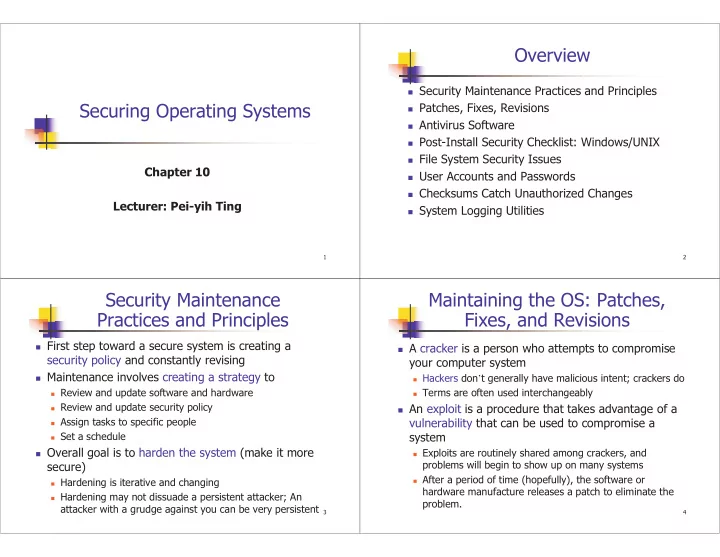
Security Maintenance Practices and Principles Patches, Fixes, Revisions Antivirus Software Post-Install Security Checklist: Windows/UNIX File System Security Issues User Accounts and Passwords Checksums Catch Unauthorized Changes System Logging Utilities

3

Security Maintenance Practices and Principles

First step toward a secure system is creating a

security policy and constantly revising

Maintenance involves creating a strategy to

Review and update software and hardware Review and update security policy Assign tasks to specific people Set a schedule

Overall goal is to harden the system (make it more

secure)

Hardening is iterative and changing Hardening may not dissuade a persistent attacker; An

attacker with a grudge against you can be very persistent

4

Maintaining the OS: Patches, Fixes, and Revisions

A cracker is a person who attempts to compromise

your computer system

Hackers don’t generally have malicious intent; crackers do Terms are often used interchangeably

An exploit is a procedure that takes advantage of a

vulnerability that can be used to compromise a system

Exploits are routinely shared among crackers, and

problems will begin to show up on many systems

After a period of time (hopefully), the software or

hardware manufacture releases a patch to eliminate the problem.

slide-2
SLIDE 2

5

Patches, Fixes, and Revisions

Make sure you understand what a patch does before

installing it

Make sure you have a valid system backup before

installing any new software.

Never trust a security patch you did not request. Soft

ware vendors do not send out patches. Then send notifications.

Catalog the software packages you have installed on

your system and keep them up to date.

6

Antivirus Software

Identifies files that contain known viruses Antivirus software has a scanning mode that checks

files throughout a system to see if they contain a virus signature

A virus signature is a set of instructions or data that is

unique to a particular virus

After scanning, the software can remove or

quarantine the virus

However, the cleaned system might lose some important

executables.

7

Antivirus Software (cont’d)

A virus shield runs in the background and scans

all incoming data/files for viruses

Files downloaded, web pages browsed/cached, or

emails received (sent)

The virus signature database must be up to date

in order to be effective

Most antivirus packages offer automatic updates

After an update, you should scan your file system to

catch any files that have already been infected

A final precaution is to train users to understand

the basics of malicious code attack and report suspicious activities

8

Applying a Post-Install Security Checklist

Develop and use a security checklist to ensure that

you have achieved all of the required tasks

A checklist helps you to stay organized under pressure A checklist should be based on professional

experiences

Use standard checklists available from the operating system

manufacturer and other resources as basis

They contain the summary of past attempts to secure

computers and include action items of things to do and things not to do

Customize the checklist for your own environment

slide-3
SLIDE 3

9

Windows Checklist Elements (1/6)

Hardening the Windows Registry

The registry is a central repository for system values Arranged as a hierarchical database of registry keys that

store values

Can be edited with the Windows Registry Editor

(regedit.exe or regedt32.exe) or 3rd party applications

It is important to understand the implications for each

key value, changes can be dangerous

Create a backup before changing the values in Windows

Registry

http://www.winguides.com/registry/ In WinXP, you can assign 11 permissions to each key 10

Windows Checklist Elements (2/6)

Table 10.1 Windows Registry Keys That Affect Security

Shell Implement a user-based custom shell DisablePersonalDirChange, DisableMyPicturesDirChange, DisableMyMusicDirChange, DisableFavoritesDirChange Restrict changes to user folder locations UpdateMode, NetworkPath, Verbose, Load Balance Manage system policy updates NoWindowsUpdate Restrict access to the Windows Update feature NoWinKeys Disable the Windows hotkeys NoClose Disable the shutdown command DisableRegistryTools Disable registry editing tools RestrictRun Restrict applications users can run NoViewOnDrive Prevent access to the content of selected drives KeyValueNames Descriptions

11

Windows Checklist Elements (3/6)

Removing Unneeded Services

The default Windows installation enables services that

may not be needed in many environments

Extra services consume resources and provide entry

points for attackers

Securing Networking Protocols and Services

Limit access to services that are not disabled Use a firewall if you’re connected to the Internet Disable networking protocols that are not used Review services related to remote access and

networking, and remove any that are non-essential, Be careful, many services are grouped together, you might be able to remove them but it could be hard to restore

12

Windows Checklist Elements (4/6)

Table 10.2 Windows Services That May Be Unneeded

If you do not plan to manage the registry remotely, disable this service Allows remote users to modify and maintain the registry Remote Registry Unless you need to perform

  • r support remote support,

disable this service Allows remote support Remote Desktop Help Session Manager Unless you need it, disable this service Allows others to share your desktop NetMeeting Remote Desktop Sharing Unless you are hosting a Web site, do not install this service Microsoft’s Web server Internet Information Services (IIS) Disable this service Allows remote users to print to a local printer Printer Sharing Disable this service Allows remote users to access local drives and files File Sharing Comments Descriptions Service

slide-4
SLIDE 4

13

Windows Checklist Elements (5/6)

Because all information, including passwords, is transmitted in the clear, disable this service. Use ssh instead Allows remote users to log in to your system Telnet Because there are no practical applications for this service yet, disable this service Allows your system to connect to network- enabled appliances Universal Plug and Play Device Host Disable this service; closes port 5000 Supports the Universal PnP Service SSDP Discovery Service Unless you need to dial in to your system, disable this service Allows for remote access to

  • ur system

Routing and Remote Access Comments Descriptions Service

Table 10.2 Windows Services That May Be Unneeded

14

Windows Checklist Elements (6/6)

Windows Security Miscellany

Physically secure your computer Stay up-to-date with operating system patches, through

Windows Update Web site

Download and use the Microsoft Baseline Security

Analyzer (MBSA) and enable the Encrypting File System for Windows XP

Do not use the Administrator account for daily usage Disable the Guest account Enable strong password policy Disable the CDROM auto-run feature, use antivirus S/W Enable system auditing, protect backup 15

UNIX Checklist Elements (1/4)

Security philosophy is similar for Windows and UNIX

but the details are substantially different

Removing Unneeded UNIX Protocols and Services

Disable any non-essential services and daemons Some services can be disabled by editing the /etc/inet.d

Working with the TCPWrapper

TCPWrapper is a common name for the tcpd daemon Can accept or deny any packet before it is passed to its

target

Uncover spoofed address through double-reverse lookup Suspicious requests can be dropped, logged, and/or an

administrator can be notified

16

UNIX Checklist Elements (2/4)

Table 10.3 UNIX Services and Daemons That May Be Unneeded

Disable it if you don’t need to provide FTP access Transfers files using the File Transfer Protocol (FTP) daemon Ftpd Disable this service if not needed Remote Procedure Call RPC Consider disallowing cron for regular users Executes commands at specified times Cron Disable the commands to reduce password and other data disclosure Allow remote users to interact with your system R-commands (rlogin, rsh, rcp, …) Disable this daemon unless it is considered essential Provides information about users on your system Fingerd Disable this Telnet daemon. Use ssh instead Allows remote user access Telnetd Comments Descriptions Service

slide-5
SLIDE 5

17

UNIX Checklist Elements (3/4)

Use these only if absolutely

  • necessary. Use with care.

Provide network access to files and volumes NFS, SAMBA, AFS, DFS Disable this service unless your computer processes e-

  • mail. If you need e-mail

processing, consider alternatives (qmail or postfix) Sends and forwards e-mail Sendmail Disable this service Transfers files (older method) UNIX to UNIX copy (UUCP) Disable this program Transfers files using a simpler version of FTP Trivial ftp (TFTP) Comments Descriptions Service

Table 10.3 UNIX Services and Daemons That May Be Unneeded

18

UNIX Checklist Elements (4/4)

UNIX Security Miscellany

Physically secure your computer Stay up-to-date with operating system patches Protect superuser Ids Ensure strong user passwords and train users on

passwords

Use antivirus software Protect backups Enable system auditing and review logs Run vulnerability scanners against your system 19

Understanding File System Security Issues

The file system is the set of programs that manage

and store data on secondary storage

The file system is presented as a hierarchical tree

structure

The top of the tree is the root directory (the entry point)

Disks can be divided into sections called partitions

Each partition has its own file system and root directory

In Windows, each file system has a drive letter In UNIX, each file system has a mount point

20

Securing NT File System (NTFS)

NTFS is the preferred file system for Windows

servers

Designed for file protection in a multi-user

environment

Each file or folder has associated access control lists File systems offer 6 to 13 possible permissions for

files and folders, attributes, and extended attributes

Stored in an access control entry (an ACL consists of

multiple ACEs)

NTFS gives administrators very precise access

control for files and folders

slide-6
SLIDE 6

21

Securing NTFS (cont’d)

Table 10.4 NTFS Permissions in Windows NT/2000/XP

Take folder ownership Take file ownership Take Ownership (O) Change a folder’s permission setting Change a file’s permission setting Change Permission (P) Delete a folder Delete a file Delete (D) Traverse a folder or subfolder Execute a program file Execute (X) Modify a folder’s contents Modify a file’s contents Write (W) Read a folder’s contents Read a file’s contents Read (R) Folder Permission Granted File Permission Granted Permission

22

Windows Share Security

Windows files and printers can be shared with

remote users

File and Printer Sharing enabled by default

Three security levels for each share

Global level: anyone can access the share Share level: requires a password for access User level: access is restricted to specific users 23

Understanding User Accounts and Passwords

A user account is the primary access requirement

for modern systems

The most common vulnerability in a user account is

a weak password

Educate users to create strong passwords

Don’t use dictionary words, common phrases, personal

information

Use a different password for each account Don’t write down passwords, and change them

periodically

Use combinations of letters, numbers, punctuation,

uppercase, and lowercase

24

Windows Account Security Mechanisms

Users are typically created at the domain level In newer Windows operating systems, all security

permissions can be centralized

Users can log into any computer in a domain

Must have administrator privileges to create user

accounts

User accounts can be added to security groups Permissions can be set at group level

Easier to assign group permissions Plan and organize account strategy before implementing

slide-7
SLIDE 7

25

UNIX Account Security Mechanisms

UNIX accounts are typically local Two levels of account security

User and group

File permissions can be set for users or groups Overall security concepts are similar to Windows

but details are different

26

Checksums Catch Unauthorized Changes

A checksum is a mathematically generated

number that is unique for a particular input

For the same input, the checksum will not change

unless the input changes

Used to ensure that files haven’t changed

without authorization

Commonly used in collecting forensic evidence Most operating systems implement utilities for

generating checksums

md5sum utility is popular tripwire 27

Using System Logging Utilities

Current operating systems allow many events to

be logged for later inspection

Login attempts, authorization changes, resource

accesses, print job activity, application and utility activity, and performance metrics

Logging uses resources

CPU resources, Storage resources, Manpower resources

Match logging activity to what is required in your

specific environment

Do more logging for systems that require strict security

  • r for new systems, less when not needed

28

Summary

Security maintenance requires a strategic plan for

Reviewing and updating hardware, software, and policies Assigning and scheduling tasks

Crackers try to compromise systems by finding and

sharing exploits

System is most vulnerable when a new exploit is

discovered

To minimize risk, stay up-to-date on

Operating system patches, fixes, and revisions Antivirus software

Antivirus software scans existing files and shields

incoming files

slide-8
SLIDE 8

29

Summary (cont’d)

Checklists should be used to maintain thorough and

disciplined security practices

should be customized for the operating system and the

environment

File systems generally allow some level of

permissions to be assigned to each file/directory to control access

User accounts are most vulnerable to weak

passwords

Checksums are used to tell if a file has been changed System logging is a powerful tool to be used

judiciously

30

Assignments

Reading: Chapter 10 Practice 10.11 Challenge Questions Turn in Challenge Exercise 10.1 next week