Overview Given two bases B and C for the same vector space, we saw - - PowerPoint PPT Presentation

overview
SMART_READER_LITE
LIVE PREVIEW

Overview Given two bases B and C for the same vector space, we saw - - PowerPoint PPT Presentation

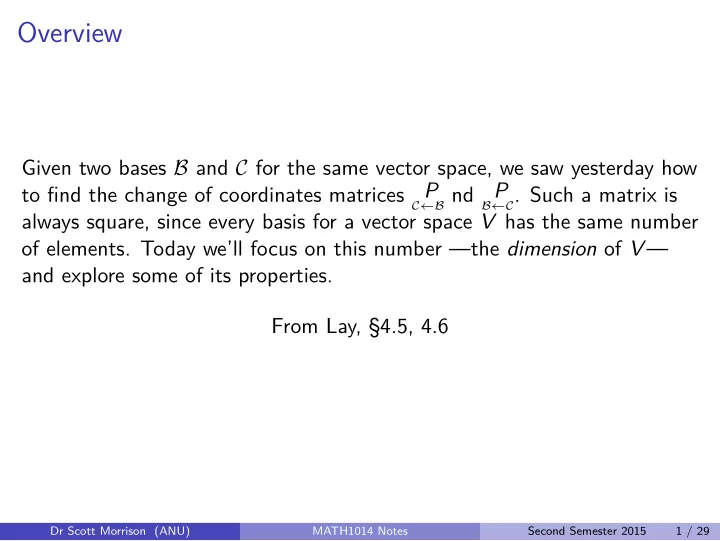
Overview Given two bases B and C for the same vector space, we saw yesterday how P P to find the change of coordinates matrices CB nd BC . Such a matrix is always square, since every basis for a vector space V has the same number of


slide-1
SLIDE 1

Overview

Given two bases B and C for the same vector space, we saw yesterday how to find the change of coordinates matrices P

C←B nd

P

B←C. Such a matrix is

always square, since every basis for a vector space V has the same number

  • f elements. Today we’ll focus on this number —the dimension of V —

and explore some of its properties. From Lay, §4.5, 4.6

Dr Scott Morrison (ANU) MATH1014 Notes Second Semester 2015 1 / 29

slide-2
SLIDE 2

Dimension

Definition

If a vector space V is spanned by a finite set, then V is said to be finite dimensional. The dimension of V , (written dim V ), is the number of vectors in a basis for V . The dimension of the zero vector space {0} is defined to be zero. If V is not spanned by a finite set, then V is said to be infinite dimensional.

Dr Scott Morrison (ANU) MATH1014 Notes Second Semester 2015 2 / 29

slide-3
SLIDE 3

Example 1

1 The standard basis for Rn contains n vectors, so dim Rn = n. 2 The standard basis for P3, which is {1, t, t2, t3}, shows that

dim P3 = 4.

3 The vector space of continuous functions on the real line is infinite

dimensional.

Dr Scott Morrison (ANU) MATH1014 Notes Second Semester 2015 3 / 29

slide-4
SLIDE 4

Dimension and the coordinate mapping

Recall the theorem we saw yesterday:

Theorem

Let B = {b1, b2, . . . , bn} be a basis for a vector space V . Then the coordinate mapping P : V → Rn defined by P(x) = [x]B is an isomorphism. (Recall that an isomorphism is a linear transformation that’s both

  • ne-to-one and onto.)

This means that every vector space with an n-element basis is isomorphic to Rn.

Dr Scott Morrison (ANU) MATH1014 Notes Second Semester 2015 4 / 29

slide-5
SLIDE 5

Dimension and the coordinate mapping

Recall the theorem we saw yesterday:

Theorem

Let B = {b1, b2, . . . , bn} be a basis for a vector space V . Then the coordinate mapping P : V → Rn defined by P(x) = [x]B is an isomorphism. (Recall that an isomorphism is a linear transformation that’s both

  • ne-to-one and onto.)

This means that every vector space with an n-element basis is isomorphic to Rn. We can now rephrase this theorem in new language:

Theorem

Any n-dimensional vector space is isomorphic to Rn.

Dr Scott Morrison (ANU) MATH1014 Notes Second Semester 2015 4 / 29

slide-6
SLIDE 6

Dimensions of subspaces of R3

Example 2

The 0 - dimensional subspace contains only the zero vector

               

.

Dr Scott Morrison (ANU) MATH1014 Notes Second Semester 2015 5 / 29

slide-7
SLIDE 7

Dimensions of subspaces of R3

Example 2

The 0 - dimensional subspace contains only the zero vector

               

. If u = 0, then Span {u} is a 1 - dimensional subspace. These subspaces are lines through the origin.

Dr Scott Morrison (ANU) MATH1014 Notes Second Semester 2015 5 / 29

slide-8
SLIDE 8

Dimensions of subspaces of R3

Example 2

The 0 - dimensional subspace contains only the zero vector

               

. If u = 0, then Span {u} is a 1 - dimensional subspace. These subspaces are lines through the origin. If u and v are linearly independent vectors in R3, then Span {u, v} is a 2 - dimensional subspace. These subspaces are planes through the origin.

Dr Scott Morrison (ANU) MATH1014 Notes Second Semester 2015 5 / 29

slide-9
SLIDE 9

Dimensions of subspaces of R3

Example 2

The 0 - dimensional subspace contains only the zero vector

               

. If u = 0, then Span {u} is a 1 - dimensional subspace. These subspaces are lines through the origin. If u and v are linearly independent vectors in R3, then Span {u, v} is a 2 - dimensional subspace. These subspaces are planes through the origin. If u, v and w are linearly independent vectors in R3, then Span {u, v, w} is a 3 - dimensional subspace. This subspace is R3 itself.

Dr Scott Morrison (ANU) MATH1014 Notes Second Semester 2015 5 / 29

slide-10
SLIDE 10

Theorem

Let H be a subspace of a finite dimensional vector space V . Then any linearly independent set in H can be expanded (if necessary) to form a basis for H.

Dr Scott Morrison (ANU) MATH1014 Notes Second Semester 2015 6 / 29

slide-11
SLIDE 11

Theorem

Let H be a subspace of a finite dimensional vector space V . Then any linearly independent set in H can be expanded (if necessary) to form a basis for H. Also, H is finite dimensional and dim H ≤ dim V .

Dr Scott Morrison (ANU) MATH1014 Notes Second Semester 2015 6 / 29

slide-12
SLIDE 12

Example 3

Let H = Span

       

1 1

   ,   

1 1

       

.

Dr Scott Morrison (ANU) MATH1014 Notes Second Semester 2015 7 / 29

slide-13
SLIDE 13

Example 3

Let H = Span

       

1 1

   ,   

1 1

       

. Then H is a subspace of R3 and dim H < dim R3.

Dr Scott Morrison (ANU) MATH1014 Notes Second Semester 2015 7 / 29

slide-14
SLIDE 14

Example 3

Let H = Span

       

1 1

   ,   

1 1

       

. Then H is a subspace of R3 and dim H < dim R3. Furthermore, we can expand the given spanning set for H

       

1 1

   ,   

1 1

       

to

       

1 1

   ,   

1 1

   ,   

1

       

to form a basis for R3.

Question

Can you find another vector that you could have added to the spanning set for H to form a basis for R3?

Dr Scott Morrison (ANU) MATH1014 Notes Second Semester 2015 7 / 29

slide-15
SLIDE 15

When the dimension of a vector space or subspace is known, the search for a basis is simplified.

Theorem (The Basis Theorem)

Let V be a p-dimensional space, p ≥ 1.

1 Any linearly independent set of exactly p elements in V is a basis for

V .

2 Any set of exactly p elements that spans V is a basis for V . Dr Scott Morrison (ANU) MATH1014 Notes Second Semester 2015 8 / 29

slide-16
SLIDE 16

Example 4

Schrödinger’s equation is of fundamental importance in quantum

  • mechanics. One of the first problems to solve is the one-dimensional

equation for a simple quadratic potential, the so-called linear harmonic

  • scillator.

Analysing this leads to the equation d2y dx2 − 2x dy dx + 2ny = 0 where n = 0, 1, 2, ...

Dr Scott Morrison (ANU) MATH1014 Notes Second Semester 2015 9 / 29

slide-17
SLIDE 17

Example 4

Schrödinger’s equation is of fundamental importance in quantum

  • mechanics. One of the first problems to solve is the one-dimensional

equation for a simple quadratic potential, the so-called linear harmonic

  • scillator.

Analysing this leads to the equation d2y dx2 − 2x dy dx + 2ny = 0 where n = 0, 1, 2, ... There are polynomial solutions, the Hermite polynomials. The first few are H0(x) = 1 H3(x) = −12x + 8x3 H1(x) = 2x H4(x) = 12 − 48x3 + 16x4 H2(x) = −2 + 4x2 H5(x) = 120x − 160x3 + 32x5

Dr Scott Morrison (ANU) MATH1014 Notes Second Semester 2015 9 / 29

slide-18
SLIDE 18

Example 4

Schrödinger’s equation is of fundamental importance in quantum

  • mechanics. One of the first problems to solve is the one-dimensional

equation for a simple quadratic potential, the so-called linear harmonic

  • scillator.

Analysing this leads to the equation d2y dx2 − 2x dy dx + 2ny = 0 where n = 0, 1, 2, ... There are polynomial solutions, the Hermite polynomials. The first few are H0(x) = 1 H3(x) = −12x + 8x3 H1(x) = 2x H4(x) = 12 − 48x3 + 16x4 H2(x) = −2 + 4x2 H5(x) = 120x − 160x3 + 32x5 We want to show that these polynomials form a basis for P5.

Dr Scott Morrison (ANU) MATH1014 Notes Second Semester 2015 9 / 29

slide-19
SLIDE 19

Writing the coordinate vectors relative to the standard basis for P5 we get

        

1

        

,

        

2

        

,

        

−2 4

        

,

        

−12 8

        

,

        

12 −48 16

        

,

        

120 −160 32

        

.

Dr Scott Morrison (ANU) MATH1014 Notes Second Semester 2015 10 / 29

slide-20
SLIDE 20

Writing the coordinate vectors relative to the standard basis for P5 we get

        

1

        

,

        

2

        

,

        

−2 4

        

,

        

−12 8

        

,

        

12 −48 16

        

,

        

120 −160 32

        

. This makes it clear that the vectors are linearly independent. Why?

Dr Scott Morrison (ANU) MATH1014 Notes Second Semester 2015 10 / 29

slide-21
SLIDE 21

Writing the coordinate vectors relative to the standard basis for P5 we get

        

1

        

,

        

2

        

,

        

−2 4

        

,

        

−12 8

        

,

        

12 −48 16

        

,

        

120 −160 32

        

. This makes it clear that the vectors are linearly independent. Why? Since dim P5 = 6 and there are 6 polynomials that are linearly independent, the Basis Theorem shows that they form a basis for P5.

Dr Scott Morrison (ANU) MATH1014 Notes Second Semester 2015 10 / 29

slide-22
SLIDE 22

The dimensions of Nul A and Col A

Recall that last week we saw explicit algorithms for finding bases for the null space and the column space of a matrix A.

Dr Scott Morrison (ANU) MATH1014 Notes Second Semester 2015 11 / 29

slide-23
SLIDE 23

The dimensions of Nul A and Col A

Recall that last week we saw explicit algorithms for finding bases for the null space and the column space of a matrix A.

1 To find a basis for Nul A, use elementary row operations to transform

[A 0] to an equivalent reduced row echelon form [B 0]. Use the row reduced echelon form to find a parametric form of the general solution to Ax = 0. If Nul A = {0}, the vectors found in this parametric form of the general solution are automatically linearly independent and form a basis for Nul A.

Dr Scott Morrison (ANU) MATH1014 Notes Second Semester 2015 11 / 29

slide-24
SLIDE 24

The dimensions of Nul A and Col A

Recall that last week we saw explicit algorithms for finding bases for the null space and the column space of a matrix A.

1 To find a basis for Nul A, use elementary row operations to transform

[A 0] to an equivalent reduced row echelon form [B 0]. Use the row reduced echelon form to find a parametric form of the general solution to Ax = 0. If Nul A = {0}, the vectors found in this parametric form of the general solution are automatically linearly independent and form a basis for Nul A.

2 A basis for Col A is is formed from the pivot columns of A.

The matrix B determines the pivot columns, but it is important to return to the matrix A.

Dr Scott Morrison (ANU) MATH1014 Notes Second Semester 2015 11 / 29

slide-25
SLIDE 25

The dimensions of Nul A and Col A

Recall that last week we saw explicit algorithms for finding bases for the null space and the column space of a matrix A.

1 To find a basis for Nul A, use elementary row operations to transform

[A 0] to an equivalent reduced row echelon form [B 0]. Use the row reduced echelon form to find a parametric form of the general solution to Ax = 0. If Nul A = {0}, the vectors found in this parametric form of the general solution are automatically linearly independent and form a basis for Nul A.

2 A basis for Col A is is formed from the pivot columns of A.

The matrix B determines the pivot columns, but it is important to return to the matrix A.

Dimension of Nul A and Col A

The dimension of Nul A is the number of free variables in the equation Ax = 0. The dimension of Col A is the number of pivot columns in A.

Dr Scott Morrison (ANU) MATH1014 Notes Second Semester 2015 11 / 29

slide-26
SLIDE 26

Example 5

Given the matrix A =

    

1 −6 9 10 −2 1 2 −4 5 5 1

     ,

what are the dimensions of the null space and column space?

Dr Scott Morrison (ANU) MATH1014 Notes Second Semester 2015 12 / 29

slide-27
SLIDE 27

Example 5

Given the matrix A =

    

1 −6 9 10 −2 1 2 −4 5 5 1

     ,

what are the dimensions of the null space and column space? There are three pivots and two free variables, so dim(Nul A) = 2 and dim(Col A) = 3.

Dr Scott Morrison (ANU) MATH1014 Notes Second Semester 2015 12 / 29

slide-28
SLIDE 28

Example 6

Given the matrix A =

  

1 −1 4 7 5

   ,

Dr Scott Morrison (ANU) MATH1014 Notes Second Semester 2015 13 / 29

slide-29
SLIDE 29

Example 6

Given the matrix A =

  

1 −1 4 7 5

   ,

there are three pivots and no free variables, dim(Nul A) = 0 and dim(Col A) = 3.

Dr Scott Morrison (ANU) MATH1014 Notes Second Semester 2015 13 / 29

slide-30
SLIDE 30

The rank theorem

As before, let A be a matrix and let B be its reduced row echelon form dim Col A = # of pivots of A = # of pivot columns of B

Definition

The rank of a matrix A is the dimension of the column space of A.

Dr Scott Morrison (ANU) MATH1014 Notes Second Semester 2015 14 / 29

slide-31
SLIDE 31

The rank theorem

As before, let A be a matrix and let B be its reduced row echelon form dim Col A = # of pivots of A = # of pivot columns of B

Definition

The rank of a matrix A is the dimension of the column space of A. dim Nul A = # of free variables of B = # of non-pivot columns of B. Compare the two red boxes. What does this tell about the relationship between the dimensions of the null space and column space of matrix?

Dr Scott Morrison (ANU) MATH1014 Notes Second Semester 2015 14 / 29

slide-32
SLIDE 32

Theorem

If A is an m × n matrix, then Rank A + dim Nul A = n.

Dr Scott Morrison (ANU) MATH1014 Notes Second Semester 2015 15 / 29

slide-33
SLIDE 33

Theorem

If A is an m × n matrix, then Rank A + dim Nul A = n.

Proof.

  • number of

pivot columns

  • +
  • number of

nonpivot columns

  • =
  • number of

columns

  • .

Dr Scott Morrison (ANU) MATH1014 Notes Second Semester 2015 15 / 29

slide-34
SLIDE 34

Examples

Example 7

If a 6 × 3 matrix A has rank 3, what can we say about dim Nul A, dim Col A and Rank A?

Dr Scott Morrison (ANU) MATH1014 Notes Second Semester 2015 16 / 29

slide-35
SLIDE 35

Examples

Example 7

If a 6 × 3 matrix A has rank 3, what can we say about dim Nul A, dim Col A and Rank A? Rank A + dim Nul A = 3. Since A only has three columns, and and all three are pivot columns, there are no free variables in the equation Ax = 0. Hence dim Nul A = 0. dim Col A = Rank A = 3.

Dr Scott Morrison (ANU) MATH1014 Notes Second Semester 2015 16 / 29

slide-36
SLIDE 36

The row space of a matrix

The null space and the column space are the fundamental subspaces associated to a matrix, but there’s one other natural subspace to consider:

Definition

The row space Row A of an m × n matrix A is the subspace of Rn spanned by the rows of A.

Dr Scott Morrison (ANU) MATH1014 Notes Second Semester 2015 17 / 29

slide-37
SLIDE 37

Example 8

For the matrix A given by A =

    

1 −6 9 10 −2 3 1 2 −4 5 −2 −1 5 1 4 −3 1 6

     ,

we can write r1 = [1, −6, 9, 10, −2] r2 = [3, 1, 2, −4, 5] r3 = [−2, 0, −1, 5, 1] r4 = [4, −3, 1, 0, 6 The row space of A is the subspace of R5 spanned by {r1, r2, r3, r4}. (Note that we’re writing the vectors ri as rows, rather than columns, for convenience.)

Dr Scott Morrison (ANU) MATH1014 Notes Second Semester 2015 18 / 29

slide-38
SLIDE 38

A basis for Row B

Theorem

Suppose a matrix B is obtained from a matrix A by row operations. Then Row A = Row B. If B is an echelon form of A, then the non-zero rows of B form a basis for Row B.

Dr Scott Morrison (ANU) MATH1014 Notes Second Semester 2015 19 / 29

slide-39
SLIDE 39

A basis for Row B

Theorem

Suppose a matrix B is obtained from a matrix A by row operations. Then Row A = Row B. If B is an echelon form of A, then the non-zero rows of B form a basis for Row B. Compare this to our procedure for finding a basis for Col A. Notice that it’s simpler: after row reducing, we don’t need to return to the original matrix to find our basis!

Dr Scott Morrison (ANU) MATH1014 Notes Second Semester 2015 19 / 29

slide-40
SLIDE 40

A basis for Row B

Theorem

Suppose a matrix B is obtained from a matrix A by row operations. Then Row A = Row B. If B is an echelon form of A, then the non-zero rows of B form a basis for Row B. Compare this to our procedure for finding a basis for Col A. Notice that it’s simpler: after row reducing, we don’t need to return to the original matrix to find our basis!

Proof.

If a matrix B is obtained from a matrix A by row operations, then the rows

  • f B are linear combinations of those of A, so that Row B ⊆ Row A.

But row operations are reversible, which gives the reverse inclusion so that Row A = Row B. In fact if B is an echelon form of A, then any non-zero row is linearly independent of the rows below it (because of the leading non-zero entry), and so the non-zero rows of B form a basis for Row B = Row A.

Dr Scott Morrison (ANU) MATH1014 Notes Second Semester 2015 19 / 29

slide-41
SLIDE 41

The Rank Theorem –Updated!

Theorem

For any m × n matrix A, Col A and Row A have the same dimension. This common dimension, the rank of A, is equal to the number of pivot positions in A and satisfies the equation Rank A + dim Nul A = n.

Dr Scott Morrison (ANU) MATH1014 Notes Second Semester 2015 20 / 29

slide-42
SLIDE 42

The Rank Theorem –Updated!

Theorem

For any m × n matrix A, Col A and Row A have the same dimension. This common dimension, the rank of A, is equal to the number of pivot positions in A and satisfies the equation Rank A + dim Nul A = n. This additional statement in this theorem follows from our process for finding bases for Row A and Col A: Use row operations to replace A with its reduced row echelon form. Each pivot determines a vector (a column of A) in the basis for Col A and a vector (a row of B) in the basis for Row A. Note also Rank A = Rank AT.

Dr Scott Morrison (ANU) MATH1014 Notes Second Semester 2015 20 / 29

slide-43
SLIDE 43

Example 9

Suppose a 4 × 7 matrix A has 4 pivot columns.

Dr Scott Morrison (ANU) MATH1014 Notes Second Semester 2015 21 / 29

slide-44
SLIDE 44

Example 9

Suppose a 4 × 7 matrix A has 4 pivot columns. Col A ⊆ R4 and dim Col A = 4. So Col A = R4. On the other hand, Row A ⊆ R7, so that even though dim Row A = 4, Row A = R4.

Dr Scott Morrison (ANU) MATH1014 Notes Second Semester 2015 21 / 29

slide-45
SLIDE 45

Example 9

Suppose a 4 × 7 matrix A has 4 pivot columns. Col A ⊆ R4 and dim Col A = 4. So Col A = R4. On the other hand, Row A ⊆ R7, so that even though dim Row A = 4, Row A = R4.

Example 10

If A is a 6 × 8 matrix, then the smallest possible dimension of Nul A is 2.

Dr Scott Morrison (ANU) MATH1014 Notes Second Semester 2015 21 / 29

slide-46
SLIDE 46

Example 11

A =

  

1 2 2 −1 3 6 5 1 2 1 2

  

rref

− − →

  

1 2 5 1 −3

  

Dr Scott Morrison (ANU) MATH1014 Notes Second Semester 2015 22 / 29

slide-47
SLIDE 47

Example 11

A =

  

1 2 2 −1 3 6 5 1 2 1 2

  

rref

− − →

  

1 2 5 1 −3

  

Thus, {r1 = (1, 2, 0, 5), r2 = (0, 0, 1, −3)} is a basis for Row A. (Note that these are rows of rref (A), not rows of A.)

Dr Scott Morrison (ANU) MATH1014 Notes Second Semester 2015 22 / 29

slide-48
SLIDE 48

Example 11

A =

  

1 2 2 −1 3 6 5 1 2 1 2

  

rref

− − →

  

1 2 5 1 −3

  

Thus, {r1 = (1, 2, 0, 5), r2 = (0, 0, 1, −3)} is a basis for Row A. (Note that these are rows of rref (A), not rows of A.) Pivots are in columns 1 and 3 of rref (A), so that

       

1 3 1

   ,   

2 5 1

       

is a basis for Col A. (Note these are columns of A.)

Dr Scott Morrison (ANU) MATH1014 Notes Second Semester 2015 22 / 29

slide-49
SLIDE 49

Example 12

A =

    

2 −3 6 2 5 −2 3 −3 −3 −4 4 −6 9 5 9 −2 3 3 −4 1

    

ref

− − → B =

    

2 −3 6 2 5 3 −1 1 1 3

    

Dr Scott Morrison (ANU) MATH1014 Notes Second Semester 2015 23 / 29

slide-50
SLIDE 50

Example 12

A =

    

2 −3 6 2 5 −2 3 −3 −3 −4 4 −6 9 5 9 −2 3 3 −4 1

    

ref

− − → B =

    

2 −3 6 2 5 3 −1 1 1 3

    

The number of pivots in B is three, so dim Col A = 3 and a basis for Col A is given by

             

2 −2 4 −2

     ,     

6 −3 9 3

     ,     

2 −3 5 −4

             

Dr Scott Morrison (ANU) MATH1014 Notes Second Semester 2015 23 / 29

slide-51
SLIDE 51

Example 12

A =

    

2 −3 6 2 5 −2 3 −3 −3 −4 4 −6 9 5 9 −2 3 3 −4 1

    

ref

− − → B =

    

2 −3 6 2 5 3 −1 1 1 3

    

The number of pivots in B is three, so dim Col A = 3 and a basis for Col A is given by

             

2 −2 4 −2

     ,     

6 −3 9 3

     ,     

2 −3 5 −4

             

A basis for Row A is given by {(2, −3, 6, 2, 5), (0, 0, 3, −1, 1), (0, 0, 0, 1, 3)}.

Dr Scott Morrison (ANU) MATH1014 Notes Second Semester 2015 23 / 29

slide-52
SLIDE 52

Example 12

A =

    

2 −3 6 2 5 −2 3 −3 −3 −4 4 −6 9 5 9 −2 3 3 −4 1

    

ref

− − → B =

    

2 −3 6 2 5 3 −1 1 1 3

    

The number of pivots in B is three, so dim Col A = 3 and a basis for Col A is given by

             

2 −2 4 −2

     ,     

6 −3 9 3

     ,     

2 −3 5 −4

             

A basis for Row A is given by {(2, −3, 6, 2, 5), (0, 0, 3, −1, 1), (0, 0, 0, 1, 3)}. From B we can see that there are two free variables for the equation Ax = 0, so dim Nul A = 2. How would you find a basis for this subspace?

Dr Scott Morrison (ANU) MATH1014 Notes Second Semester 2015 23 / 29

slide-53
SLIDE 53

Applications to systems of equations

The rank theorem is a powerful tool for processing information about systems of linear equations.

Example 13

Suppose that the solutions of a homogeneous system of five linear equations in six unknowns are all multiples of one nonzero solution. Will the system necessarily have a solution for every possible choice of constants on the right hand side of the equations?

Dr Scott Morrison (ANU) MATH1014 Notes Second Semester 2015 24 / 29

slide-54
SLIDE 54

Applications to systems of equations

The rank theorem is a powerful tool for processing information about systems of linear equations.

Example 13

Suppose that the solutions of a homogeneous system of five linear equations in six unknowns are all multiples of one nonzero solution. Will the system necessarily have a solution for every possible choice of constants on the right hand side of the equations? Solution The hardest thing to figure out is What is the question asking? A non-homogeneous system of equations Ax = b always has a solution if and only if the dimension of the column space of the matrix A is the same as the length of the columns.

Dr Scott Morrison (ANU) MATH1014 Notes Second Semester 2015 24 / 29

slide-55
SLIDE 55

In this case if we think of the system as Ax = b, then A is a 5 × 6 matrix, and the columns have length 5: each column is a vector in R5. The question is asking Do the columns span R5?

  • r equivalently,

Is the rank of the column space equal to 5? First note that dim Nul A = 1. We use the equation: Rank A + dim Nul A = 6 to deduce that Rank A = 5. Hence the dimension of the column space of A is 5, Col A = R5 and the system of non-homogeneous equations always has a solution.

Dr Scott Morrison (ANU) MATH1014 Notes Second Semester 2015 25 / 29

slide-56
SLIDE 56

Example 14

A homogeneous system of twelve linear equations in eight unknowns has two fixed solutions that are not multiples of each other, and all other solutions are linear combinations of these two solutions. Can the set of all solutions be described with fewer than twelve homogeneous linear equations? If so, how many?

Dr Scott Morrison (ANU) MATH1014 Notes Second Semester 2015 26 / 29

slide-57
SLIDE 57

Example 14

A homogeneous system of twelve linear equations in eight unknowns has two fixed solutions that are not multiples of each other, and all other solutions are linear combinations of these two solutions. Can the set of all solutions be described with fewer than twelve homogeneous linear equations? If so, how many? Considering the corresponding matrix system Ax = 0, the key points are A is a 12 × 8 matrix. dim Nul A = 2 Rank A + dim Nul A = 8 What is the rank of A? How many equations are actually needed?

Dr Scott Morrison (ANU) MATH1014 Notes Second Semester 2015 26 / 29

slide-58
SLIDE 58

Example 15

Let A =

  

2 −2 −2 2 1 2

  .

Dr Scott Morrison (ANU) MATH1014 Notes Second Semester 2015 27 / 29

slide-59
SLIDE 59

Example 15

Let A =

  

2 −2 −2 2 1 2

  . The following are easily checked:

Nul A is the z-axis. Row A is the xy-plane. Col A is the plane whose equation is x + y = 0. Nul AT is the set of all multiples of (1, 1, 0). Nul A and Row A are perpendicular to each other. Col A and Nul AT are also perpendicular.

Dr Scott Morrison (ANU) MATH1014 Notes Second Semester 2015 27 / 29

slide-60
SLIDE 60

Theorem (Invertible Matrix Theorem ctd)

Let A be an n × n matrix. Then the following statements are each equivalent to the statement that A is an invertible matrix.

  • m. The columns of A form a basis of Rn.
  • n. Col A = Rn.
  • . dim Col A = n.
  • p. Rank A = n.
  • q. Nul A = {0}.
  • r. dim Nul A = 0.

(The numbering continues the statement of the Invertible Matrix Theorem from Lay §2.3.)

Dr Scott Morrison (ANU) MATH1014 Notes Second Semester 2015 28 / 29

slide-61
SLIDE 61

Summary

1 Every basis for V has the same number of elements. This number is

called the dimension of V .

2 If V is n-dimensional, V is isomorphic to Rn. 3 A linearly independent list of vectors in V can be extended to a basis

for V .

4 If the dimension of V is n, any linearly independent list of n vectors is

a basis for V .

5 If the dimension of V is n, any spanning set of n vectors is a basis for

V .

Dr Scott Morrison (ANU) MATH1014 Notes Second Semester 2015 29 / 29