Overview Hash Functions On Building Hash Functions From - - PDF document

overview
SMART_READER_LITE
LIVE PREVIEW

Overview Hash Functions On Building Hash Functions From - - PDF document

Overview Hash Functions On Building Hash Functions From Multivariate Quadratic Equations Multivariate quadratic equations Olivier Billet, Thomas Peyrin, and Matt Robshaw Hash functions and multivariate quadratic equations Orange Labs


slide-1
SLIDE 1

1

Orange Labs

On Building Hash Functions From Multivariate Quadratic Equations

Olivier Billet, Thomas Peyrin, and Matt Robshaw Orange Labs France

02.07.07

MQ-Hash Matt Robshaw (2) Orange Labs

Overview

Hash Functions Multivariate quadratic equations Hash functions and multivariate quadratic equations Pro's and con's Conclusions

MQ-Hash Matt Robshaw (3) Orange Labs

Hash Functions

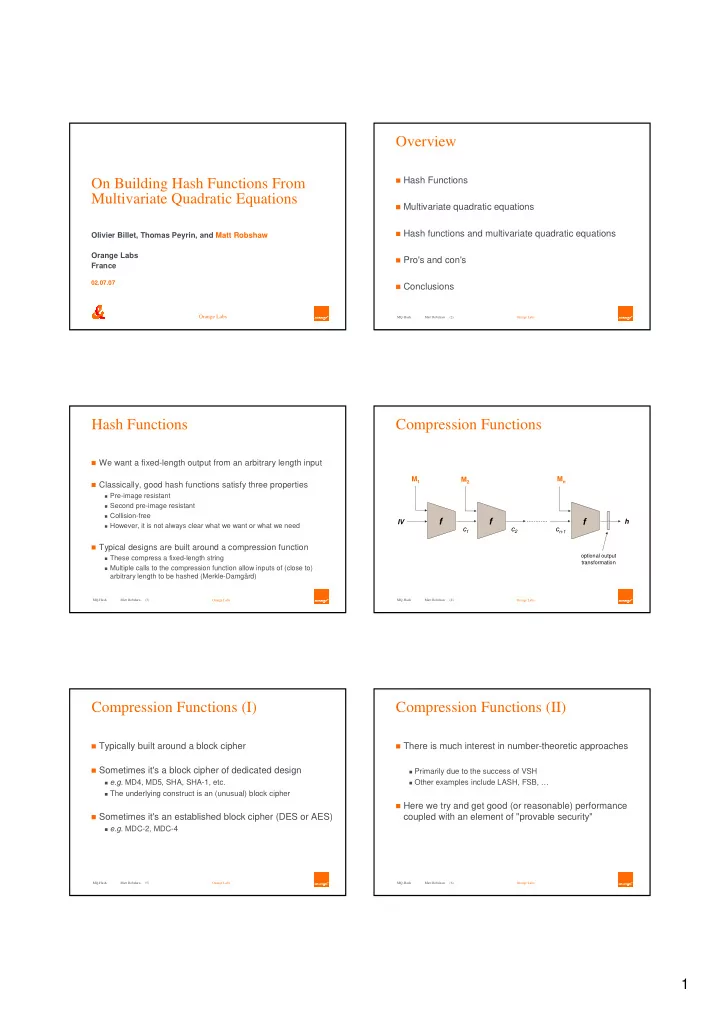
We want a fixed-length output from an arbitrary length input Classically, good hash functions satisfy three properties

Pre-image resistant Second pre-image resistant Collision-free However, it is not always clear what we want or what we need

Typical designs are built around a compression function

These compress a fixed-length string Multiple calls to the compression function allow inputs of (close to)

arbitrary length to be hashed (Merkle-Damgård)

MQ-Hash Matt Robshaw (4) Orange Labs

IV M1 M2

f f

Mn

f

h c1 c2 cn-1

Compression Functions

  • ptional output

transformation

MQ-Hash Matt Robshaw (5) Orange Labs

Compression Functions (I)

Typically built around a block cipher Sometimes it's a block cipher of dedicated design

e.g. MD4, MD5, SHA, SHA-1, etc. The underlying construct is an (unusual) block cipher

Sometimes it's an established block cipher (DES or AES)

e.g. MDC-2, MDC-4

MQ-Hash Matt Robshaw (6) Orange Labs

Compression Functions (II)

There is much interest in number-theoretic approaches

Primarily due to the success of VSH Other examples include LASH, FSB, …

Here we try and get good (or reasonable) performance

coupled with an element of "provable security"

slide-2
SLIDE 2

2

MQ-Hash Matt Robshaw (7) Orange Labs

In This Paper

We consider efforts to build a compression function

based on Multivariate Quadratic Equations (MQE)

Can we get some "provable" security with reasonable

performance ?

MQ-Hash Matt Robshaw (8) Orange Labs

Multivariate Quadratic Equations

Solving a random system of multivariate quadratic

equations over a field F is (in general) difficult q1 (x1, … , xn) = Σ1 ≤ i ≤ j ≤ n ai,jxixj + Σ1 ≤ k ≤ n bkxk + c q2 (x1, … , xn) = … ↓ qm (x1, … , xn) = … Given y1, … , ym find some x1, … , xn such that y1 = q1 (x1, … , xn), … , ym = qm (x1, … , xn)

MQ-Hash Matt Robshaw (9) Orange Labs

Multivariate Quadratic Equations

However, evaluating a set of polynomials is very easy

There is a very appealing natural one-way quality

There has been mixed success using this in public key

cryptography

We need to embed a trapdoor which is not always easy

But some success in symmetric cryptography (QUAD)

MQ-Hash Matt Robshaw (10) Orange Labs

Starting Out

It is natural to try and build a hash function from MQE

We get one-way properties for free

compress: F n → F v compress(x1, … , xn) = (q1(x1, … , xn), … , qv(x1, … , xn)) f

arrange the input bits as n variables in F v variables in F are the output from v equations

MQ-Hash Matt Robshaw (11) Orange Labs

Pre-image Resistant, but …

If there are collisions they will be easy to find

First order differential of quadratic polynomials is affine

Our challenge is to find a different way of using MQE

Provably maintain pre-image resistance property Provide (at least) plausible collision-free property

MQ-Hash Matt Robshaw (12) Orange Labs

A Two-Step Approach

We build a two-step compression function MQ-hash

Use MQE in both steps

Use MQE to give some "compression" but apply some

pre-processing

Pre-processing appears in several guises, but our work is

somewhat related to Aiello, Haber, and Venketasen (FSE 1998)

Intuition: Collisions might be obvious in the second component

but they hard to extend to the full compression function

slide-3
SLIDE 3

3

MQ-Hash Matt Robshaw (13) Orange Labs

MQ-hash = Qg •Qf

f g

ci ci-1 Mi

Qf Qg

n + m r r n expansion compression

MQ-Hash Matt Robshaw (14) Orange Labs

Outline of Reasoning

For MQ-hash to be one-way

Qg is one-way (this is our starting point) The MQE in Qf are "well-behaved"

  • We borrow from QUAD for this

For MQ-hash to be (plausibly) collision-free

Collisions in Qg cannot be lifted to the compression function

  • Qf should be one-way

Qf should not induce collisions

  • Qf stretches the input

MQ-Hash Matt Robshaw (15) Orange Labs

Parameters and Performance

Qf consists of r equations in n+m variables Qg consists of n equations in r variables Suppose we seek a security level of 2k operations

We require that n ≥

≥ ≥ ≥ 2k

We can bound the probability that Qf is not an injection We require that r ≈

≈ ≈ ≈ 2(n+m) + k

At each iteration we hash m bits of message For GF(2) we might chose n = 160, m = 32, and r = 464

… but the performance is (very) poor

MQ-Hash Matt Robshaw (16) Orange Labs

The MQ-hash Proposal

Pro's:

Provably pre-image resistant construction Conjectured collision-free and second pre-image resistant

Con's:

Terrible performance (storage and hashing rate)

MQ-Hash Matt Robshaw (17) Orange Labs

An Alternative Construction

However MQE are very versatile building blocks

Perhaps this construction could be of some interest

f g

ci ci-1 Mi

Qf Qg

m n

MQ-Hash Matt Robshaw (18) Orange Labs

Conclusions

We have explored the use of multivariate quadratic

equations in designing a hash function

We (successfully) tackled some intricate issues Gained additional insight into using MQE

However, our feeling is that this isn't the way to go

New research might uncover better ways of using ME But we doubt random MQE systems are a practical building

block for a hash function