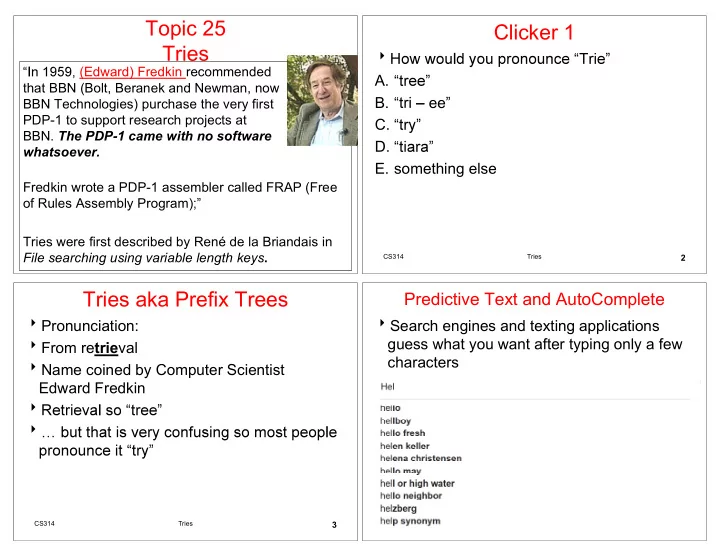
Topic 25 Clicker 1 Tries (Edward) Fredkin recommended A. that - - PowerPoint PPT Presentation

topic 25 clicker 1 tries
SMART_READER_LITE
LIVE PREVIEW

Topic 25 Clicker 1 Tries (Edward) Fredkin recommended A. that - - PowerPoint PPT Presentation

Topic 25 Clicker 1 Tries (Edward) Fredkin recommended A. that BBN (Bolt, Beranek and Newman, now B. ee BBN Technologies) purchase the very first PDP-1 to support research projects at C. BBN. The PDP-1 came with no software D. whatsoever.


slide-1
SLIDE 1

Topic 25 Tries

(Edward) Fredkin recommended that BBN (Bolt, Beranek and Newman, now BBN Technologies) purchase the very first PDP-1 to support research projects at

  • BBN. The PDP-1 came with no software

whatsoever. Fredkin wrote a PDP-1 assembler called FRAP (Free

  • f Rules Assembly Program

Tries were first described by René de la Briandais in File searching using variable length keys.

Clicker 1

A. B. ee C. D.

  • E. something else

CS314 Tries

2

Tries aka Prefix Trees

Pronunciation: From retrieval Name coined by Computer Scientist Edward Fredkin

CS314 Tries

3

CS314 Tries

4

Predictive Text and AutoComplete

Search engines and texting applications guess what you want after typing only a few characters

slide-2
SLIDE 2

AutoComplete

So do other programs such as IDEs

CS314 Tries

5

Searching a Dictionary

How? Could search a set for all values that start with the given prefix. Naively O(N) (search the whole data structure). Could improve if possible to do a binary search for prefix and then localize search to that location. Difficulties if prefix is not actually in the set or dictionary

CS314 Tries

6

Tries

A general tree Root node (or possible a list of root nodes) Nodes can have many children

not a binary tree

In simplest form each node stores a character and a data structure (list?) to refer to its children Stores all the words or phrases in a dictionary. How?

CS314 Tries

7

René de la Briandais Original Paper

CS314 Tries

8

slide-3
SLIDE 3

????

CS314 Tries

9

Picture of a Dinosaur

Can

CS314 Tries

10

Candy

CS314 Tries

11

Fox

CS314 Tries

12

slide-4
SLIDE 4

Clicker 2

Trie?

  • A. No
  • B. Yes
  • C. It depends

CS314 Tries

13

Clicker 3

Trie?

  • A. No
  • B. Yes
  • C. It depends

CS314 Tries

14

Tries

CS314 Tries

15

Another example

  • f a Trie

Each node stores:

A char A boolean indicating if the string ending at that node is a word A list of children

Predictive Text and AutoComplete

CS314 Tries

16

As characters are entered we descend the Trie we can descend to terminators and leaves to see all possible words based on current prefix b, e, e -> bee, been, bees

slide-5
SLIDE 5

Stores words and phrases.

  • ther values

possible, but typically Strings

The whole word or phrase is not actually stored at a single spot. Rather the path in the tree represents the word

Tries Implementing a Trie

CS314 Tries

18

TNode Class

Basic implementation uses a LinkedList of TNode objects for children Other options?

ArrayList? Something more exotic?

CS314 Tries

19

Basic Operations

Adding a word to the Trie Getting all words with given prefix Demo in IDE

CS314 Tries

20

slide-6
SLIDE 6

Compressed Tries

Some words, especially long ones, lead to a chain of nodes with single child, followed by single child:

b s e i u a r l l d

  • y

y e l l t

  • c

k p

Compressed Trie

Reduce number of nodes, by having nodes store Strings A chain of single child followed by single compressed to a single node with that String Does not have to be a chain that terminates in a leaf node

Can be an internal chain of nodes

CS314 Tries

22

Original, Uncompressed

CS314 Tries

23

b s e i u a r l l d s y y e l l t

  • c

k p

Compressed Version

CS314 Tries

24

b s e id u ar ll sy y ell to ck p 8 fewer nodes compared to uncompressed version s t

  • c - k
slide-7
SLIDE 7

Data Structures

Data structures we have studied

arrays, array based lists, linked lists, maps, sets, stacks, queue, trees, binary search trees, graphs, hash tables, red-black trees, priority queues, heaps

Most program languages have some built in data structures, native or library Must be familiar with performance of data structures

best learned by implementing them yourself

CS314 Heaps

25

Data Structures

We have not covered every data structure

Heaps

http://en.wikipedia.org/wiki/List_of_data_structures

Data Structures

deque, b-trees, quad-trees, binary space partition trees, skip list, sparse list, sparse matrix, union-find data structure, Bloom filters, AVL trees, trie, 2-3-4 trees, and more! Must be able to learn new and apply new data structures

CS314 Heaps

27