Text Processing We have seen that preprocessing the pattern speeds - - PDF document

text processing
SMART_READER_LITE
LIVE PREVIEW

Text Processing We have seen that preprocessing the pattern speeds - - PDF document

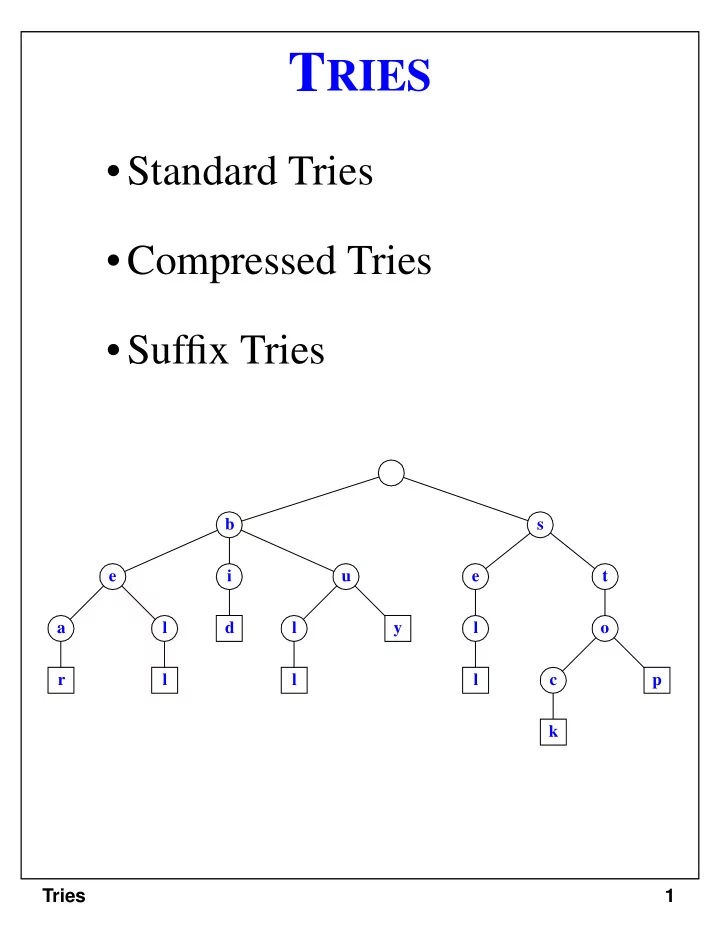
T RIES Standard Tries Compressed Tries Suffix Tries b s e i u e t a l d l y l o r l l l c p k Tries 1 Text Processing We have seen that preprocessing the pattern speeds up pattern matching queries


slide-1
SLIDE 1

1 Tries

TRIES

  • Standard Tries
  • Compressed Tries
  • Suffix Tries

a e b r l l s u l l y e t l l

  • c

k p i d

slide-2
SLIDE 2

2 Tries

Text Processing

  • We have seen that preprocessing the pattern speeds

up pattern matching queries

  • After preprocessing the pattern in time proportional

to the pattern length, the Boyer-Moore algorithm searches an arbitrary English text in (average) time proportional to the text length

  • If the text is large, immutable and searched for often

(e.g., works by Shakespeare), we may want to preprocess the text instead of the pattern in order to perform pattern matching queries in time proportional to the pattern length.

  • Tradeoffs in text searching

n = text size m = pattern size * on average

Preprocess Pattern Preprocess Text Space Search Time Brute Force O(1) O(mn) Boyer Moore O(m+d) O(d) O(n) * Suffix Trie O(n) O(n) O(m)

slide-3
SLIDE 3

3 Tries

Standard Tries

  • The standard trie for a set of strings S is an ordered

tree such that:

  • each node but the root is labeled with a character
  • the children of a node are alphabetically ordered
  • the paths from the external nodes to the root yield

the strings of S

  • Example: standard trie for the set of strings

S = { bear, bell, bid, bull, buy, sell, stock, stop }

  • A standard trie uses O(n) space. Operations (find,

insert, remove) take time O(dm) each, where:

  • n = total size of the strings in S,
  • m =size of the string parameter of the operation
  • d =alphabet size,

a e b r l l s u l l y e t l l

  • c

k p i d

slide-4
SLIDE 4

4 Tries

Applications of Tries

  • A standard trie supports the following operations on

a preprocessed text in time O(m), where m = |X|

  • word matching: find the first occurence of word X

in the text

  • prefix matching: find the first occurrence of the

longest prefix of word X in the text

  • Each operation is performed by tracing a path in the

trie starting at the root

s e e b e a r ? s e l l s t

  • c

k ! s e e b u l l ? b u y s t

  • c

k ! b i d s t

  • c

k ! a a h e t h e b e l l ? s t

  • p

! b i d s t

  • c

k !

1 2 3 4 5 6 7 8 9 10 11 12 13 14 15 16 17 18 19 20 21 22 23 24 25 26 27 28 29 30 31 32 33 34 35 36 37 38 39 40 41 42 43 44 45 46 47 48 49 50 51 52 53 54 55 56 57 58 59 60 61 62 63 64 65 66 67 68 69 70 71 72 73 74 75 76 77 78 79 80 81 82 83 84 85 86

a r

87 88

a e b l s u l e t e

0, 24

  • c

i l r

6

l

78

d

47, 58

l

30

y

36

l

12

k

17, 40, 51, 62

p

84

h e r

69

a

slide-5
SLIDE 5

5 Tries

Compressed Tries

  • Trie with nodes of degree at least 2
  • Obtained from standard trie by compressing chains
  • f redundant nodes
  • Standard Trie:
  • Compressed Trie:

a e b r l l s u l l y e t l l

  • c

k p i d

e b ar ll s u ll y ell to ck p id

slide-6
SLIDE 6

6 Tries

Compact Storage of Compressed Tries

  • A compressed trie can be stored in space O(s), where

s = |S|, by using O(1) space index ranges at the nodes

s e e b e a r s e l l s t

  • c

k b u l l b u y b i d h e b e l l s t

  • p

1 2 3 4

a r S[0] = S[1] = S[2] = S[3] = S[4] = S[5] = S[6] = S[7] = S[8] = S[9] =

1 2 3 1 2 3

1, 1, 1 1, 0, 0 0, 0, 0 4, 1, 1 0, 2, 2 3, 1, 2 1, 2, 3 8, 2, 3 6, 1, 2 4, 2, 3 5, 2, 2 2, 2, 3 3, 3, 4 9, 3, 3 7, 0 3 0, 1, 1

e b ar ll s u ll y ell to ck p id

slide-7
SLIDE 7

7 Tries

Insertion and Deletion into/from a Compressed Trie

a b abab baab b abbb aaa bab

1 2 3 4 5 a b abab baab b abbb aa bab

1 2 3 4 5

search stops here

6

bb a

insert(bbaabb)

slide-8
SLIDE 8

8 Tries

Suffix Tries

  • A suffix trie is a compressed trie for all the suffixes
  • f a text
  • Example
  • Compact representation:

m i n i z e m i

1 2 3 4 5 6 7

e nimize nimize ze ze i mi mize nimize ze 7, 7 2, 7 2, 7 6, 7 6, 7 4, 7 2, 7 6, 7 1, 1 0, 1

slide-9
SLIDE 9

9 Tries

Properties of Suffix Tries

  • The suffix trie for a text X of size n from an alphabet
  • f size d
  • stores all the n(n−1)/2 suffixes of X in O(n) space
  • supports arbitrary pattern matching and prefix

matching queries in O(dm) time, where m is the length of the pattern

  • can be constructed in O(dn) time

7, 7 2, 7 2, 7 6, 7 6, 7 4, 7 2, 7 6, 7 1, 1 0, 1

m i n i z e m i

1 2 3 4 5 6 7

slide-10
SLIDE 10

10 Tries

Tries and Web Search Engines

  • The index of a search engine (collection of all

searchable words) is stored into a compressed trie

  • Each leaf of the trie is associated with a word and

has a list of pages (URLs) containing that word, called occurrence list

  • The trie is kept in internal memory
  • The occurrence lists are kept in external memory

and are ranked by relevance

  • Boolean queries for sets of words (e.g., Java and

coffee) correspond to set operations (e.g., intersection) on the occurrence lists

  • Additional information retrieval techniques are

used, such as

  • stopword elimination (e.g., ignore “the” “a” “is”)
  • stemming (e.g., identify “add” “adding” “added”)
  • link analysis (recognize authoritative pages)
  • For this and more ... take CS 295-3
slide-11
SLIDE 11

11 Tries

Tries and Internet Routers

  • Computers on the internet (hosts) are identified by a

unique 32-bit IP (internet protocol) addres, usually written in “dotted-quad-decimal” notation

  • E.g., www.cs.brown.edu is 128.148.32.110
  • Use nslookup on Unix to find out IP addresses
  • An organization uses a subset of IP addresses with

the same prefix, e.g., Brown uses 128.148.*.*, Yale uses 130.132.*.*

  • Data is sent to a host by fragmenting it into packets.

Each packet carries the IP address of its destination.

  • The internet whose nodes are routers, and whose

edges are communication links.

  • A router forwards packets to its neighbors using IP

prefix matching rules. E.g., a packet with IP prefix 128.148. should be forwarded to the Brown gateway router.

  • Routers use tries on the alphabet 0,1 to do prefix

matching.

  • To learn more, take CS 196-5