SLIDE 1
Lecture 5 Revisit dipole field clicker problem Dipole - - PowerPoint PPT Presentation
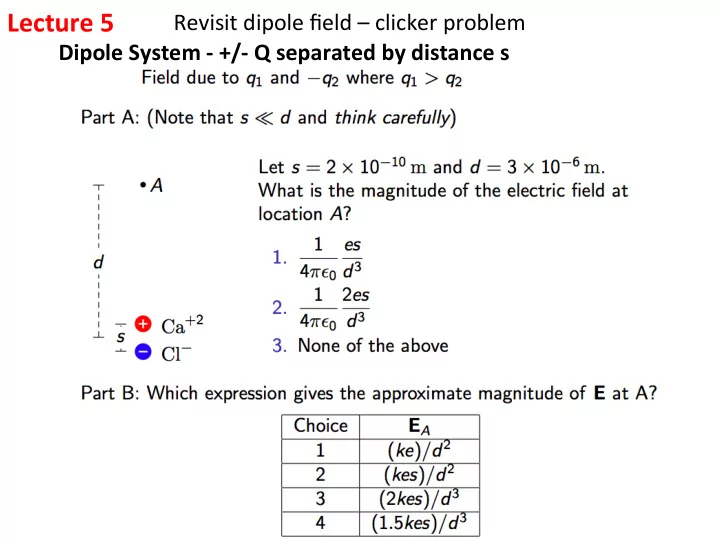
Lecture 5 Revisit dipole field clicker problem Dipole System - +/- Q separated by distance s Clicker 5-2 E kp Which loca6on has:
SLIDE 2
SLIDE 3
Clicker ¡5-‑3 ¡
SLIDE 4
Chapter ¡15: ¡Electric ¡Field ¡and ¡MaAer ¡
Net ¡Charge ¡and ¡ConservaCon ¡of ¡Charge ¡
MaAer: ¡Basic ¡building ¡blocks ¡of ¡maEer ¡are ¡made ¡out ¡of ¡+ ¡and ¡– ¡and ¡0 ¡
- charge. ¡MaEer ¡is ¡made ¡out ¡out ¡+ ¡and ¡– ¡bits ¡of ¡maEer. ¡Net ¡charge ¡of ¡
maEer ¡can ¡be ¡+, ¡-‑ ¡charged. ¡
Conserva6on ¡of ¡Charges ¡
Net ¡charge ¡of ¡a ¡system: ¡
- Eg. ¡sys, ¡+1 ¡charge ¡
Can ¡have ¡bits ¡of ¡charge ¡move ¡from ¡A ¡to ¡B, ¡but ¡net ¡charge ¡will ¡s6ll ¡be ¡+1 ¡
A B
Can ¡also ¡have ¡cancela6on ¡process: ¡
e+e− → γγ
Net ¡charge ¡= ¡0 ¡ Net ¡charge ¡= ¡0 ¡
In ¡nature, ¡net ¡charge ¡of ¡an ¡isolated ¡system ¡is ¡conserved. ¡ ¡ Total ¡charge ¡of ¡the ¡universe ¡is ¡conserved. ¡
SLIDE 5
Insulator ¡
MaEer ¡medium ¡ ¡
insulators ¡ conductors ¡ induced ¡dipole: ¡ ¡insulator: ¡electrons ¡are ¡bound ¡to ¡the ¡atom ¡“no ¡free ¡electrons” ¡ ¡
E
F + = qE F − = −qE
Induced ¡dipole ¡
With ¡dipole ¡moment: ¡
p = qs
Atom ¡is ¡polarized ¡
SLIDE 6
x Q
neutral atom
Force ¡between ¡Q ¡(posi6ve) ¡and ¡neutral ¡atom ¡
F induced p
Q
= QEp
0 = Q2kp
x3 = Q2k x3 · αEQ
x
= 2α(kq)2 x5
EQ
x = kQ
x2
−4✏ = −4 s
2
x = −2s x
Q
Q
atom
Fatom = 2Qq x3 (−2) = −FQ
If ¡ ¡Q ¡< ¡0, ¡there ¡is ¡sCll ¡an ¡aAracCon ¡force ¡
F Q
induced p = F −Q +q
⇣ x + s 2 ⌘ + F Q
−q
⇣ x − s 2 ⌘ = kQq
- x + s
2
2 − kQq
- x − s
2
2 = kQq x2 1 (1 + ✏)2 − 1 (1 − ✏)2
SLIDE 7
Microscopic ¡view ¡of ¡insula6ng ¡medium ¡
SLIDE 8