SLIDE 1 Chapter 8
Time-reversal symmetric two-dimensional topological insulators – the Bernevig–Hughes–Zhang model
ics forma-
edges moves quan-
f
.
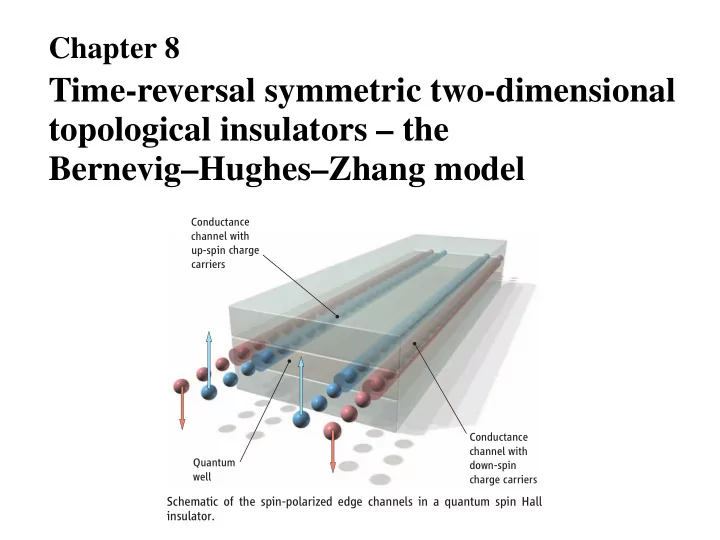
Conductance channel with down-spin charge carriers Conductance channel with up-spin charge carriers Quantum well
Schematic of the spin-polarized edge channels in a quantum spin Hall insulator.
SLIDE 2 Anderson localization in 1D
In 1D, even a tiny disorder renders the wavefunctions localized. Hence, disorder transforms a metal into an (Anderson) insulator.
SLIDE 3 1D edge of 2D Chern insulator: no localization
y
Fermi level in gap => edge electrons can’t be backscattered => edge conductor (quantized conductance)
Qi et al. PRB 2006 Chapter 6
SLIDE 4
1D edge of 2D time-reversal invariant topological insulator: edge states conduct or localize?
Chapter 8
They conduct.
SLIDE 5
(Fermionic) Time-Reversal Symmetry … from now on, TRS means fermionic TRS.
usual symmetry: U unitary such that UHU −1 = H. chiral symmetry: Γ unitary such that ΓHΓ−1 = −H (fermionic) time-reversal symmetry: T antiunitary such that T 2 = −1, and T HT −1 = H. (bosonic) time-reversal symmetry: T antiunitary such that T 2 = +1, and T HT −1 = H.
SLIDE 6
Kramers degeneracy in the band structure
Kramers theorem: Take a Hamiltonian with fermionic time-reversal symmetry T . Take an eigenstate |ψi of H with energy E. Then, T |ψi is also an energy eigenstate with energy E, and hψ|T ψi = 0. Consequence for band structures: In a crystal with fermionic time-reversal symmetry, every band is twofold degenerate at time-reversal-invariant momenta.
SLIDE 7 BHZ model: edge-state Kramers pairs, robust against time-reversal-invariant perturbation
ˆ HBHZ(k) = ˆ s0 ⊗[(u+coskx +cosky) ˆ σz +sinky ˆ σy)]+ ˆ sz ⊗sinkx ˆ σx + ˆ sx ⊗ ˆ C, (8.38)
example: Bernevig-Hughes-Zhang model
Stripe dispersion relations of the BHZ model, with sublattice potential parameter u = −1.2. Right/left edge states (more than 60% weight on the last/first two columns of unit cells) marked in dark red/light blue. (a): uncoupled layers, ˆ C = 0. (b): Symmetric coupling ˆ C = 0.3σx gaps the edge states out. (c): Antisymmetric coupling ˆ C = 0.3σy cannot open a gap in the edge spetrum.
ˆ HBHZ = ˆ s0 ⊗ [(u + cos kx + cos ky)ˆ σz + sin kxˆ σx] + ˆ sz ⊗ sin kyˆ σy + ˆ sx ⊗ ˆ C.
SLIDE 8
… from now on, topological insulator refers to 2D topological insulator with fermionic time-reversal symmetry
Number parity of edge-state Kramers pairs is a topological invariant
SLIDE 9 Absence of backscattering clean region scattering region
Full transmission through scattering region => absence of localization
SLIDE 10 Time-reversal invariant momenta (1) Take a 2D square crystal lattice. Its Brillouin zone is sketched here. Where are the time-reversal invariant momenta? A B C D
kx ky
SLIDE 11 Time-reversal invariant momenta (2) Take a 2D triangular crystal lattice. Its Brillouin zone is sketched here. Where are the time-reversal invariant momenta? A B C D
kx ky
SLIDE 12
SSH model with nearest-neighbor real-valued hopping
Consider the SSH model with only nearest-neighbor hopping, all hopping amplitudes being real. Does it have time-reversal symmetry? (a) Yes, it has fermionic time-reversal symmetry. (b) Yes, it has bosonic time-reversal symmetry. (c) Yes, both types. (d) No.
SLIDE 13 Edge states and time reversal symmetry (1)
Take a clean QWZ model with Chern number 1. Consider the edge state |Ψi with a given wave number k. Then T |Ψi ... (a) ... is orthogonal to |Ψi, and is an eigenstate of the Hamiltonian with the same energy as |Ψi. (b) ... is orthogonal to |Ψi, and is an eigenstate of the Hamiltonian which propagates on the other edge. (c) ... is orthogonal to |Ψi, but it is not an eigenstate of the Hamiltonian. (d) ... doesn’t exist: time reversal can’t be applied as the model has no time-reversal symmetry.
SLIDE 14 Edge states and time reversal symmetry (2)
Take an edge state |Ψi of a clean topological insulator with a given wave number k. Then T |Ψi ... (a) ... is orthogonal to |Ψi, and is an eigenstate of the Hamiltonian with the same energy as |Ψi. (b) ... is orthogonal to |Ψi, and is an eigenstate of the Hamiltonian which propagates on the other edge. (c) ... is orthogonal to |Ψi, but it is not an eigenstate of the Hamiltonian. (d) ... is the same as |Ψi, since the system has time-reversal symmetry.
SLIDE 15
Two-band model with time reversal symmetry
2D two-band lattice models with fermionic time-reversal symmetry ... (a) ... always have a band gap. (b) ... never have a band gap. (c) ... might have a band gap. (d) ... do not exist.
SLIDE 16 Edge spectrum of a 2D topological insulator
Each figure shows the edge spectrum
Bulk valence bands are way below, and bulk conduction bands are way above these edge states. Which edge spectrum belongs to a 2D topological insulator?
SLIDE 17
Scattering in a topological insulator (1)
Consider a long and wide ribbon of a 2D topological insulator, in which each edge hosts a single edge-state Kramers pair. Part of the ribbon is disordered and serves as a scattering region. The whole system is time-reversal symmetric. What is the dimension of the scattering matrix S describing the scattering region? (a) 2 ⇥ 2 (b) 4 ⇥ 4 (c) 8 ⇥ 8 (d) 16 ⇥ 16
SLIDE 18
Scattering in a topological insulator (2)
Consider a long and wide ribbon of a 2D topological insulator, in which each edge hosts a single edge-state Kramers pair. Part of the ribbon is disordered and serves as a scattering region. The whole system is time-reversal symmetric. How many nonzero entries are there in the scattering matrix S of the scattering region? (a) 0 (b) 2 (c) 4 (d) 8
SLIDE 19
Scattering in a topological insulator (3)
Consider a constriction of a ribbon of a 2D topological insulator, in which each edge hosts a single edge-state Kramers pair. The constriction is disordered and serves as a scattering region. The whole system is time-reversal symmetric. How many zero entries are guaranteed in the scattering matrix S of the constriction? (a) 0 (b) 4 (c) 8 (d) 12