
SLIDE 1
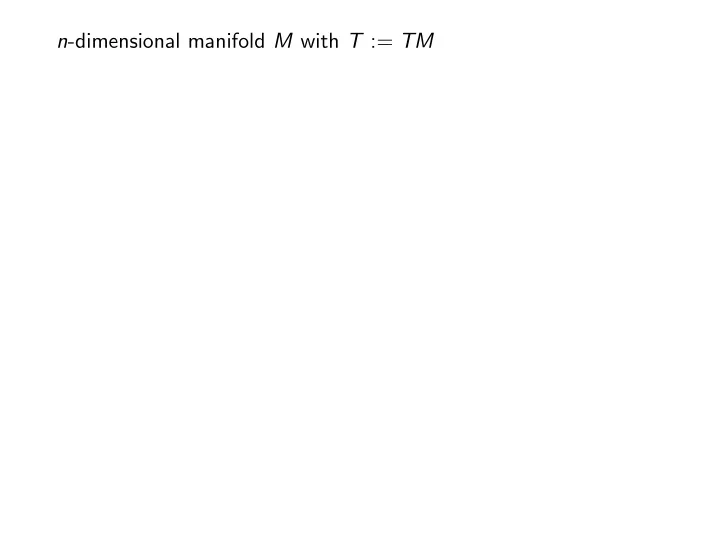
n-dimensional manifold M with T := TM
n -dimensional manifold M with T := TM n -dimensional manifold M with - - PowerPoint PPT Presentation
n -dimensional manifold M with T := TM n -dimensional manifold M with T := TM T n -dimensional manifold M with T := TM T frame bundle GL ( R n , T ) is a principal GL ( n )-bundle n -dimensional manifold M with T := TM T + T frame bundle
n-dimensional manifold M with T := TM
n-dimensional manifold M with T := TM
n-dimensional manifold M with T := TM
frame bundle GL(Rn, T) is a principal GL(n)-bundle
n-dimensional manifold M with T := TM
frame bundle GL(Rn, T) is a principal GL(n)-bundle
n-dimensional manifold M with T := TM
frame bundle GL(Rn, T) is a principal GL(n)-bundle
pairing X + ξ, X + ξ = iXξ
n-dimensional manifold M with T := TM
frame bundle GL(Rn, T) is a principal GL(n)-bundle
pairing X + ξ, X + ξ = iXξ generalized frame bundle O(Rn + (Rn)∗, T + T ∗)
n-dimensional manifold M with T := TM
frame bundle GL(Rn, T) is a principal GL(n)-bundle
pairing X + ξ, X + ξ = iXξ generalized frame bundle O(Rn + (Rn)∗, T + T ∗) is a principal O(n, n)-bundle
n-dimensional manifold M with T := TM
frame bundle GL(Rn, T) is a principal GL(n)-bundle Lie bracket [ , ]
pairing X + ξ, X + ξ = iXξ generalized frame bundle O(Rn + (Rn)∗, T + T ∗) is a principal O(n, n)-bundle
n-dimensional manifold M with T := TM
frame bundle GL(Rn, T) is a principal GL(n)-bundle Lie bracket [ , ]
pairing X + ξ, X + ξ = iXξ generalized frame bundle O(Rn + (Rn)∗, T + T ∗) is a principal O(n, n)-bundle Courant bracket [ , ]
Generalized almost complex structures (Hitchin,Gualtieri)
Generalized almost complex structures (Hitchin,Gualtieri)
J : T + T ∗ → T + T ∗ such that J 2 = − Id
Generalized almost complex structures (Hitchin,Gualtieri)
J : T + T ∗ → T + T ∗ such that J 2 = − Id
Generalized almost complex structures (Hitchin,Gualtieri)
J : T + T ∗ → T + T ∗ such that J 2 = − Id
Examples: −J J∗
Generalized almost complex structures (Hitchin,Gualtieri)
J : T + T ∗ → T + T ∗ such that J 2 = − Id
Examples: −J J∗
−ω−1 ω
Generalized almost complex structures (Hitchin,Gualtieri)
J : T + T ∗ → T + T ∗ such that J 2 = − Id
Examples: −J J∗
−ω−1 ω
Constraint: M must admit almost cplx. str. → n = 2m even.
Generalized almost complex structures (Hitchin,Gualtieri)
J : T + T ∗ → T + T ∗ such that J 2 = − Id
Examples: −J J∗
−ω−1 ω
Constraint: M must admit almost cplx. str. → n = 2m even. Almost cplx. str.: reduction from GL(2m, R) to GL(m, C).
Generalized almost complex structures (Hitchin,Gualtieri)
J : T + T ∗ → T + T ∗ such that J 2 = − Id
Examples: −J J∗
−ω−1 ω
Constraint: M must admit almost cplx. str. → n = 2m even. Almost cplx. str.: reduction from GL(2m, R) to GL(m, C). Generalized ones: reduction from O(2m, 2m) to U(m, m).
Equivalently, one could define J by giving:
Equivalently, one could define J by giving:
∂z1 , . . . , ∂ ∂zm
Equivalently, one could define J by giving:
∂z1 , . . . , ∂ ∂zm
the +i-eigenspace of J in (T + T ∗)C, i.e.,
Equivalently, one could define J by giving:
∂z1 , . . . , ∂ ∂zm
the +i-eigenspace of J in (T + T ∗)C, i.e., a maximal isotropic subbundle L ⊂ (T + T ∗)C such that L ∩ L = 0.
Equivalently, one could define J by giving:
∂z1 , . . . , ∂ ∂zm
the +i-eigenspace of J in (T + T ∗)C, i.e., a maximal isotropic subbundle L ⊂ (T + T ∗)C such that L ∩ L = 0.
z1 ∧ . . . ∧ d¯ zm,
Equivalently, one could define J by giving:
∂z1 , . . . , ∂ ∂zm
the +i-eigenspace of J in (T + T ∗)C, i.e., a maximal isotropic subbundle L ⊂ (T + T ∗)C such that L ∩ L = 0.
z1 ∧ . . . ∧ d¯ zm, which is a form ϕ ∈ Ω•(M)C such that (ϕ, ϕ) = 0 for (α, β) = [αT ∧ β]top.
Equivalently, one could define J by giving:
∂z1 , . . . , ∂ ∂zm
the +i-eigenspace of J in (T + T ∗)C, i.e., a maximal isotropic subbundle L ⊂ (T + T ∗)C such that L ∩ L = 0.
z1 ∧ . . . ∧ d¯ zm, which is a form ϕ ∈ Ω•(M)C such that (ϕ, ϕ) = 0 for (α, β) = [αT ∧ β]top. For the action (X + ξ) · ϕ = iXϕ + ξ ∧ ϕ, we want Ann(ϕ) = L, the maximal isotropic subbundle.
Equivalently, one could define J by giving:
∂z1 , . . . , ∂ ∂zm
the +i-eigenspace of J in (T + T ∗)C, i.e., a maximal isotropic subbundle L ⊂ (T + T ∗)C such that L ∩ L = 0.
z1 ∧ . . . ∧ d¯ zm, which is a form ϕ ∈ Ω•(M)C such that (ϕ, ϕ) = 0 for (α, β) = [αT ∧ β]top. For the action (X + ξ) · ϕ = iXϕ + ξ ∧ ϕ, we want Ann(ϕ) = L, the maximal isotropic subbundle. As (X + ξ)2 · ϕ = iXξϕ = X + ξ, X + ξϕ,
Equivalently, one could define J by giving:
∂z1 , . . . , ∂ ∂zm
the +i-eigenspace of J in (T + T ∗)C, i.e., a maximal isotropic subbundle L ⊂ (T + T ∗)C such that L ∩ L = 0.
z1 ∧ . . . ∧ d¯ zm, which is a form ϕ ∈ Ω•(M)C such that (ϕ, ϕ) = 0 for (α, β) = [αT ∧ β]top. For the action (X + ξ) · ϕ = iXϕ + ξ ∧ ϕ, we want Ann(ϕ) = L, the maximal isotropic subbundle. As (X + ξ)2 · ϕ = iXξϕ = X + ξ, X + ξϕ, Ω•(M)C are (up to scaling) spinors, and ϕ must be pure.
Pure spinors are either even or odd (the spin representation splits).
Pure spinors are either even or odd (the spin representation splits). E.g., ϕ = ϕ0 + ϕ2 + ϕ4 + . . .
Pure spinors are either even or odd (the spin representation splits). E.g., ϕ = ϕ0 + ϕ2 + ϕ4 + . . . The type at a point p is the least index j for which ϕj(p) = 0.
Pure spinors are either even or odd (the spin representation splits). E.g., ϕ = ϕ0 + ϕ2 + ϕ4 + . . . The type at a point p is the least index j for which ϕj(p) = 0.
Pure spinors are either even or odd (the spin representation splits). E.g., ϕ = ϕ0 + ϕ2 + ϕ4 + . . . The type at a point p is the least index j for which ϕj(p) = 0.
In a 4-manifold we can have ϕ0 + ϕ2 + ϕ4, with ϕ0 vanishing at a codimension 2 submanifold.
Pure spinors are either even or odd (the spin representation splits). E.g., ϕ = ϕ0 + ϕ2 + ϕ4 + . . . The type at a point p is the least index j for which ϕj(p) = 0.
In a 4-manifold we can have ϕ0 + ϕ2 + ϕ4, with ϕ0 vanishing at a codimension 2 submanifold. For example, in R4 ∼ = C2, ϕ = z1 + dz1 ∧ dz2
Pure spinors are either even or odd (the spin representation splits). E.g., ϕ = ϕ0 + ϕ2 + ϕ4 + . . . The type at a point p is the least index j for which ϕj(p) = 0.
In a 4-manifold we can have ϕ0 + ϕ2 + ϕ4, with ϕ0 vanishing at a codimension 2 submanifold. For example, in R4 ∼ = C2, ϕ = z1 + dz1 ∧ dz2 When looking at integrable structures (L involutive w.r.t. [·, ·]):
Pure spinors are either even or odd (the spin representation splits). E.g., ϕ = ϕ0 + ϕ2 + ϕ4 + . . . The type at a point p is the least index j for which ϕj(p) = 0.
In a 4-manifold we can have ϕ0 + ϕ2 + ϕ4, with ϕ0 vanishing at a codimension 2 submanifold. For example, in R4 ∼ = C2, ϕ = z1 + dz1 ∧ dz2 When looking at integrable structures (L involutive w.r.t. [·, ·]): there are compact generalized complex manifolds that do not admit neither complex nor symplectic structures (3CP2#19CP2 by Gualtieri/Cavalcanti, and more by Rafael Torres, Wed 18:40).
Bn-generalized geometry
Bn-generalized geometry
Suggested by Baraglia. Denote 1 = M × R and consider
Bn-generalized geometry
Suggested by Baraglia. Denote 1 = M × R and consider
Bn-generalized geometry
Suggested by Baraglia. Denote 1 = M × R and consider
pairing X + λ + ξ, X + λ + ξ = iXξ + λ2 the generalized frame bundle is a principal O(n + 1, n)-bundle
Bn-generalized geometry
Suggested by Baraglia. Denote 1 = M × R and consider
pairing X + λ + ξ, X + λ + ξ = iXξ + λ2 the generalized frame bundle is a principal O(n + 1, n)-bundle As O(n + 1, n) is a real form of O(2n + 1, C), of Lie type Bn:
Bn-generalized geometry
Suggested by Baraglia. Denote 1 = M × R and consider
pairing X + λ + ξ, X + λ + ξ = iXξ + λ2 the generalized frame bundle is a principal O(n + 1, n)-bundle As O(n + 1, n) is a real form of O(2n + 1, C), of Lie type Bn: Geometric structures in Bn-geometry. Roberto Rubio (IMPA)
First joint meeting SBM-SBMAC-RSME, Fortaleza, 7th December 2015.
Definition: A Bn-generalized almost cplx. str. is a maximal isotropic subbundle L ⊂ (T + 1 + T ∗)C such that L ∩ L = 0.
Definition: A Bn-generalized almost cplx. str. is a maximal isotropic subbundle L ⊂ (T + 1 + T ∗)C such that L ∩ L = 0. No constraint on the dimension of M:
Definition: A Bn-generalized almost cplx. str. is a maximal isotropic subbundle L ⊂ (T + 1 + T ∗)C such that L ∩ L = 0. No constraint on the dimension of M:
Definition: A Bn-generalized almost cplx. str. is a maximal isotropic subbundle L ⊂ (T + 1 + T ∗)C such that L ∩ L = 0. No constraint on the dimension of M:
Definition: A Bn-generalized almost cplx. str. is a maximal isotropic subbundle L ⊂ (T + 1 + T ∗)C such that L ∩ L = 0. No constraint on the dimension of M:
In odd dimensions, e.g., normal almost contact and cosymplectic.
Definition: A Bn-generalized almost cplx. str. is a maximal isotropic subbundle L ⊂ (T + 1 + T ∗)C such that L ∩ L = 0. No constraint on the dimension of M:
In odd dimensions, e.g., normal almost contact and cosymplectic.
The spin representation is the same as before, Ω•(M)C, but now it is not reducible, so there is no parity in pure spinors.
The spin representation is the same as before, Ω•(M)C, but now it is not reducible, so there is no parity in pure spinors.
The spin representation is the same as before, Ω•(M)C, but now it is not reducible, so there is no parity in pure spinors.
ϕ = ϕ0 + ϕ1 + ϕ2 on a compact surface
The spin representation is the same as before, Ω•(M)C, but now it is not reducible, so there is no parity in pure spinors.
ϕ = ϕ0 + ϕ1 + ϕ2 on a compact surface The quotient ϕ1/ϕ0 patches together to a meromorphic 1-form.
The spin representation is the same as before, Ω•(M)C, but now it is not reducible, so there is no parity in pure spinors.
ϕ = ϕ0 + ϕ1 + ϕ2 on a compact surface The quotient ϕ1/ϕ0 patches together to a meromorphic 1-form. Assuming non-degeneracy, the poles (ϕ0 = 0) are simple.
The spin representation is the same as before, Ω•(M)C, but now it is not reducible, so there is no parity in pure spinors.
ϕ = ϕ0 + ϕ1 + ϕ2 on a compact surface The quotient ϕ1/ϕ0 patches together to a meromorphic 1-form. Assuming non-degeneracy, the poles (ϕ0 = 0) are simple. By Stokes’ theorem, the type-change locus cannot be just a point.
The spin representation is the same as before, Ω•(M)C, but now it is not reducible, so there is no parity in pure spinors.
ϕ = ϕ0 + ϕ1 + ϕ2 on a compact surface The quotient ϕ1/ϕ0 patches together to a meromorphic 1-form. Assuming non-degeneracy, the poles (ϕ0 = 0) are simple. By Stokes’ theorem, the type-change locus cannot be just a point.
The spin representation is the same as before, Ω•(M)C, but now it is not reducible, so there is no parity in pure spinors.
ϕ = ϕ0 + ϕ1 + ϕ2 on a compact surface The quotient ϕ1/ϕ0 patches together to a meromorphic 1-form. Assuming non-degeneracy, the poles (ϕ0 = 0) are simple. By Stokes’ theorem, the type-change locus cannot be just a point.
(are they knotted? are they linked?)
The group of generalized diffeomorphisms
The group of generalized diffeomorphisms
Bundle maps of T + T ∗ preserving [·, ·] and ·, · consist of:
The group of generalized diffeomorphisms
Bundle maps of T + T ∗ preserving [·, ·] and ·, · consist of:
The group of generalized diffeomorphisms
Bundle maps of T + T ∗ preserving [·, ·] and ·, · consist of:
cl(M), X + ξ → X + ξ + iXB.
The group of generalized diffeomorphisms
Bundle maps of T + T ∗ preserving [·, ·] and ·, · consist of:
cl(M), X + ξ → X + ξ + iXB.
In Bn-geometry, T + 1 + T ∗, some new fields join:
The group of generalized diffeomorphisms
Bundle maps of T + T ∗ preserving [·, ·] and ·, · consist of:
cl(M), X + ξ → X + ξ + iXB.
In Bn-geometry, T + 1 + T ∗, some new fields join:
cl(M), acting by X + λ + iXA + ξ − (2λ + iXA)A.
The group of generalized diffeomorphisms
Bundle maps of T + T ∗ preserving [·, ·] and ·, · consist of:
cl(M), X + ξ → X + ξ + iXB.
In Bn-geometry, T + 1 + T ∗, some new fields join:
cl(M), acting by X + λ + iXA + ξ − (2λ + iXA)A.
GDiff(M) = Diff(M) ⋉ Ω2+1
cl
(M),
The group of generalized diffeomorphisms
Bundle maps of T + T ∗ preserving [·, ·] and ·, · consist of:
cl(M), X + ξ → X + ξ + iXB.
In Bn-geometry, T + 1 + T ∗, some new fields join:
cl(M), acting by X + λ + iXA + ξ − (2λ + iXA)A.
GDiff(M) = Diff(M) ⋉ Ω2+1
cl
(M), where 1 → Ω2
cl(M) → Ω2+1 cl
(M) → Ω1
cl(M) → 1.
G 2
2 -structures
G 2
2 -structures
For a 3-manifold M, the “Bn-structure group” is O(4, 3). The real spin representation is 8-dim, with a (4, 4)-pairing, the non-null elements (non-pure) have stabilizer G 2
2 ⊂ SO(4, 3).
G 2
2 -structures
For a 3-manifold M, the “Bn-structure group” is O(4, 3). The real spin representation is 8-dim, with a (4, 4)-pairing, the non-null elements (non-pure) have stabilizer G 2
2 ⊂ SO(4, 3).
Definition A G 2
2 -structure on a 3-manifold M is an everywhere
non-null real form ρ = ρ0 + ρ1 + ρ2 + ρ3 ∈ Ω•(M) with dρ = 0.
G 2
2 -structures
For a 3-manifold M, the “Bn-structure group” is O(4, 3). The real spin representation is 8-dim, with a (4, 4)-pairing, the non-null elements (non-pure) have stabilizer G 2
2 ⊂ SO(4, 3).
Definition A G 2
2 -structure on a 3-manifold M is an everywhere
non-null real form ρ = ρ0 + ρ1 + ρ2 + ρ3 ∈ Ω•(M) with dρ = 0. From (ρ, ρ) = 2(ρ0ρ3 − ρ1 ∧ ρ2) = 0, M must be orientable.
G 2
2 -structures
For a 3-manifold M, the “Bn-structure group” is O(4, 3). The real spin representation is 8-dim, with a (4, 4)-pairing, the non-null elements (non-pure) have stabilizer G 2
2 ⊂ SO(4, 3).
Definition A G 2
2 -structure on a 3-manifold M is an everywhere
non-null real form ρ = ρ0 + ρ1 + ρ2 + ρ3 ∈ Ω•(M) with dρ = 0. From (ρ, ρ) = 2(ρ0ρ3 − ρ1 ∧ ρ2) = 0, M must be orientable. We look at compact orientable 3-manifolds, up to GDiff+(M):
G 2
2 -structures
For a 3-manifold M, the “Bn-structure group” is O(4, 3). The real spin representation is 8-dim, with a (4, 4)-pairing, the non-null elements (non-pure) have stabilizer G 2
2 ⊂ SO(4, 3).
Definition A G 2
2 -structure on a 3-manifold M is an everywhere
non-null real form ρ = ρ0 + ρ1 + ρ2 + ρ3 ∈ Ω•(M) with dρ = 0. From (ρ, ρ) = 2(ρ0ρ3 − ρ1 ∧ ρ2) = 0, M must be orientable. We look at compact orientable 3-manifolds, up to GDiff+(M):
2 -structures with ρ0 = 0 always exist, are equivalent to ρ0 + ρ3
and are determined by the non-zero cohomology classes of (ρ0, ρ3).
G 2
2 -structures
For a 3-manifold M, the “Bn-structure group” is O(4, 3). The real spin representation is 8-dim, with a (4, 4)-pairing, the non-null elements (non-pure) have stabilizer G 2
2 ⊂ SO(4, 3).
Definition A G 2
2 -structure on a 3-manifold M is an everywhere
non-null real form ρ = ρ0 + ρ1 + ρ2 + ρ3 ∈ Ω•(M) with dρ = 0. From (ρ, ρ) = 2(ρ0ρ3 − ρ1 ∧ ρ2) = 0, M must be orientable. We look at compact orientable 3-manifolds, up to GDiff+(M):
2 -structures with ρ0 = 0 always exist, are equivalent to ρ0 + ρ3
and are determined by the non-zero cohomology classes of (ρ0, ρ3).
2 -structure with ρ0 = 0 ↔ M is the mapping torus of an
Main results:
Main results:
G 2
2 -structure within its cohomology class is equivalent to the
identity + exact (B, A)-fields).
Main results:
G 2
2 -structure within its cohomology class is equivalent to the
identity + exact (B, A)-fields).
2 -structures:
{[ρ] ∈ H•(M, R) | [ρ0] = 0 and [ρ0][ρ3] − [ρ1][ρ2] > 0}
where C1 is the set of 1-cohomology classes with non-vanishing representatives (cf. Thurston)
B3-Calabi Yau and G 2
2 structures
B3-Calabi Yau and G 2
2 structures
A Bn-Calabi Yau is a Bn-generalized cplx. str. globally given by a pure spinor ρ ∈ Ω•(M)C such that dρ = 0.
B3-Calabi Yau and G 2
2 structures
A Bn-Calabi Yau is a Bn-generalized cplx. str. globally given by a pure spinor ρ ∈ Ω•(M)C such that dρ = 0. For 3-manifolds, this means dρ = 0 and (ρ, ¯ ρ) = 0.
B3-Calabi Yau and G 2
2 structures
A Bn-Calabi Yau is a Bn-generalized cplx. str. globally given by a pure spinor ρ ∈ Ω•(M)C such that dρ = 0. For 3-manifolds, this means dρ = 0 and (ρ, ¯ ρ) = 0.
pair of orthogonal G 2
2 -structures of the same norm, and any such a
pair determines a B3-Calabi Yau structure.
B3-Calabi Yau and G 2
2 structures
A Bn-Calabi Yau is a Bn-generalized cplx. str. globally given by a pure spinor ρ ∈ Ω•(M)C such that dρ = 0. For 3-manifolds, this means dρ = 0 and (ρ, ¯ ρ) = 0.
pair of orthogonal G 2
2 -structures of the same norm, and any such a
pair determines a B3-Calabi Yau structure. This corresponds to the inclusions SU(2, 1) ⊂ G 2
2 ⊂ SO(4, 3),
B3-Calabi Yau and G 2
2 structures
A Bn-Calabi Yau is a Bn-generalized cplx. str. globally given by a pure spinor ρ ∈ Ω•(M)C such that dρ = 0. For 3-manifolds, this means dρ = 0 and (ρ, ¯ ρ) = 0.
pair of orthogonal G 2
2 -structures of the same norm, and any such a
pair determines a B3-Calabi Yau structure. This corresponds to the inclusions SU(2, 1) ⊂ G 2
2 ⊂ SO(4, 3),
which is the non-compact version of SU(3) ⊂ G2 ⊂ SO(7).