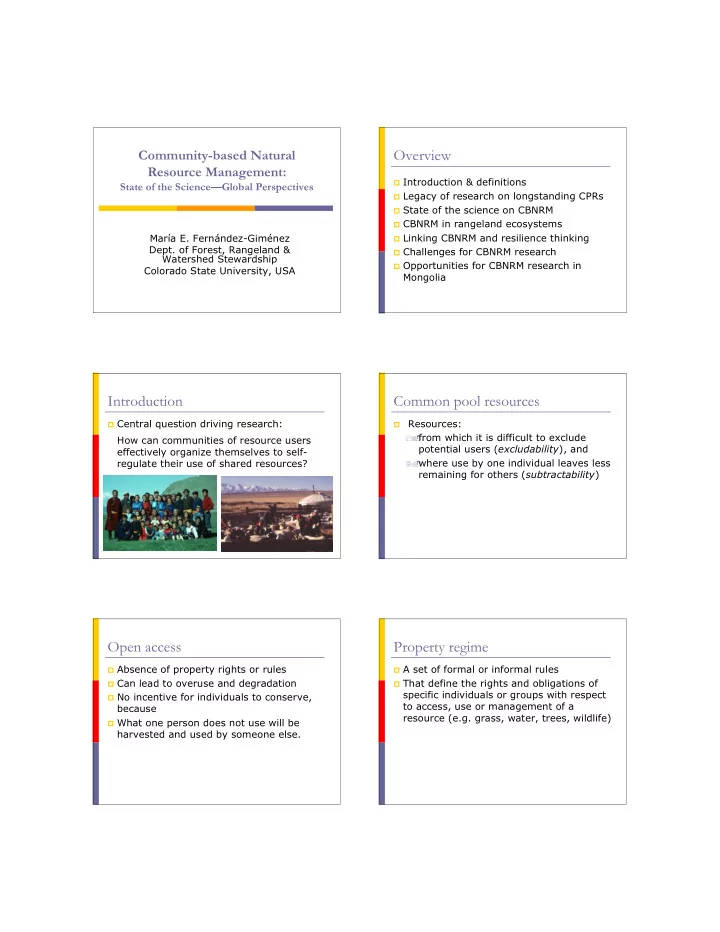
Overview Community-based Natural Resource Management: Introduction - - PDF document

overview
SMART_READER_LITE
LIVE PREVIEW

Overview Community-based Natural Resource Management: Introduction - - PDF document

Overview Community-based Natural Resource Management: Introduction & definitions State of the ScienceGlobal Perspectives Legacy of research on longstanding CPRs State of the science on CBNRM CBNRM in rangeland ecosystems


slide-1
SLIDE 1

Community-based Natural Resource Management:

State of the Science—Global Perspectives

María E. Fernández-Giménez

  • Dept. of Forest, Rangeland &

Watershed Stewardship Colorado State University, USA

Overview

 Introduction & definitions  Legacy of research on longstanding CPRs  State of the science on CBNRM  CBNRM in rangeland ecosystems  Linking CBNRM and resilience thinking  Challenges for CBNRM research  Opportunities for CBNRM research in

Mongolia

Introduction

 Central question driving research:

How can communities of resource users effectively organize themselves to self- regulate their use of shared resources?

Common pool resources

Resources:

 

from which it is difficult to exclude potential users (excludability), and



where use by one individual leaves less remaining for others (subtractability)

Open access

 Absence of property rights or rules  Can lead to overuse and degradation  No incentive for individuals to conserve,

because

 What one person does not use will be

harvested and used by someone else.

Property regime

 A set of formal or informal rules  That define the rights and obligations of

specific individuals or groups with respect to access, use or management of a resource (e.g. grass, water, trees, wildlife)

slide-2
SLIDE 2

Right to sell or lease Alienation Determine who has access and how rights are transferred Exclusion Regulate internal use and transform resource via improvements

(e.g. set aside reserve pasture, regulate seasonal movements, limit stocking rates to within carrying capacity)

Management Obtain resource units

(e.g. hunt wildlife, graze grass, divert water for irrigation, cut trees)

Use (Withdrawal) Enter & enjoy non-subtractive benefits

(e.g. wildlife watching)

Access

Typology of property rights Property rights

Property Rights No rights or rules, individuals capture as much as possible

Open access (none)

√? √? √? √

State property (government on behalf of citizens)

√ √ √ √

Common property (group of resource users)

√ √ √ √ √

Private property (individual, corporation) Alienation Exclusion Management Use (Withdrawal) Access

Property Regime & Rights Holder

Private property vs. common property Community-based Natural Resource Management

 “A process by which landholders gain access

and use rights to, or ownership of, natural resources; collaboratively and transparently plan and participate in the management of resource use; and achieve financial and other benefits from their stewardship.”

  • B. Child & M.W. Lyman. 2005. Natural Resources as Community

Assets, Lessons from Two Continents. Madison, WI: The Sand County Foundation.

Community-based Conservation

 involves people who directly affect and are

affected by conservation decisions in conservation planning and stewardship

 provides direct economic and social benefits to

resource users while improving or maintaining biodiversity and land health

Western, D. & M. Wright. 1994. Natural Connections. Washington, D.C.: Island Pres..

Co-management

 Institutional arrangement for natural resource

management in which decision-making authority is shared between local people and local, regional, or national government.

Pinkerton, E., ed. 1989. Cooperative Management of Local Fisheries: New Directions for Improved Management and Community Development. Vancouver: University of British Columbia Press.

slide-3
SLIDE 3

10 Proposed Benefits of CBNRM

 Increased social legitimacy and likelihood

  • f implementation of management

decisions

Application of diverse knowledge sources

to management--local knowledge and science

Improved on-the-ground resource

management

 Increased monitoring and adaptive

management

Decreased conflict over resources

10 Proposed Benefits of CBNRM (cont’d.)

Increased trust and strengthened

relationships within the community

 Improved livelihoods  Greater community capacity  Improved environmental conditions   

More resilient social-ecological systems

Additional Research Questions

 Does CBNRM live up to its promise?  How should “success” be defined and who

should define it?

 What factors influence the process and

  • utcomes of CBNRM?

 Are the outcomes of CBNRM really

different or better than other alternatives

  • r existing management regimes?

Legacy of Research on Longstanding CPRs

Learning from Long-standing CPRs

 Case studies of long-term common

property regimes

 Ostrom, E. 1990. Governing the Commons  8 design principles  Bromley, D. ed. 1992. Making the Commons Work  Baland, J.M. & J.P. Plateau. 1996. Halting

Degradation of Natural Resources; Is there a Role for Rural Communities?

 Acheson, J. and B. McCay. 1987. The Question of the

Commons.

 Many others…

 Mostly qualitative, 1 or few cases

Findings from Longstanding CPRs

(Synthesis by A. Agrawal. 2002. Ch 2 in Drama of the Commons)

 Resource characteristics

 Small, well-bounded, predictable supply, low mobility, storable

 Group characteristics

 Small, well-bounded, shared norms, interdependence, leadership,

low poverty  Resource-group relationships

 Users live near and depend on resource, benefits allocated fairly,

low demand

 Users have clear rights to use and manage the resource

 Rules

 Simple & easy to understand  Locally devised  Easy to monitor & enforce  Monitors and officials accountable to users

slide-4
SLIDE 4

State of the Science on Contemporary CBNRM Institutions

Research on Contemporary CBNRM

 Initially, mostly positive “success stories”  Recently, more critical perspectives  Important to avoid oversimplification of

“community” and to attend to implications

  • f differences in gender, ethnicity,

poverty/wealth and power within communities

 Critiques of the role and motivations of

facilitating donors and NGOs

CBNRM in Rangeland Ecosystems

 Difficult to define spatial boundaries in

semi-arid and arid ecosystems

 Difficult to identify group members in

mobile societies where social organization is fluid

 Yet, many examples of historically well-

functioning CPRs in rangeland systems

CBNRM in Rangeland Ecosystems

Today: Challenges due to:

 Land conversion & intensification of use,  Privatization of communal lands,  Land appropriation by the state for other

purposes

 Political conflict and lack of security

Linking CBNRM & Resilience Thinking: Why might CBNRM build resilience?

  • 1. Locally-adaptive practices based on local

ecological knowledge

  • 2. Large, centralized bureaucracies make

large mistakes—small, local institutions make smaller mistakes and learn & adapt faster

  • 3. Diversity of CBNRM institutions, increases

likelihood of learning what works

Linking CBNRM & Resilience Thinking: Why might CBNRM build resilience?

  • 4. CBNRM strengthens social capital, which is

important for adaptive capacity

  • 5. CBNRM promotes social learning through

monitoring and adaptive management, which strengthen feedbacks between social and ecological systems

slide-5
SLIDE 5

Challenges in CBNRM Research

 Defining and measuring “success”  Measuring environmental outcomes:

 Often slow to appear  Many confounding factors, including those beyond

community’s control

 Variability among cases limits comparisons and

generalizations  Measuring social outcomes:

 Difficult to measure “intangibles” such as trust and hope  Appropriate scale for measuring social outcomes?

Challenges in CBNRM Research

 Determining causal relationships between

CBNRM and social and ecological

  • utcomes

 Comparing CBNRM cases to “status

quo”—similar locations without CBNRM

 Need for research that combines the

richness of case studies with the rigor and inferential power of large samples quantitatively analyzed.

Opportunities for CBNRM Research in Mongolia

 Relatively homogeneous environment

within each ecological zone

 Relatively homogeneous social and

cultural context in most of the country

 Over 2000 potential CBNRM cases, most

started within the past 5-10 years.

 Cases vary in “design”, with multiple

examples of each design approach.

Opportunities for CBNRM Research in Mongolia

 “case-control” studies comparing sites

with and without CBNRM

 large sample studies as well as in-depth

case studies.

 involve project managers and community

members in the research design and implementation

 reflect, learn and apply learning to

improve practice

 understand role of CBNRM in resilience to

climate and economic change

Conclusions

 Strong theoretical basis for CBNRM  Vast empirical research, but mostly based

  • n individual case studies or limited

comparative case studies

 Gaps in knowledge and research about

ecological and social outcomes

 Lack of empirical research on social-

ecological resilience and the potential role

  • f CBNRM in resilience-building

Conclusions

 Opportunity for research to help document

and understand the social and ecological

  • utcomes of community-based

conservation in Mongolia.

slide-6
SLIDE 6

Thank You!