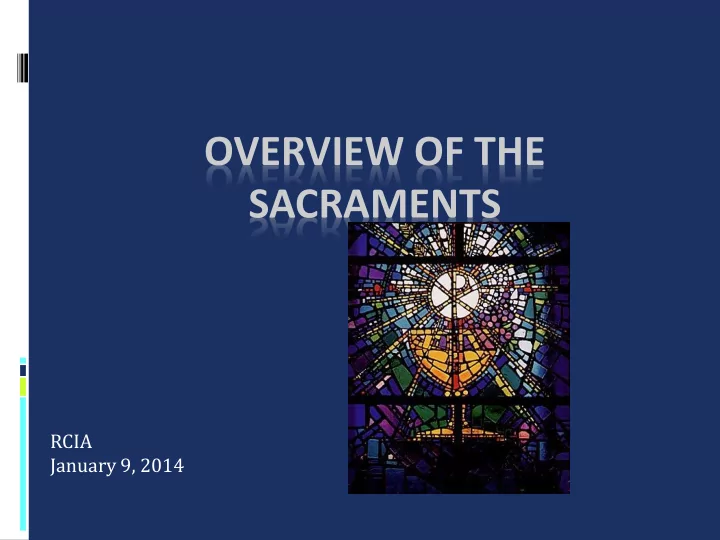
SLIDE 1 OVERVIEW OF THE SACRAMENTS
RCIA January 9, 2014
SLIDE 2 Sacraments
The Latin word sacramentum means "a sign of the sacred." Our sacraments are ceremonies or rituals that point to what is sacred, significant and important for Christians. The sacraments are special occasions for experiencing God's saving presence (Grace). That's what theologians mean when they say that sacraments are at the same time signs and instruments
SLIDE 3
Sacraments Our belief in the Sacraments as sources of
Grace differentiate us from many of our Non- Catholic brothers and sisters However, there is significant diversity within the Protestant tradition on this issue.
SLIDE 4
Grace
We all agree that Grace is a gift from God, freely given, both undeserved and unmerited It is solely the initiative of God It is given for the Forgiveness of Sins and our Salvation From here it gets more complex …
SLIDE 5
Catholic Teaching on the Sacraments
The Roman Catholic Church and Oriental Orthodoxy teach that there are seven sacraments. The Eastern Orthodox Church also believes that there are seven major sacraments, but applies the corresponding Greek word, μυστήριον (mysterion) also to rites that in the Western tradition are called sacramentals The Catholic Church did not finally set the number of sacraments at seven until the Council of Trent (1545- 63)
SLIDE 6
Anglican/Episcopalian
Anglican teaching is that "there are two
Sacraments ordained of Christ our Lord in the Gospel … Baptism and the Supper of the Lord", and that "those five commonly called Sacraments … Confirmation, Penance, Orders, Matrimony, and Extreme Unction, are not to be counted for Sacraments of the Gospel".
SLIDE 7 Lutheran
Martin Luther defined a sacrament as an act or rite:
- instituted by God
- in which God Himself has joined His Word of promise to the visible
element
- and by which He offers, gives and seals the forgiveness of sin earned by
Christ
This strict definition narrowed the number of sacraments down to two or three: Holy Baptism, the Eucharist, and for some, Holy Absolution (Reconciliation), with the other four rites eliminated for not having a visible element or the ability to forgive sin. Lutherans do not dogmatically define the exact number of sacraments.
SLIDE 8
Methodists
As a descendant of the Anglican and German Pietist traditions, Methodists recognize Baptism and the Eucharist as Sacraments. Only these were specifically commanded by Christ ("Do this in remembrance of me"; "Go to all the world, baptizing . . . .")
SLIDE 9 Teachings of other Christian Traditions
The Eucharist is considered a sacrament, ordinance, or equivalent in most Christian denominations. The enumeration, naming, understanding, and the adoption of the sacraments formally vary according to denomination, although the finer theological distinctions are not always understood and may not even be known to many of the faithful. Many Protestants and other post-Reformation traditions affirm Luther's definition and have only Baptism and Eucharist as sacraments, while others see the ritual as merely symbolic, and still others do not have a sacramental dimension at all
SLIDE 10
What is a Sacrament?
A visible (outward) sign of an invisible (inward) Grace, instituted by Christ for our sanctification
SLIDE 11
Visible/Outward Sign
Something that appeals to our senses: We can: See it Touch/Feel it Taste/Smell it Hear it
SLIDE 12
Visible/Outward Sign
Example: Water (Baptism) Physical properties
Washes, Cleanses, Purifies Removes stains & blemishes
Nourishes
Life giving
SLIDE 13 Invisible/Inward Grace
What is Grace? The living and loving presence
(Fr Michael Roverse)
SLIDE 14 Grace and the Catechism
- Free Gift from God … unearned, unmerited
- Divine Favor: Grace is favor, the free and undeserved help that
God gives us to respond to his call to become children of God, adoptive sons, partakers of the divine nature and of eternal life.
- Grace is a participation in the life of God. It introduces us into the
intimacy of Trinitarian life: by Baptism the Christian participates in the grace of Christ, the Head of his Body. As an “adopted son” he can henceforth call God “Father,” in union with the only Son. He receives the life of the Spirit who breathes charity into him and who forms the Church.
SLIDE 15 Grace
- The grace of Christ is the gift that God makes to us of his own life,
infused by the Holy Spirit into our soul to heal it of sin and to sanctify it.
- The preparation of man for the reception of grace is already a
work of grace.
SLIDE 16 Sacraments and Grace
When celebrated worthily in faith, the sacraments confer the grace that they signify. Example of Baptism
- We are cleansed of all sin; purified and made
holy
- We are said to die with Jesus as we are
submerged in the water but share in the resurrection of Jesus as we emerge from the water and are given new life as children of God
SLIDE 17 Instituted by Christ
The sacraments are efficacious (successful in achieving a desired result) because in them Christ himself is at work It is he who baptizes, he who acts in his sacraments in
- rder to communicate the grace that each sacrament
signifies.
SLIDE 18
Instituted by Christ
"Adhering to the teaching of the Holy Scriptures, to the apostolic traditions, and to the consensus . . . of the Fathers," we profess that "the sacraments were . . . all instituted by Jesus Christ our Lord.”
SLIDE 19 Scripture - Baptism
Matthew 3:13 Then Jesus came from Galilee to John at the Jordan to be baptized by him. John tried to prevent him, saying, "I need to be baptized by you, and yet you are coming to me?” Jesus said to him in reply, "Allow it now, for thus it is fitting for us to fulfill all righteousness." Then he allowed him. Matthew 28:19-20 Go, therefore, and make disciples of all nations, baptizing them in the name of the Father, and of the Son, and of the holy Spirit, teaching them to
- bserve all that I have commanded you.
Mark 16:15-16. He said to them, "Go into the whole world and proclaim the gospel to every creature. Whoever believes and is baptized will be saved; whoever does not believe will be condemned. John 3:5. Jesus answered, "Amen, amen, I say to you, no one can enter the kingdom
- f God without being born of water and Spirit.
SLIDE 20 Scripture: Confirmation
Acts 1:8. But you will receive power when the holy Spirit comes upon you, and you will be my witnesses in Jerusalem, throughout Judea and Samaria, and to the ends of the earth." John 20:22 And when he had said this, he breathed on them and said to them, "Receive the Holy Spirit. Acts 2:1-4. When the time for Pentecost was fulfilled, they were all in one place together. And suddenly there came from the sky a noise like a strong driving wind, and it filled the entire house in which they were. Then there appeared to them tongues as
- f fire, which parted and came to rest on each one of them. And they were all filled
with the Holy Spirit and began to speak in different tongues, as the Spirit enabled them to proclaim.
SLIDE 21 Scripture - Confirmation
Acts 2:38. Peter (said) to them, "Repent and be baptized, every one of you, in the name of Jesus Christ for the forgiveness of your sins; and you will receive the gift of the holy Spirit. Ezekiel 36:25-27 I will sprinkle clean water upon you to cleanse you from all your impurities, and from all your idols I will cleanse you. I will give you a new heart and place a new spirit within you, taking from your bodies your stony hearts and giving you natural
- hearts. I will put my spirit within you and make you live by my statutes, careful to
- bserve my decrees.
Joel 3:1-2. Then afterward I will pour out my spirit upon all mankind… Luke 12:12; John 3:5-8; 7:37-39; 16:7-15
SLIDE 22 Scripture - Eucharist
Luke 22:19 Then he took the bread, said the blessing, broke it, and gave it to them, saying, "This is my body, which will be given for you; do this in memory of me.” And likewise the cup after they had eaten, saying, "This cup is the new covenant in my blood, which will be shed for you. 1 Corinthians 11:24. For I received from the Lord what I also handed on to you, that the Lord Jesus, on the night he was handed over, took bread, and, after he had given thanks, broke it and said, "This is my body that is for you. Do this in remembrance of me.” In the same way also the cup, after supper, saying, "This cup is the new covenant in my
- blood. Do this, as often as you drink it, in remembrance of me.” For as often as you
eat this bread and drink the cup, you proclaim the death of the Lord until he comes.
SLIDE 23 Scripture - Eucharist
Mt 26:26; Mk 14:22. 1 Cor 11:20; Rev 19:9. Mt 14:19; 15:36; Mk 8:6, 19. Mt 26:26; 1 Cor 11:24. Lk 24:13-35. Acts 2:42, 46; 20:7, 11. 1 Cor 10:16-17. 1 Cor 11:17-34. Heb 13:15; cf. 1 Pet 2:5; Ps 116:13, 17; Mal 1:11. 1 Cor 10:16-17.
SLIDE 24 Scripture - Reconciliation
Matthew 16:19; Matthew 18:18; 28:16-20
"I will give you the keys of the kingdom of heaven, and whatever you bind on earth shall be bound in heaven, and whatever you loose on earth shall be loosed in heaven.”
SLIDE 25
Scripture - Anointing
James 5; 14-15: "Is any among you sick? Let him call for the elders [presbyters] of the Church and let them pray over him, anointing him with oil in the name of the Lord; and the prayer of faith will save the sick man, and the Lord will raise him up; and if he has committed sins, he will be forgiven.”
SLIDE 26 Scripture – Holy Orders
The liturgy of the Church sees in the priesthood of Aaron and the service of the Levites, a prefiguring of the ordained ministry of the New Covenant. Hebrews 5:6; 7:11; Psalms 110:4.
1 Timothy 3:1-7 Titus 1: 5:7 Acts 20: 17, 28 Philippians 1:1 Acts 6: 3-6
SLIDE 27 Scriptures - Matrimony
Genesis 1: 27-28 God created man in his image; in the divine image he created him; male and female he created them. God blessed them, saying: "Be fertile and multiply; fill the earth and subdue it. Have dominion over the fish of the sea, the birds of the air, and all the living things that move on the earth.” Genesis 2: 24 That is why a man leaves his father and mother and clings to his wife, and the two
Matthew 19: 4-6 "Have you not read that from the beginning the Creator 'made them male and female’ and said, 'For this reason a man shall leave his father and mother and be joined to his wife, and the two shall become one flesh’? So they are no longer two, but one flesh. Therefore, what God has joined together, no human being must separate."
SLIDE 28 Sanctification
The purpose of the sacraments is to sanctify men (to make us holy), to build up the Body
- f Christ, and to give worship to God.
SLIDE 29
Sacraments
The whole liturgical life of the Church revolves around the sacraments especially the Eucharistic sacrifice. Sacraments are actions of the Holy Spirit at work in his Body, the Church. The sacraments are not wrought by the righteousness of either the celebrant or the recipient, but by the power of God. The Church affirms that for believers the sacraments are necessary for salvation.
SLIDE 30
Seven Sacraments
Baptism Confirmation Eucharist Reconciliation Anointing of the Sick Holy Orders Matrimony
SLIDE 31
Sacraments – 3 Groups
Sacraments of Initiation: Baptism, Confirmation and Eucharist Sacraments of Healing Reconciliation and Anointing of the Sick Sacraments of Service Holy Orders and Matrimony
SLIDE 32 Sacraments of Initiation
Christian initiation is accomplished by three sacraments together:
- Baptism which is the beginning of new life
- Confirmation which is its strengthening
- The Eucharist which nourishes the disciple with
Christ's Body and Blood for his/her transformation in Christ.
SLIDE 33
Sacrament of Baptism
Holy Baptism is the basis of the whole Christian life, the gateway to life in the Spirit and the door that gives access to the other sacraments. Through Baptism we are freed from sin and reborn as children of God; we become members of Christ, are incorporated into the Church and made sharers in her mission The water symbolizes the catechumen's burial into Christ's death, from which he/she rises up by resurrection with Him/in Him, as "a new creature."
SLIDE 34 Baptism/Salvation
The Lord himself affirms that Baptism is necessary for
- salvation. He also commands his disciples to proclaim the
Gospel to all nations and to baptize them.
The Church does not know of any means other than Baptism that assures entry into eternal beatitude; this is why she takes care not to neglect the mission she has received from the Lord to see that all who can be baptized are "reborn of water and the Spirit.
Baptism is necessary for salvation for those to whom the Gospel has been proclaimed and who have had the possibility of asking for this sacrament.
God has bound salvation to the sacrament of Baptism, but he himself is not bound by his sacraments.
SLIDE 35 Confirmation
The reception of the sacrament of Confirmation is necessary for the completion of baptismal grace. The effect of the sacrament of Confirmation is the special outpouring of the Holy Spirit as was granted to the apostles on the day of Pentecost. Confirmation brings an increase and deepening
SLIDE 36 Eucharist
The holy Eucharist completes Christian initiation.
Those who have been raised to the dignity of the royal priesthood by Baptism and configured more deeply to Christ by Confirmation participate with the whole community in the Lord's own sacrifice by means of the Eucharist.
The Eucharist is the source and the summit of the Church's life, for in it Christ associates his Church and all her members with his sacrifice offered once for all on the cross to his Father
SLIDE 37 Eucharist
The Eucharistic celebration always includes:
- The proclamation of the Word of God
- Thanksgiving to God the Father for all his benefits,
above all the gift of his Son
- The consecration of bread and wine
- The participation in the liturgical banquet by receiving
the Lord's body and blood. These elements constitute one single act of worship.
SLIDE 38
Eucharist
The Eucharist is the memorial of Christ's Passover, that is, of the work of salvation accomplished by the life, death, and resurrection of Christ. It is Christ himself, acting through the ministry of the priests, who offers the Eucharistic sacrifice. And it is the same Christ, really present under the species of bread and wine, who is the offering of the Eucharistic sacrifice.
SLIDE 39
Eucharist
Anyone who desires to receive Christ in Eucharistic communion must be in the state of grace. Anyone aware of having sinned mortally must not receive communion without having received absolution in the sacrament of penance. Communion with the Body and Blood of Christ increases the communicant's union with the Lord, forgives his venial sins, and preserves him from grave sins.
SLIDE 40
Sacraments of Healing
Through the sacraments of Christian initiation, man receives the new life of Christ. This new life as a child of God can be weakened and even lost by sin. The Lord Jesus Christ has willed that his Church continue his work of healing and salvation even among her own members. This is the purpose of the two sacraments of healing: the Sacrament of Penance and the Sacrament of Anointing of the Sick.
SLIDE 41 Sacrament of Reconciliation
The forgiveness of sins committed after Baptism is conferred by a particular sacrament called the sacrament
- f confession, penance, or reconciliation.
The sinner wounds:
- God's honor and love
- His own human dignity as a man called to be a son of God
- The spiritual well-being of the Church
To return to communion with God after having lost it through sin is a process born of the grace of God who is rich in mercy and eager for the salvation of men.
SLIDE 42 Sacrament of Reconciliation
The sacrament of Reconciliation is a whole consisting in three actions of the penitent and the priest's absolution. The penitent's acts are:
- Repentance (true remorse for one’s sins)
- Confession of sins to the priest
- The intention to make reparation (penance) and do
works of reparation.
SLIDE 43
Anointing of the Sick
The sacrament of Anointing of the Sick has as its purpose the conferral of a special grace on the Christian experiencing the difficulties inherent in the condition of illness or old age. Each time a Christian falls seriously ill, he/she may receive the Anointing of the Sick, and also when, after he has received it, the illness worsens.
SLIDE 44 Sacraments at the Service of Communion
The sacraments, Holy Orders and Matrimony, are directed towards the salvation of others They confer a particular mission in the Church and serve to build up the People of God. Those who receive the sacrament of Holy Orders are consecrated in Christ's name "to feed the Church by the word and grace of God." Those who receive the Sacrament of Matrimony are strengthened and consecrated for the duties and dignity of their state by a special sacrament."
SLIDE 45
Holy Orders
Holy Orders is the sacrament through which the mission entrusted by Christ to his apostles continues to be exercised in the Church until the end of time It is the sacrament of apostolic ministry.
SLIDE 46
Holy Orders
It includes three degrees: Episcopate (Bishop)
Presbyterate (Priest) Diaconate (Deacon)
SLIDE 47 Matrimony
"The matrimonial covenant, by which a man and a woman establish between themselves a partnership of the whole of life, is by its nature ordered toward the good of the spouses and the procreation and education
SLIDE 48
Matrimony
The Sacrament of Matrimony signifies the union of Christ and the Church. It gives spouses the grace to love each other with the love with which Christ has loved his Church The grace of the sacrament thus perfects the human love of the spouses, strengthens their indissoluble unity, and sanctifies them on the way to eternal life
SLIDE 49
Matrimony
Unity, indissolubility, and openness to fertility are essential to marriage.