Environment and Natural Resources Trust Fund 2012-2013 Request for - - PDF document

environment and natural resources trust fund 2012 2013
SMART_READER_LITE
LIVE PREVIEW

Environment and Natural Resources Trust Fund 2012-2013 Request for - - PDF document

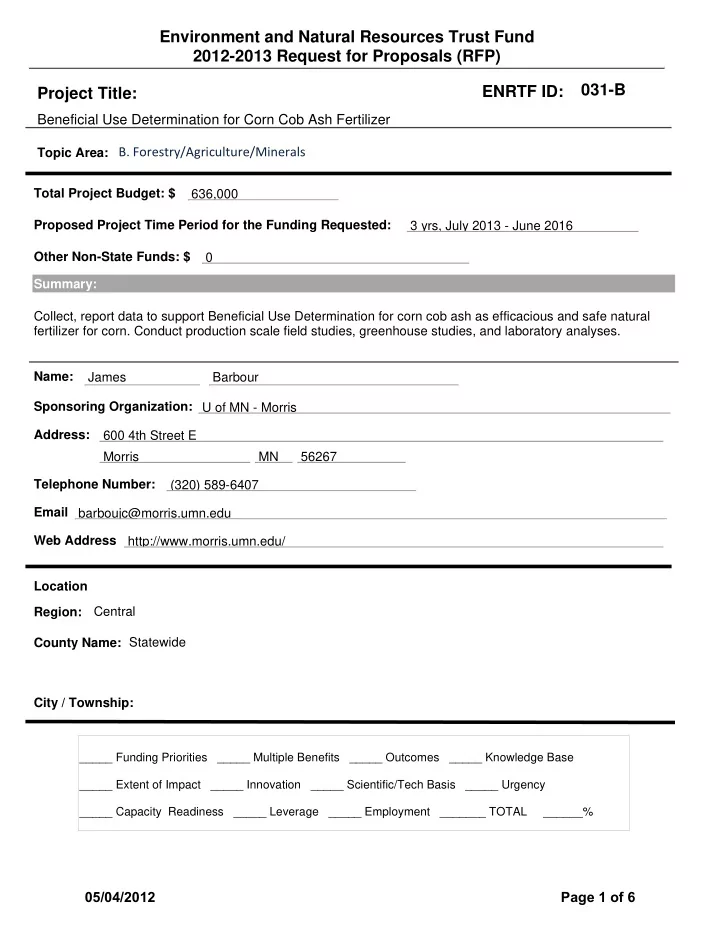
Environment and Natural Resources Trust Fund 2012-2013 Request for Proposals (RFP) 031-B ENRTF ID: Project Title: Beneficial Use Determination for Corn Cob Ash Fertilizer B. Forestry/Agriculture/Minerals Topic Area: Total Project Budget: $


slide-1
SLIDE 1

Environment and Natural Resources Trust Fund 2012-2013 Request for Proposals (RFP) Project Title:

Total Project Budget: $ Proposed Project Time Period for the Funding Requested: Other Non-State Funds: $ Name: Sponsoring Organization: Address: Telephone Number: Email Web Address County Name: City / Township: Region: Summary: Location

Beneficial Use Determination for Corn Cob Ash Fertilizer

636,000 3 yrs, July 2013 - June 2016 Collect, report data to support Beneficial Use Determination for corn cob ash as efficacious and safe natural fertilizer for corn. Conduct production scale field studies, greenhouse studies, and laboratory analyses. James U of MN - Morris 600 4th Street E Morris MN 56267 (320) 589-6407 barboujc@morris.umn.edu http://www.morris.umn.edu/ Central Statewide Barbour

_____ Funding Priorities _____ Multiple Benefits _____ Outcomes _____ Knowledge Base _____ Extent of Impact _____ Innovation _____ Scientific/Tech Basis _____ Urgency _____ Capacity Readiness _____ Leverage _____ Employment _______ TOTAL ______%

  • B. Forestry/Agriculture/Minerals

ENRTF ID: 031-B

Topic Area:

05/04/2012 Page 1 of 6

slide-2
SLIDE 2

Ver.11.0 1 Project Title: Use of Corn Cob Ash for Phosphorus & Potassium Fertilization in Corn: A Production Scale Comparison with Commercial Fertilizer Project Statement: Ash from the gasification/combustion of agricultural residues is a potentially marketable byproduct for land application. In Minnesota, the use of biomass-derived ash (except wood ash) as fertilizer can be done only through a process called Case-Specific Beneficial Use Determination (CSBUD). This project will provide much-needed data to support a general Beneficial Use Determination for corn cob ash. The data will be shared with MPCA. An experiment done at the U of M Southern Research and Outreach Center in 20081 showed that biomass ash from two different sources when applied at the same phosphorus rate produced corn grain yields that were not significantly different from a commercial fertilizer. This project will focus specifically on corn cob ash from the UMM biomass-fired heat and power plant. The goal of this project is to show that corn cob ash can be used as an efficacious and safe natural source

  • f P and K in corn. The outcomes of this project include (1) data on which to base a Beneficial Use

Determination; (2) a potential new fertilizer option for farmers in the Midwest; (3) ash as a lower-cost alternative to mined or synthetic fertilizer; (4) Undergraduate Research Opportunities for two students; and (5) employment for a lab technician, graduate student, and the PI. The likelihood of long-term cheap natural gas is forcing generators of biomass energy to find value-added products and markets. Having a market for the ash would be a boon to the industry, encouraging future development that will provide new jobs in rural Minnesota and keep local energy expenditures in the local economy. I. Description of project activities Activity 1: Data for Beneficial Use Determination Budget: $255,000 (A) Three year field study on four field sites in West Central Minnesota. Each field site will have 9 strip plots of about 3 acres each, being treated with no P/K fertilizer, P/ K commercial fertilizer, or corn cob ash at the same rate of P or K, depending on which is shown by soil testing to be limiting. (B) Greenhouse study using ash and commercial fertilizer on multiple soil types representative of Minnesota soils. (C) Travel to Twin Cities to meet with colleagues/collaborators to review data. Outcome: Completion Date

  • 1. Demonstrated efficacy and safety of corn cob ash fertilizer
  • 2. Data shared with MPCA

Q3 2016 Q4 2016 Activity 2: Sampling and Lab Analyses Budget: $277,000 Soil samples will be taken from all plots preplanting and postharvest each year and analyzed for P, K, and pH at the USDA-Agricultural Research Service (ARS) laboratory in Morris. Plant samples will be taken

1 Vetsch, J. 2010. Utilizing ash as a nutrient source for corn: 2009 final report. Univ. of Minnesota, AURI, and

Minnesota Corn Growers Assoc.

05/04/2012 Page 2 of 6

slide-3
SLIDE 3

Ver.11.0 2 and grain yield will be measured at harvest, and grain samples will be analyzed for P and K. Analyses will be done at the ARS Lab in Morris. Outcome: Completion Date

  • 1. Data corroborate the efficacy and safety of corn cob ash fertilizer
  • 2. Data shared with MPCA

Q3 2016 Q4 2016 Activity 3: Data Analysis and Reporting Budget: $104,000 Write journal articles, submit for publication. Write final report and submit to LCCMR, MPCA. Outcome Completion Date

  • 1. Dissemination of results
  • 2. MPCA acts on Beneficial Use Determination for corn cob ash

Q2 2017 Q2 2017

  • III. Project Strategy
  • A. Project team/partners (Note: All are receiving funding from ENRTF)
  • Dr. James Barbour, University of MN, Morris; Role: PI, Project Manager
  • Dr. Jane Johnson, USDA-ARS, Morris; Role: Soil Scientist, Analytical Laboratory Supervisor
  • Mr. Kevin Lundberg, Landowner; Role: All agronomic activities
  • Dr. Kurt Spokas, USDA-ARS; Role: Soil Scientist, Ash/Char expert, direct greenhouse studies
  • Dr. Peter Wyckoff, UMM, Undergraduate Student Research Advisor
  • B. Timeline Requirements

The project will begin July 1, 2013 and conclude on June 30, 2017. We are requesting the additional year to allow for completing the third full growing season.

  • C. Long-Term Strategy and Future Funding Needs

Once the Beneficial Use Determination is in place and nonwoody biomass ash becomes a commercially available alternative to volatile fertilizer markets, UM Morris will then move to set up a demonstration site to process ash into a commercially compatible alternative fertilizer. This project is on our five-year timeline and will require substantial funding from multiple sources, including commodity groups, fertilizer processers, state and federal sources. A demonstration site will eventually generate revenue from fertilizer blenders testing ash in their product, thus becoming self-supporting.

05/04/2012 Page 3 of 6

slide-4
SLIDE 4

BUDGET ITEM Personnel: James Barbour, PI, 0.75 FTE yrs 1-3; 0.20 FTE yr 4; Salary: $106,244; Fringe: $39,373 $145,617 Peter Wyckoff, Student Research Advisor, Summer Salary, $10,456 Fringe: $2,079 $12,535

  • Undergrad. Res. Assistants (2) - 10 hr/wk Academic year: Salary: $16,200 Fringe: $0

$16,200

  • Undergrad. Res. Assistants (2) - 40 hr/wk Summer: $30,240 Fringe: $2202

$32,442 Contracts: Lundberg Farms, Kevin Lundberg - Land use and agronomic operations - Mr. Lundberg is current corn cob supplier. He has the land at different locations less than 40 miles from Morris under his management and has equipment to handle the ash. 60,000 $ ARS - Johnson and Spokas - includes salary for lab technician (Johnson) and graduate student (Spokas), sample processing and anaysis costs, costs for greenhouse studies 360,000 $ Equipment/Tools/Supplies: Sampling Equipment (soil probes, probe extensions, WhirlPak sample bags) $1,000

  • Misc. Supplies (e.g., lubricants, field gloves, etc)

$2,000 Travel: Travel to field sites (avg. 60 mi.round trip, avg. 18 trips each year); Travel to Twin Cities to meet with collaborators (6 trips; 2 per year); based on vehicle charges of $61/day and $0.23/mile) $5,000 Additional Budget Items: Ash Hauling - from UMM campus to field sites $1,000 TOTAL ENVIRONMENT AND NATURAL RESOURCES TRUST FUND $ REQUEST = SOURCE OF FUNDS AMOUNT Status Other Non-State $ Being Applied to Project During Project Period: 138,059 $ Unrecovered indirect costs (52% of Modified Total Direct Costs) Other State $ Being Applied to Project During Project Period:

  • $

In-kind Services During Project Period:

  • $

Remaining $ from Current ENRTF Appropriation (if applicable): N/A Funding History: N/A

2012-2013 Detailed Project Budget

  • IV. TOTAL ENRTF REQUEST BUDGET 4 years

AMOUNT $5,000 $1,000 $420,000

  • V. OTHER FUNDS

$207,000 $636,000 $3,000

I:\ML2013\RFP\proposals_received\barbour-james_0412-2-133-Budget

05/04/2012 Page 4 of 6

slide-5
SLIDE 5

Project Manager Qualifications and Organization Description

  • Dr. Barbour: James C. Barbour is a researcher in the Biomass Gasification Project at the

University of Minnesota, Morris, and a member of the course development team for UMM’s Environmental Science 1131, Renewable Energy with Biomass Gasification. He also teaches a portion of the course. He earned his PhD at the University of Georgia. While there, he studied the acclimation of photosynthesis in peanuts to shading by associated plant competitors. Jim earned his BS and MS degrees from North Carolina State University in Crop Science with an emphasis in plant physiology.

  • Dr. Barbour has been at UMM for four years, and currently is project coordinator for a

DOE-funded grant titled “Determining optimal performance in adapting onsite electrical generation platforms to operate on producer gas from fuels of opportunity.” The project is in its final years of a two-stage project. The budget totals $1.64 million, of which $1.05 million is funded by DOE. University of Minnesota, Morris: UMM is a four-year Liberal Arts campus of the University of Minnesota System with an enrollment of about 1900 students. The campus has a 5.3 MWth biomass gasifier/boiler producing heating, cooling, and electricity for the

  • campus. This facility provides about 50% of the campus heating needs. The primary fuel

is corn cobs. UMM has the knowledge and experience in handling and thermal conversion of corn cobs at a community scale and are especially motivated to develop data that can lead to the deregulation of corn cob ash so that the ash generated can be returned to the field as fertilizer. Lundberg Farms is UMM’s current corn cob supplier and is a large-scale corn farm in West Central Minnesota. Lundberg Farms has the equipment, skill, and manpower to handle all field work described and needed for this project. 05/04/2012 Page 5 of 6

slide-6
SLIDE 6

05/04/2012 Page 6 of 6