Environment and Natural Resources Trust Fund 2012-2013 Request for - - PDF document

environment and natural resources trust fund 2012 2013
SMART_READER_LITE
LIVE PREVIEW

Environment and Natural Resources Trust Fund 2012-2013 Request for - - PDF document

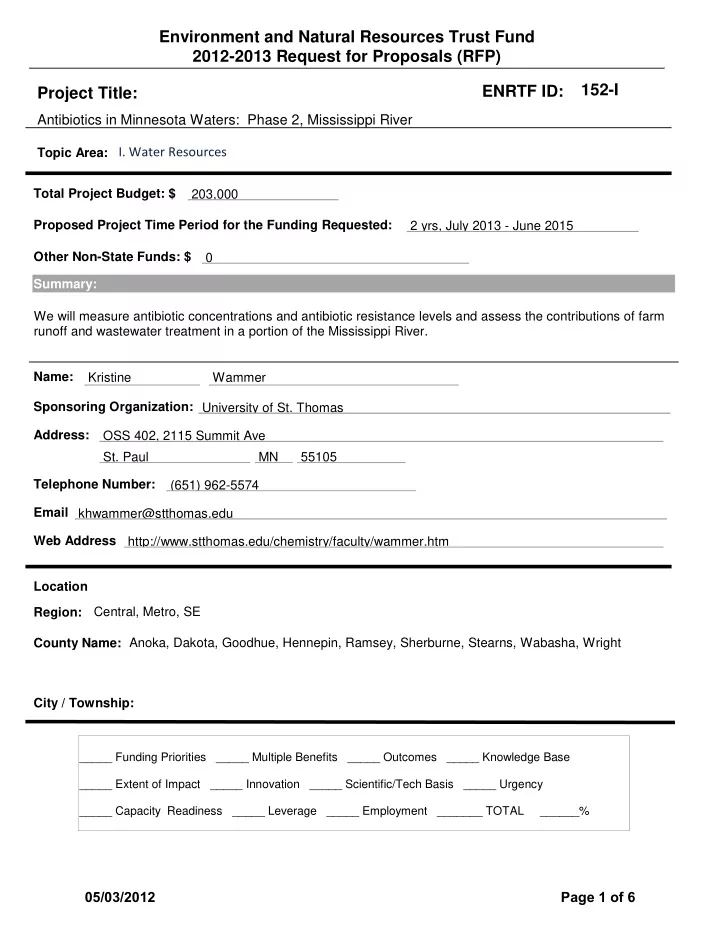
Environment and Natural Resources Trust Fund 2012-2013 Request for Proposals (RFP) 152-I ENRTF ID: Project Title: Antibiotics in Minnesota Waters: Phase 2, Mississippi River I. Water Resources Topic Area: Total Project Budget: $ 203,000


slide-1
SLIDE 1

Environment and Natural Resources Trust Fund 2012-2013 Request for Proposals (RFP) Project Title:

Total Project Budget: $ Proposed Project Time Period for the Funding Requested: Other Non-State Funds: $ Name: Sponsoring Organization: Address: Telephone Number: Email Web Address County Name: City / Township: Region: Summary: Location

Antibiotics in Minnesota Waters: Phase 2, Mississippi River

203,000 2 yrs, July 2013 - June 2015 We will measure antibiotic concentrations and antibiotic resistance levels and assess the contributions of farm runoff and wastewater treatment in a portion of the Mississippi River. Kristine University of St. Thomas OSS 402, 2115 Summit Ave

  • St. Paul

MN 55105 (651) 962-5574 khwammer@stthomas.edu http://www.stthomas.edu/chemistry/faculty/wammer.htm Central, Metro, SE Anoka, Dakota, Goodhue, Hennepin, Ramsey, Sherburne, Stearns, Wabasha, Wright Wammer

_____ Funding Priorities _____ Multiple Benefits _____ Outcomes _____ Knowledge Base _____ Extent of Impact _____ Innovation _____ Scientific/Tech Basis _____ Urgency _____ Capacity Readiness _____ Leverage _____ Employment _______ TOTAL ______%

  • I. Water Resources

ENRTF ID: 152-I

Topic Area:

05/03/2012 Page 1 of 6

slide-2
SLIDE 2

Environment and Natural Resources Trust Fund (ENRTF) 2012-2013 Main Proposal

1 PROJECT TITLE: Antibiotics in Minnesota Waters: Phase 2, Mississippi River

  • I. PROJECT STATEMENT

Pharmaceuticals and personal care products have gained significant attention in recent years as emerging contaminants in the environment, including attention from legislative bodies. The MN legislature passed a bill in 2009 regulating human pharmaceutical disposal and a current bill in the U.S. Congress would restrict the use of antibiotics for agricultural purposes due to concerns over harm to human health related to the development of antibiotic resistance. While the environmental occurrence of these compounds has spurred interest, major gaps still remain in our understanding of their significance and potential health and ecological impacts. The critical question of which, if any, emerging contaminants are of the most direct concern to human health is still largely unanswered. Because the threat of decreased efficacy of antibiotics due to increases in antibiotic resistance levels is such a significant human health threat, this class of pharmaceuticals is a priority for further study. The goal of this project is to study the development of antibiotic resistance due to the presence of antibiotics and antibiotic resistance genes in farm runoff and in wastewater treatment plant effluents, which then subsequently impact surface waters. We will study a portion of the Mississippi River from north of St. Cloud to south of Kellogg. This project team is currently working on a similar ENRTF-funded study in a portion of the Minnesota River. Our findings to date suggest that wastewater treatment plant effluents are a potentially important path for both antibiotics and antibiotic resistance genes to reach surface waters. This is consistent with findings by a recent USGS study that reported elevated levels of pharmaceuticals, including one antibiotic (sulfamethoxazole) in wastewater treatment plant effluents throughout Minnesota. We now propose to address the pressing question of whether drinking water is being impacted, and whether this is observed on a larger scale. Samples will be obtained from locations selected to allow comparison of primarily agricultural (including drainage ditches), primarily residential/industrial (including wastewater treatment effluents), and mixed inputs to the Mississippi River. In addition, we will collect samples near drinking water intakes and tap water from Minneapolis, St. Paul, and St. Cloud. The project will assess current antibiotic concentrations and current antibiotic resistance levels for members of four major classes of antibiotics used in both human medicine and agriculture: tetracyclines, sulfa drugs, macrolides, and

  • fluoroquinolones. A unique strength of this project is that the project team combines expertise in cutting-

edge analytical chemistry techniques with expertise in rigorous microbiology and molecular biology techniques to characterize each water sample.

  • II. DESCRIPTION OF PROJECT ACTIVITIES

Activity 1: Measure antibiotic concentrations at targeted Mississippi River sites Budget: $ 81,841 We will analyze water samples for the presence of selected antibiotics using methods based on two- dimensional high performance liquid chromatography developed in the laboratory of Dwight Stoll (one of the project partners). These methods have exceptional separation power that will allow us to accurately detect antibiotics even in complicated sample matrices such as those being considered in this work. We will use established solid-phase extraction methods for sample pre-concentration prior to analysis to allow detection of antibiotics present at low levels. In the work currently funded by the ENRTF, the Stoll group has successfully measured the concentration of several antibiotics in drainage ditches, the Minnesota River, and wastewater treatment plant effluents with detection limits in the parts per trillion range. Outcome Completion Date

  • 1. Screen samples collected throughout the summer for the presence of 4 target

antibiotics: tetracycline, tylosin (a macrolide), sulfamethoxazole (a sulfa drug) and ciprofloxacin (a fluoroquinolone) November 2013

  • 2. Optimize our methods for the samples of interest. Identify potential new target

antibiotics based on initial results, and develop detection methods. March 2014

  • 3. Quantify concentrations of the 4 target antibiotics plus any new target antibiotics

for samples collected throughout the year. June 2015

05/03/2012 Page 2 of 6

slide-3
SLIDE 3

2 Activity 2: Measure antibiotic resistance levels at same Mississippi river sites Budget: $139,456 Enumerating “antibiotic resistance” poses a unique challenge because of the diversity of microorganisms in nature and the diversity of antibiotics studied. Therefore, we will use two techniques that provide complementary data to give us the most accurate information. In the past, we have been successful using quantitative polymerase chain reaction (qPCR) as well as cultivation-based approaches. The qPCR technique involves concentrating the bacteria within the samples on filters and then extracting/purifying the DNA of any gene of interest. The qPCR technique allows us to quantify specific genes that encode antibiotic resistance, but the organisms that harbor the genes (and their characteristics) remain unknown. The benefit of the cultivation-based approach is that it provides bacterial isolates that can be analyzed further (for example, we will identify these organisms and determine their resistance to multiple antibiotics). We cultivate antibiotic-resistant bacteria using solid growth media amended with the target antibiotic. Outcome Completion Date

  • 1. Cultivate bacteria from the initial sample sets on growth media with a range of

concentrations of the 4 target antibiotics. November 2013

  • 2. Quantify genes conferring resistance to tetracyclines, sulfa drugs, macrolides,

and fluoroquinolones in bacteria from the initial sample sets. March 2014

  • 3. Develop any new necessary gene- and cultivation-based methods.

March 2014

  • 4. Enumerate antibiotic-resistant bacteria from sites for samples collected

throughout the year, including bacteria resistant to any new target antibiotics. Isolate resistant bacteria, and test their resistance to other classes of antibiotics. November 2014

  • 5. Quantify genes conferring resistance to the 4 original classes of antibiotics plus

any new classes of interest for samples collected throughout the year. June 2015

  • III. PROJECT STRATEGY
  • A. Project Team/Partners : Kris Wammer, University of St. Thomas, Chemistry. Responsible for

coordinating sampling effort, getting samples to other researchers in a timely fashion, and some tasks related to antibiotic resistance levels including supervision of St. Thomas undergraduate students (Activity 2). Will coordinate project and make sure reports are filed on time and results disseminated. Dwight Stoll, Gustavus Adolphus, Chemistry. Responsible for analysis of concentrations of antibiotics and supervision of Gustavus undergraduate students and research technician (Activity 1). Tim LaPara, University of Minnesota, Civil Engineering. Responsible for some tasks related to antibiotic resistance, including supervision of St. Thomas undergraduate students (Activity 2). All are proposed to receive ENRTF funds; St. Thomas is providing some in-kind services.

  • B. Timeline Requirements: Analysis of samples will be completed by June 2015, therefore this project

will be completed within 24 months. Our plan is to collect several sets of samples beginning in the summer of 2013 to provide baseline information about which antibiotics are present and which sites show indications of higher levels of antibiotic resistance. We will then refine our methods based on our findings from these initial samples, and perform the bulk of our sampling beginning in Spring 2014. Sample collection will vary seasonally and with rainfall events.

  • C. Long-Term Strategy and Future Funding Needs: This project builds upon knowledge gained by

studying antibiotics in the Minnesota River and allows us to apply this new information in a very practical

  • way. Because the proposed project will study a drinking water source, we will be able to communicate

more directly with the MDH drinking water protection program both to alert them to the presence of our selected antibiotics and to measure antibiotics that are of interest to them. The project will allow us to determine whether the presence of antibiotics and antibiotic resistance is a potential pressing threat for the many Minnesotans served by municipalities that rely on treated surface water for a drinking water source.

05/03/2012 Page 3 of 6

slide-4
SLIDE 4

J:\SHARE\WORKFILE\ML2013\RFP\proposals_recevied\wammer-kristine_0412-2-065-Budget.xls

BUDGET ITEM Personnel: Kristine Wammer, Principal Investigator. 1.5 months of salary per year plus associated fringe benefits (7.65%). Duties: responsible for coordinating sampling effort, getting samples to other researchers in timely fashion, and some tests of antibiotic resistance levels including supervision of St. Thomas undergraduate students (Activity 2). Will coordinate project and make sure reports are filed on time and results disseminated. University of St. Thomas undergraduate students. 3 students during the academic year, will work 6 hours per week for 32 weeks each year, $10 per hour. 2 students during each summer, will work 40 hours per week for 12 weeks each year, $10 per hour, plus associated fringe benefits (7.65%). Will perform experiments associated with Activity 2. Contracts: University of Minnesota: Timothy LaPara, Principal Investigator. 4 weeks of salary per year plus associated fringe benefits (34.9%). Duties: Responsible for some tests of antibiotic resistance levels including supervision of St. Thomas undergraduate students (Activity 2) ($31,340). General lab supplies (e.g. PCR primers, reagents ($12,500). Travel funds for a few targeted sampling trips independent of the main sampling events ($1000). Gustavus Adolphus College: Dwight Stoll, Principal Investigator. 1 month of salary per year plus associated fringe benefits (16.48%). Duties: Responsible for analysis of concentrations

  • f antibiotics and supervision of Gustavus undergraduate students and reseach technician

(Activity 1) ($14,319). Research technician 15 hours per week at $20 per hour plus associated fringe benefits (9.48%) ($34,540). 1 student during each summer, 40 hours per week for 12 weeks each year, $10.50 per hour, plus associated fringe benefits and summer housing ($12,512). 1 student during the academic year, 8 hours per week for 32 weeks, $10.50 per hour ($5,470). General lab supplies, e.g. solvents, vials, analytical standards ($6000). LC/MS instrument access ($8,000). Travel for meetings with Wammer and LaPara groups and some sampling trips ($1,000). Equipment/Tools/Supplies: General lab supplies, e.g. antibiotics, nutrient media, petri dishes, solvents Travel: Approximately 20 sampling trips, 300 miles round trip, 50 cents per mile for mileage

  • reimbursement. $50 per trip for meals for students/faculty.

TOTAL ENVIRONMENT AND NATURAL RESOURCES TRUST FUND $ REQUEST = SOURCE OF FUNDS AMOUNT Status Other Non-State $ Being Applied to Project During Project Period: Summer salary and fringe benefits for one undergraduate student will be provided by the University of St. Thomas each summer. 10,541 $ Pending In-kind Services During Project Period: The PI will contribute an additional 0.5 months effort each year with associated salary and fringe as in-kind services. 7,756 $ Remaining $ from Current ENRTF Appropriation (if applicable): Funds from Assessment of Minnesota River Antibiotic Concentrations (M.L. 2011, First Special Session,

  • Chp. 2, Art. 3, Sect. 2, Subd. 05e). Findings to date from this project led to the proposed

study. 161,389 $ Not yet

  • fficially

submitted for reimbursem ent as of 4/1/12 (project ends 6/30/2013) 4,000 $

  • V. OTHER FUNDS

203,000 $ 16,356 $ 81,841 $

2012-2013 Detailed Project Budget

  • IV. TOTAL ENRTF REQUEST BUDGET 2 years

AMOUNT 23,211 $ 32,752 $ 44,840 $

05/03/2012 Page 4 of 6

slide-5
SLIDE 5

Project Title: Antibiotics and Antibiotic Resistance in the Mississippi River Project Manager Qualifications Timothy M. LaPara

Education: B.S.C.E., 1995, Civil Engineering, University of Notre Dame; Ph.D., 1999, Environmental Engineering, Purdue University. Employment: Associate Professor, 2006-present, Department of Civil Engineering, University of Minnesota; Assistant Professor, 2000-2006, Department of Civil Engineering, University of Minnesota; Post-doctoral Research Associate, 2000, Department of Biological Sciences, Purdue University. Research

  • Dr. LaPara’s research is focused on the role of municipal and industrial wastewater treatment plants in

preserving environmental quality and in protecting public health. His research has a strong interdisciplinary nature, stemming from his unique background in both environmental engineering and microbiology.

Dwight R. Stoll

Education: B.S., 1999, Plant Biology, and B.S., 2001, Biochemistry, Minnesota State University, Mankato; Ph.D., 2007, Analytical Chemistry, University of Minnesota. Employment: Assistant Professor, 2008-present, Department of Chemistry, Gustavus Adolphus College; Post-doctoral Fellow, 2007-2008, Departments of Biochemistry, Molecular Biology, and Biophysics, and Medicine, University of Minnesota; Instructor, 2005-2006, Department of Chemistry,

  • St. Olaf College.

Research

  • Dr. Stoll’s research is focused on the development of novel separations based methods for the

determination of trace level compounds in complex matrices such as environmental and biological

  • samples. He uses multidimensional separations coupled with detection methods that include mass

spectrometry and UV absorbance spectroscopy.

Kristine H. Wammer

Education: B.A., 1997, Chemistry, St. Olaf College; Ph.D., 2003, Civil and Environmental Engineering, Princeton University. Employment: Assistant Professor, 2005-present, Department of Chemistry, University of St. Thomas. Post-doctoral Fellow, 2003-2005, Departments of Environmental Health Sciences, Chemistry and Civil Engineering, University of Minnesota. Research

  • Dr. Wammer’s research focuses on elucidating the chemical and microbiological processes affecting fate
  • f organic contaminants in the aquatic environment. Her group’s current interests include the

environmental photochemistry and potential biological impacts of certain classes of pharmaceutical and personal care products. See both the main proposal and the project budget for a description of the specific responsibilities of each project manager within this proposed project. Organization Descriptions

  • Dr. LaPara is in the Civil Engineering department at the University of Minnesota-Twin Cities, which is

the state of Minnesota’s largest institution of higher education. Dr. Stoll and Dr. Wammer are both in Chemistry departments that educate undergraduate students at Gustavus Adolphus College (St. Peter, MN) and the University of St. Thomas (St. Paul, MN).

05/03/2012 Page 5 of 6

slide-6
SLIDE 6

05/03/2012 Page 6 of 6