Environment and Natural Resources Trust Fund 2012-2013 Request for - - PDF document

environment and natural resources trust fund 2012 2013
SMART_READER_LITE
LIVE PREVIEW

Environment and Natural Resources Trust Fund 2012-2013 Request for - - PDF document

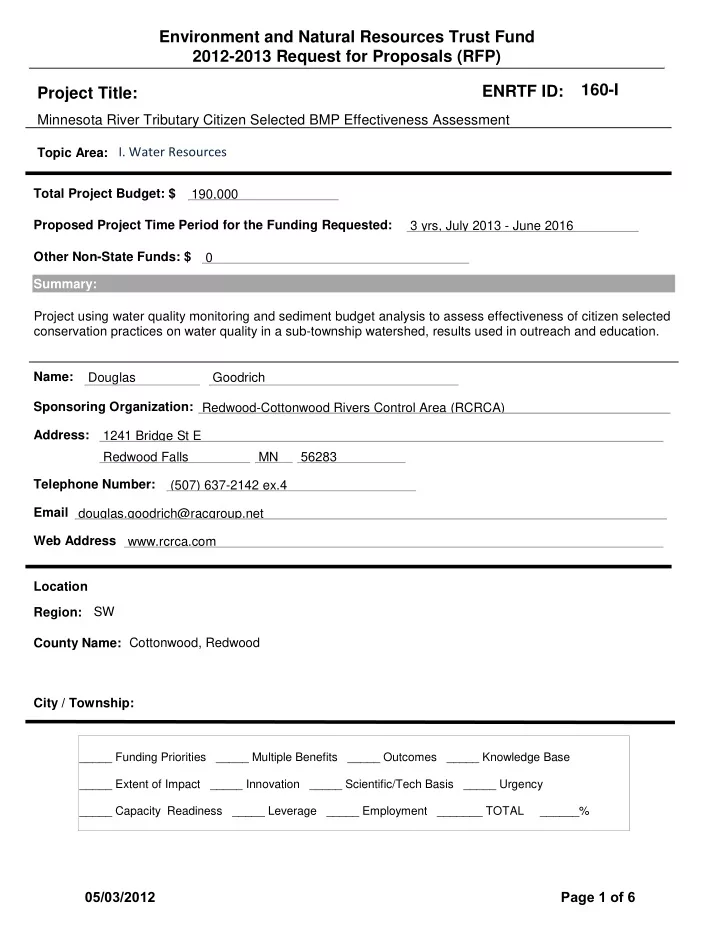
Environment and Natural Resources Trust Fund 2012-2013 Request for Proposals (RFP) 160-I ENRTF ID: Project Title: Minnesota River Tributary Citizen Selected BMP Effectiveness Assessment I. Water Resources Topic Area: Total Project Budget: $


slide-1
SLIDE 1

Environment and Natural Resources Trust Fund 2012-2013 Request for Proposals (RFP) Project Title:

Total Project Budget: $ Proposed Project Time Period for the Funding Requested: Other Non-State Funds: $ Name: Sponsoring Organization: Address: Telephone Number: Email Web Address County Name: City / Township: Region: Summary: Location

Minnesota River Tributary Citizen Selected BMP Effectiveness Assessment

190,000 3 yrs, July 2013 - June 2016 Project using water quality monitoring and sediment budget analysis to assess effectiveness of citizen selected conservation practices on water quality in a sub-township watershed, results used in outreach and education. Douglas Redwood-Cottonwood Rivers Control Area (RCRCA) 1241 Bridge St E Redwood Falls MN 56283 (507) 637-2142 ex.4 douglas.goodrich@racgroup.net www.rcrca.com SW Cottonwood, Redwood Goodrich

_____ Funding Priorities _____ Multiple Benefits _____ Outcomes _____ Knowledge Base _____ Extent of Impact _____ Innovation _____ Scientific/Tech Basis _____ Urgency _____ Capacity Readiness _____ Leverage _____ Employment _______ TOTAL ______%

  • I. Water Resources

ENRTF ID: 160-I

Topic Area:

05/03/2012 Page 1 of 6

slide-2
SLIDE 2

Environment and Natural Resources Trust Fund (ENRTF) 2012‐2013 Main Proposal

1 PROJECT TITLE: “Minnesota River Tributary Citizen Selected BMP Effectiveness Assessment”

  • I. PROJECT STATEMENT

Best management practices (BMPs) for conservation agricultural lands are a common method used to stem pollutants and hydrograph fluctuation associated with non‐point runoff and agricultural drainage. The effectiveness of these projects has been studied in controlled settings and approximated through calculation in their design. The importance of studying multiple BMPs in concert in real world, field level situations is seldom realized or monitored for effectiveness. This project seizes the chance to study a small watershed within Pell Creek, a 22 square mile tributary to the Cottonwood River and the Minnesota River located in Redwood County near Walnut Grove. This project will measure the effectiveness of a roster of planned BMP projects placed in the small sub‐shed by monitoring the waters

  • f Pell Creek as well as selected tile outlets for concentrations of total suspended solids/volatile solids,

turbidity, and nutrients (phosphorus, nitrates, etc.) before and after placement of a controlled set of citizen selected BMPs. The projects are to be approved and designed through the Redwood County SWCD in conjunction with NRCS technicians and AREA II, Inc. and have a calculated pollution reduction estimate per individual project. This project seeks to describe the pollutant reductions as they translate in the surface water directly affected, where possible, and ultimately Pell Creek. Also, a sediment/nutrient budget will be derived for the sub‐shed to see if there is a marked change in the watershed through the documented efforts. This small watershed project has the possibility of being a sentinel study area providing ideas for watershed management throughout the Minnesota River Basin. Information shall be disseminated through tours, reporting, and websites associated with partner member education efforts to help in planning and stewardship decision making. OVERALL GOALS:  Measure the effectiveness of citizen selected BMP implementation on a small‐scale watershed’s water‐quality.  Increase public awareness of the effects of conservation management projects on water quality.  Share data with the public, conservation officials, and involved landowners through multimedia preparation to be used in organizational and agency activities into the future.  Testing the on‐field relationship of BMP/pollutant reduction calculations. DIRECT OUTCOMES:  Provide loading calculation data and a sediment budget before and after known conservation efforts have been implemented for comparative measures in Pell Creek.  Further underscore the effects of community led conservation choices on the local level and the agricultural region of Southwestern Minnesota.  Strengthen local partnerships with conservation districts, the public, and watershed professionals to accomplish conservation solutions that work in the Cottonwood River watershed.

  • II. DESCRIPTION OF PROJECT ACTIVITIES

Activity 1: Effectiveness Monitoring, Stream bank Measuring, Sample Analysis, and Pollutant Budgets: Budget: $162,500 This activity will serve to establish and maintain continuous water quality monitoring sites, collect water quality samples to be analyzed in a state certified laboratory, take field flow and conditions measurements, monitor stream bank erosion rates using bank (erosion) pins, compare precise bank profile surveys to LIDAR data, and channel profile mapping on an annual basis throughout the duration

  • f this study. These activities will serve to determine pollutant loads in the water column of the stream

both upstream and downstream of the area of project concentration as well as account for sources of water bound sediment and phosphorus contributed within the stretch of stream between both upstream and downstream sites. Project staff will then develop a pollutant budget for the study area, conduct statistical trends analysis of data for comparative efforts, and calculate pollutant loading. All activities in this task will be accomplished by RCRCA staff. Comparing water quality of the downstream

05/03/2012 Page 2 of 6

slide-3
SLIDE 3

2 site and upstream site isolates the area affected by the conservation projects in question and can be compared to the estimated pollution reductions estimated in the conservation project designs. Outcome Completion Date

  • 1. Pollutant loading calculations for Pell Creek

May, 2016

  • 2. Comprehensive set of bank pin measurements

March, 2016

  • 3. Comprehensive data set of water quality monitoring results

March, 2016

  • 4. Comparative topographic analysis data set for Pell Creek study area

March, 2016 Activity 2: Outreach and Data Dissemination: Budget: $27,500 These activities will publicize lessons learned and effectiveness as a result of the grass roots small watershed approach in print media articles, web‐sites, newsletters, informational, meetings, etc. Conduct community education and information efforts on NPS reduction activities and report

  • effectiveness. Increase use of social indicators through surveys of private parties involved. The idea is to

let people know the results of their efforts and create material to be used in future education activities to inspire citizens to think about and act to contribute to water quality. Tasks of this activity are to be conducted by the Redwood County SWCD and RCRCA. Outcome Completion Date

  • 1. Public awareness that small efforts make a difference in waters in their community

June, 2016

  • 2. Create section on organizational web site outlining findings and interpretation

June, 2016

  • 3. Plan cost‐effective, locally implemented, pollution reduction practices

June, 2016

  • III. PROJECT STRATEGY
  • A. Project Team/Partners

Redwood‐Cottonwood Rivers Control Area – (RCRCA): Receiving ENRTF Funds/Providing Matching Funds and Technical Resources: Douglas A. Goodrich‐Director, Coordination, reporting, equipment placement assistance. Joy Bruns‐Support Staff, reporting, promotional materials, record keeping. Shawn Wohnoutka‐Watershed Technician, Water quality monitoring, equipment placement, statistical analysis, pollutant budget analysis, webpage updates, data dissemination. Redwood Soil and Water Conservation District: Receiving ENRTF Funds/Matching Project Funds: Karen Wilhelmi‐Outreach/Education, Public education events, community education and information efforts. OTHER Partners: Redwood County NRCS, AREA II Inc., and RCRCA JPO organizational partners providing technical assistance and matching funds for the project.

  • B. Timeline Requirements

The project will occur over three years. Specific practices with known pollutant reduction estimates will be implemented in the first year. Bank measurements and reference pollutant loads need to be determined in the first year for comparison later. Two more years of pollutant monitoring will follow the reference readings and final bank measurements will be compared to the first to determine pollutant contribution through bank and bed sources and pollutant reductions.

  • C. Long‐Term Strategy and Future Funding Needs

The Redwood County SWCD and multiple agency professionals held public engagement efforts in the study area which were highlighted by willing members of the public coming together to produce a plan including a variety of conservation projects of their own for pollution reduction in Pell Creek. Intensive implementation, through the efforts of the Redwood SWCD, AREA II, and NRCS are planned for the 20+ square mile area. The funds are money received by the Redwood county SWCD from the 3/8% tax clean water amendment funds for implementation. The project is tied to the timing of implementation and would ideally be revisited for pollutant reduction comparison at a later date. No further funding is planned for now.

05/03/2012 Page 3 of 6
slide-4
SLIDE 4

BUDGET ITEM Personnel: Douglas Goodrich, Project Coordinator, field assistance: 0.136 FTE, 100% salary, 3 years Shawn Wohnoutka, Watershed Tech., duties to include water quality sampling, equipment placement and maintenance, stream bank/bed recession measurements, pollutant budget calculation, flow measurements, water sample result analysis, loading reporting, GIS map creation and bank recession point calculations, and outreach material preparation: 0.659 FTE, 100% salary, 3 years Joy Bruns, Promotions Education/Records: 0.216 FTE, 100% salary, 3 years Karen Wilhelmi, Outreach/Ed. Coordinator: 0.128 FTE, 100% salary, 3 years Professional Contracts/Services: Lab analysis services for water sample pollutant analytes with MVTL Laboratories, New Ulm. $5,000.00/yr over 3 years Equipment/Tools/Supplies: Printing and material for outreach and educational material and meetings Laser range finder w/GPS-GIS capabilities for bank measurements Stream bank pins, bed erosion chains, misc. hardware for water quality sampling and channel measurements Travel: 12,000 mile @ $0.50/mile over the project period to project site for sampling and transport to lab, surveying, and equipment placement TOTAL ENVIRONMENT AND NATURAL RESOURCES TRUST FUND $ REQUEST = SOURCE OF FUNDS AMOUNT Status Other Non-State $ Being Applied to Project During Project Period: 33.33% of annual RCRCA organizational appropriation amounts ($180,000.00 over 3 years) 60,000 $ 66% Secured, 33% Pending Other State $ Being Applied to Project During Project Period: Funds from the Minnesota State 3/8% taxing amendment Clean Water Fund awarded to the Redwood SWCD for conservation BMP projects involved in the study area. 100,000 $ Secured In-kind Services During Project Period: Technical assistance from the Redwood SWCD and AREA II Inc. associated with conservation BMP projects involved in the study area. 20,000 $ Secured Remaining $ from Current ENRTF Appropriation (if applicable): N/A

  • $

Funding History: N/A

  • $

102,700 $ 23,800 $ 15,000 $

2012-2013 Detailed Project Budget

  • IV. TOTAL ENRTF REQUEST BUDGET (3 years)

AMOUNT 6,000 $

  • V. OTHER FUNDS
  • $

190,000 $ 12,000 $ 27,000 $ 1,000 $ 2,000 $ 500 $

I:\ML2013\RFP\proposals_recevied\goodrich1-douglas_0412-2-067-Budget

05/03/2012 Page 4 of 6

slide-5
SLIDE 5

Pell Creek k Proje ect Are ea

05/03/2012 Page 5 of 6

slide-6
SLIDE 6

1 Douglas A. Goodrich, Project Manager:

As the Water Quality Technician and later the Executive Director at the Redwood‐Cottonwood Rivers Control Area (RCRCA), Doug Goodrich has coordinated and administrated projects including the organization’s water sampling

  • perations and stream pin studies as well as the Redwood and Brown county Middle MN River streams Diagnostic

Study and Redwood and Cottonwood River Turbidity TMDL Reports. His duties include analysis of cooperator participation rates in adopting conservation practices, preparation of timely reports necessary to satisfy grant requirements, conducting research on issues identified by the Board of Directors and diagnostic studies, making recommendations on new program and policy initiatives, providing assistance to local units of government within RCRCA’s jurisdiction in analyzing and solving water related problems, advising the Board of Directors on water management issues as they relate to RCRCA’s goals and objectives, keeping an accurate record of projects funded in association with cooperators in the watershed, as well as updating and maintaining watershed wide implementation plans and diagnostic studies. He brings nearly a decade of water quality planning, conservation knowledge, and project management to the project. He holds a Master’s Degree in Geography and a Bachelor’s Degree in Earth Sciences both from Minnesota State University at Mankato.

Redwood‐Cottonwood Rivers Control Area (RCRCA):

RCRCA, established in 1983, is a Joint Powers Organization of eight counties and their Soil and Water Conservation

  • Districts. This JPO structure provides equal representation from both County commissioners and SWCD
  • supervisors. The JPO structure allows multiple agencies to complement each other to better serve the

implementation of the proposed project. The structure also provides long‐term stability and a decision making body that assists with hiring project staff and the dispersal of grant funds. RCRCA staffs well qualified individuals with proven skills and techniques in many areas to help this project as has been the case for nearly three decades. The organization is able to design and execute BMP implementation projects, analyze and assess areas of priority through GIS mapping and surveying, track and report on progress and findings to be used by other agencies in water plans and reports, and calculate and analyze pollutant loads and flows within the watershed to realize and understand the progress of the project as well as grant facilitation and administration. RCRCA has a proven history backed with an extensive database, long term monitoring program, and an organizational structure that remains supportive and flexible that ensures projects such as the Redwood River Clean Water Project and the Cottonwood River Restoration Project are successful. RCRCA currently holds grants from the Minnesota CWP program, EPAs Clean Water Act Section 319 program, and BWSR administrated technical funds from the clean water tax

  • amendment. In the past, RCRCA had also been funded under the Northwest Foundation and the National Science
  • Foundation. Since 1994, RCRCA has received over $14 million dollars in grants and loan funds for outreach,

monitoring, diagnostics, implementation, and septic loan funds. Currently the organization is working under or

  • verseeing the following Minnesota CWP and Federal Section 319 grants:
  • B39161 – “Redwood and Cottonwood Rivers Watershed Conservation and Nutrient Project”319 ‐ 09 (IMP)
  • B42179 – “Redwood River Watershed NPS Reduction Project” 319 – 10 (IMP)
  • B33058 – “Cottonwood River Watershed (Lower Minnesota TMDL) Phosphorus Reduction Project” – 09 (IMP)
  • B##### ‐ “Cottonwood Streambank Inventory and Prioritization Project” 319 – 11 (IMP)

05/03/2012 Page 6 of 6