
SLIDE 1
National Taiwan University
Center r for r Weather r Climate and Disaster r Researc rch
The Climate Change for Flood and Debris Mitigation after Typhoon - - PowerPoint PPT Presentation
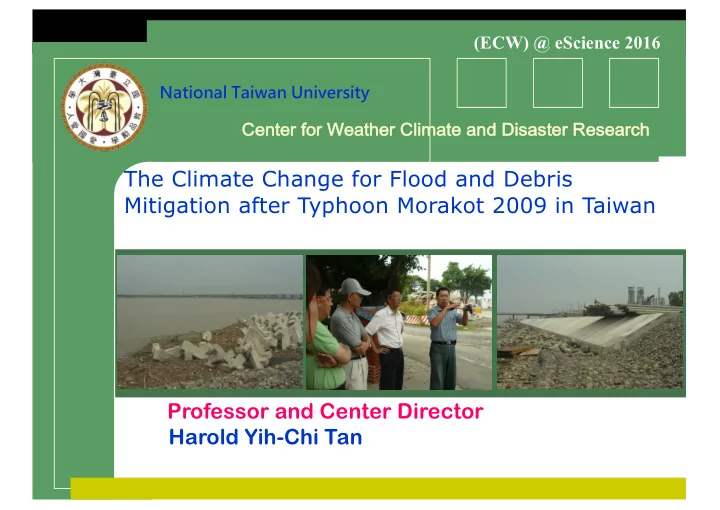
(ECW) @ eScience 2016 National Taiwan University Center r for r Weather r Climate and Disaster r Researc rch The Climate Change for Flood and Debris Mitigation after Typhoon Morakot 2009 in Taiwan Professor and Center Director Harold
National Taiwan University
Center r for r Weather r Climate and Disaster r Researc rch
2
Kaoping weir Shuangyuan Bridge
2000XANGSANE 2001NARI 2001TORAJI 2002NAKRI 2004MINDULLE 2005HAITANG 2007KROSA 2008SINLAKU 2008JANGMI 2008KALMAEGI 2009MORAKOT 2010 FANAPI 1990YANCY 1996HERB 1998ZEB 1987LYNN 1989SARAH 1973NORA 1974BESS 1978ORA
Frequency
year
NCDR(2010)
3
4
Rainfall Center MORAKOT
水保局 2009 Siaolin Village Siaolin Village Siaolin Elementary School Siaolin Elementary School
Baseline/Target year due to climate change
Current : 1. astronomical 2.Surge
Climate change: 1. astronomical 2.Surge
1.Frequency analysis 2.Rainfall pattern
1.Current condition 2.Unit Hydrograph Overbank flow simulation
Hydraulic Model
Methodology Adaptation Strategy Action Plan
Establishment of Risk analysis
Expert Committee
Compound Risk Estuary water level
Rainfall pattern Discharge
Sea dike
Risk Evaluation
6
7
Historical tidal data for 1947 to 2009 (a) Fast Fourier Transform and regression line (b) EEMD and projected for 2039
48hr-Water surface level of estuary of Kaoping River due to climate change Apply ADCIRC (ADVANCED CIRCULATION MODEL) model + sea level rise of 0.27 m.
8
站別 累積雨量
(mm)
情境
Yushan(玉山) Xinfeng(新豐) Pingtung(5) 屏東(5) Jiasian(2) [甲仙(2)] A1B
Station
Scenario
Cumulative Rainfall (mm)
Sediment Deposition
1D hydraulic Model HEC-RAS
1.Bottleneck section of levees 2.Freeobards 3.Impact assessment of sea dike
2D overland flow
9
Watershed Control point Designed (Q100)(1) A1B Simulated (Q100)(2)
(2)/(1) Kaoping River 本流 Jiou cyu-tang (九曲堂站)
Laonnog River 荖濃溪 Li gang Bridge(里港大橋)
Confluence of Laonnog River and Ailiao River (荖濃 溪與隘寮溪合流前)
Laonung Bridge(新發大橋)
Qishan River 旗山溪 Exit of Qishan (旗山溪出口)
Yuemei (月眉站)
Ailiao River 隘寮溪 Exit of Ailiao River (隘寮溪出口)
Sandimen (三地門站)
10
This image cannot currently be displayed.
Hazard危險度
Very low (1) Low (2) Medium (3) High (4) Very high (5)
脆 弱 度
Very low (1) (1) (2) (3) (4) (5) Low (2) (2) (4) (6) (8) (10) Medium (3) (3) (6) (9) (12) (15) High (4) (4) (8) (12) (16) (20) Very high (5) (5) (10) (15) (20) (25)
Where, R:Risk (風險), presented by Risk Matrix H:Hazard(危險度)Hazard V:Vulnerability(脆弱度)
ØRelative Hazard/ Vulnerability Ø相對危險等級/脆弱度等級
Very high 5 Top20% High 4 Top20~40% Medium 3 Top40~60% Low 2 Bottom20-40% Very low 1 Bottom20%
ØRelative Risk(相對風險等級)
Very high >20 Top20% High 14~20 Top20~40% Medium 10~14 Top40~60% Low 5~9 Bottom20-40% Very low 1~4 Bottom20%
11
Vulnerability
12
0.22 0.09 0.20 0.19 0.30
Water Surface Elevation
Unit Stream Power
Historical Levee Breach No.
0.36
Location of main channel Location of flood plain Protection Work
0.42
Drainage Gate
Pumping Station
0.4 0.28 0.32 0.24 0.28 0.14 0.19 0.15
Samples no. : 35, male -30; femail-5 Age:20-29 yrs. old:4;30~39 yrs. old : 14人;> 40 yrs. old :17
0.22
13
Levee is old, no flood plain,
and with gates.
14
High risk of levee located in historical levee breach locations.
l The simulated Q100 for A1B is about 1.3~1.55 times
l For A1B scenario, the risk of villages of middle and
l Plan A (Upstream-7 overflow area+
l Plan B (Upstream-4 overflow area+ 1m dredge
15