Environment and Natural Resources Trust Fund 2012-2013 Request for - - PDF document

environment and natural resources trust fund 2012 2013
SMART_READER_LITE
LIVE PREVIEW

Environment and Natural Resources Trust Fund 2012-2013 Request for - - PDF document

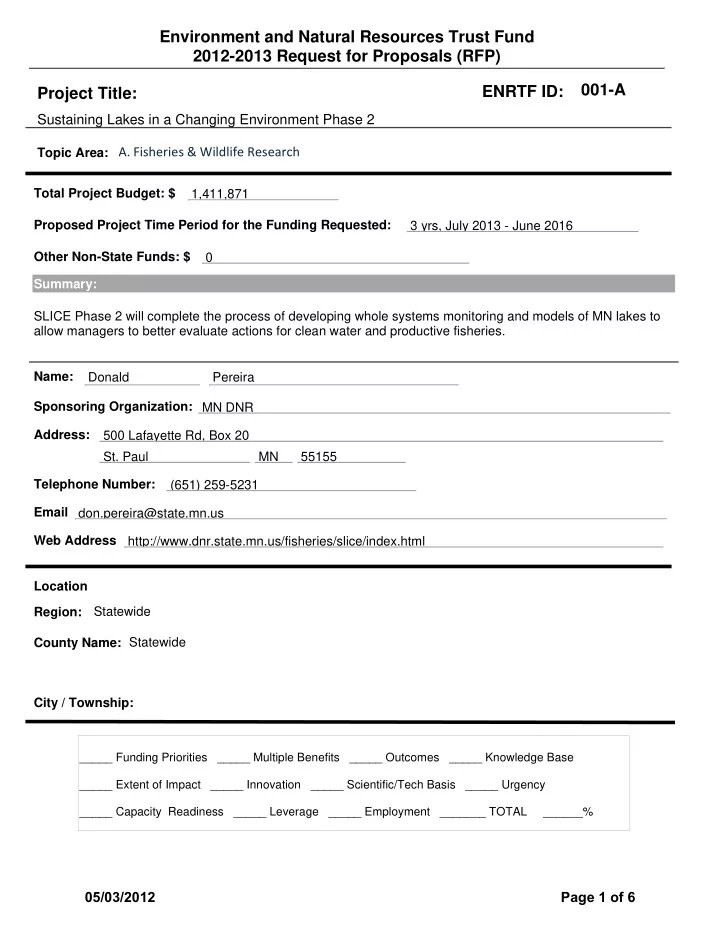
Environment and Natural Resources Trust Fund 2012-2013 Request for Proposals (RFP) 001-A ENRTF ID: Project Title: Sustaining Lakes in a Changing Environment Phase 2 A. Fisheries & Wildlife Research Topic Area: Total Project Budget: $


slide-1
SLIDE 1

Environment and Natural Resources Trust Fund 2012-2013 Request for Proposals (RFP) Project Title:

Total Project Budget: $ Proposed Project Time Period for the Funding Requested: Other Non-State Funds: $ Name: Sponsoring Organization: Address: Telephone Number: Email Web Address County Name: City / Township: Region: Summary: Location

Sustaining Lakes in a Changing Environment Phase 2

1,411,871 3 yrs, July 2013 - June 2016 SLICE Phase 2 will complete the process of developing whole systems monitoring and models of MN lakes to allow managers to better evaluate actions for clean water and productive fisheries. Donald MN DNR 500 Lafayette Rd, Box 20

  • St. Paul

MN 55155 (651) 259-5231 don.pereira@state.mn.us http://www.dnr.state.mn.us/fisheries/slice/index.html Statewide Statewide Pereira

_____ Funding Priorities _____ Multiple Benefits _____ Outcomes _____ Knowledge Base _____ Extent of Impact _____ Innovation _____ Scientific/Tech Basis _____ Urgency _____ Capacity Readiness _____ Leverage _____ Employment _______ TOTAL ______%

  • A. Fisheries & Wildlife Research

ENRTF ID: 001-A

Topic Area:

05/03/2012 Page 1 of 6

slide-2
SLIDE 2

PROJEC I. PR A Hunting a economy investmen DNR Fish (SLICE P monitorin informatio establishe fertility, c fishing an conditions stressors, also fortui understan near Alex funds for Ph and imple informatio conservat zebra mus lake conse long-term (the future

  • ver 3 yea

DNR Fish contributi II. DE Activity 1 lakes to g Several sc Four dedi water and proposed in 8 Tier 1 sentinel la Water qua fish), IBI rooted pla frequency statistical also instal Outcome

  • 1. Condu
  • 2. Inven

Environm 2012‐201

CT TITLE: S OJECT STA As Minnesota’ and fishing re demands on e nts from the E heries success Phase 1). Sent ng in order to

  • n to better un

ed a suite of 2 climate) that s nd water recre s in a wide va and outlined itously (and p nd pending im xandria, in 200 that project in hase 2 (2013 ement rigorou

  • n on lake tre

ion approach ssels in each T ervation meas m changes to th e). We seek E ars, and will h heries, MPCA ion of $657 th SCRIPTION 1: Monitorin age status and cientific and p cated regiona d fisheries reso in Phase 2 is 1 Sentinel Lak

  • akes. Thus al

ality (accordin surveys (inde ants, zooplank y for conducti analysis soon ll automated s e uct standard l ntory watershe

ment and Nat 13 Main Prop

Sustaining Lak ATEMENT ’s population lated activitie effective and ENTF, multip sfully launche tinel systems better capture nderstand the 24 lakes acros shape our lake eation) that ou ariety of Minn some expecta perhaps unfor mpacts from ze

  • 09. Phase 1 w

n this proposa

  • 2016), prop

us monitoring ends, reduce u

  • es. Phase 2 a

Tier 1 sentine sures, we mus hat baseline ( ENTF suppor hope for perm A,USFS Super housand and a N OF PROJE ng a comprehe d trends of lak programmatic al field staff w

  • urces in each

a tiered class kes (see also ll lakes will re ng to regular ex of biotic in kton sampling ing the individ n to be compl sensors in the lake surveys; ed land cover

tural Resou posal

kes in a Chan grows, increa es fuel $3.6 bi efficient lake ple partners’ in ed and is near are specific e e important ch e mechanisms s Minnesota t e resources, a ur lakes provi nesota lake ty ations for futu rtunately) gav ebra mussels will be compl al. posed here, w , modeling, a uncertainty ab also includes a el lake should st acquire info (the present), rt in the amou manent funds rior National associated equ ECT ACTIVI ensive suite o ke health (see c lessons learn will provide re h of the State sification of se activity 2) an eceive regular MPCA proto ntegrity) of all g, and continu dual monitori leted as a key e eight Tier 1 data QA/QC r & uses (inc.

rces Trust Fu

nging Environ ased demands illion in annu e habitat and f n-kind contrib r completion o ecosystems (i hanges or tren s to explain th that capture th and in large pa ide for our cit ypes, their init ure conditions ve us the oppo following the leted in June 2 ill take lesson and reporting p bout potential applying lake d they be intro formation abo and models th unt of approxi from partner Forest, and U uipment and i TIES f important la e attached ma ned from the egional exper ’s four major entinel lakes nd reduced mo rly scheduled

  • cols), Fisheri

l fish (thus in uous water tem ing componen y part of the P lakes. & database m BMP’s) & dr

und (ENRTF

nment (SLICE s are being pl ual expenditur fisheries cons butions, and m

  • f a 4-yr pilot

in this case la nds through t hose changes. he full breadt art determine

  • tizenry. Phas

tial responses s given variou

  • rtunity to set

e invasion of 2013, and we ns learned fro protocols tha l causes, and r e models to pr

  • duced. In or
  • ut baseline ha

hat forecast th imately $1.4 m agencies in th USGS propos infrastructure ake and water ap). Phase-1 pilot rtise regarding r land types. A with compreh

  • nitoring sch

d monitoring o ies population ncluding non g mperature mo nts will be de hase 1 projec management rainage featur

)

E): Phase 2 laced on our r res and a vibr

  • servation. Th

motivated citi t effort in 24 akes) chosen f time, and to g Thus, in Pha th of the basic the goods an se 1 identified s to various en us changing s t up a rigorou this nasty pes e do not reque

  • m the first ph

at will deliver result in more redict ecosyst rder to implem abitat conditi he risk of var million to sup he future and e a continued e. rshed indicato Bud t will be appli g status and tr A programma hensive, inten edules in the

  • f the followi

n assessments game species

  • nitoring. Th

etermined from

  • ct. In addition

res and resources. rant Minnesot hanks to the in izen voluntee sentinel lakes for focused give us the ase 1, we hav c conditions ( nd services (e d baseline nvironmental

  • scenarios. Ph

us system to st in Lake Car est additional hase to develo timely e precise tem impacts o ment proactiv

  • ns (the past)

rious impairm pport this wor for the long- d in-kind

  • rs in 24 sent

dget: $864,7 ied to this act rends of impo atic adaptatio nsive monitor remaining 16 ing parameter s (primarily g ) and aquatic he specific m rigorous n to this, we w Completi Ongoing June 30, 2 ta nitial ers, s ve (e.g. .g. l hase 1 rlos,

  • p
  • f

ve ), ments rk

  • term.

inel 780 tivity.

  • rtant
  • n

ring 6 rs: game will ion Date 2015

05/03/2012 Page 2 of 6

slide-3
SLIDE 3

archive in DNR’s GIS database

  • 3. Establish automated water flow, quality, and temperature sensors in 8 Tier 1 Lakes.

May 2014

  • 4. Reports on status and trends for 4 major landtypes, with stressors or BMP influence

Annual to June 2016 Activity 2: Build or adapt biophysical lake ecosystem models for 8 Tier 1 lakes and forecast future lake conditions based on scenarios that cause change but vary across lakes Budget: $547,091 To understand complex systems like natural lakes, we need both high quality and comprehensive monitoring data, but also the capacity to synthesize those data in mechanistic system models. For example, we know in general what zebra mussels do to the food webs in other lakes, but impacts will certainly vary across lakes. We can develop sound mechanistic models to explain these changes, but these models need to be fit and calibrated to our specific lakes. To further elaborate on this example, biologists have learned a lot about how zebra mussels have changed Oneida Lake in New York state, but it would be very wrong to use the Oneida data and likely the Onieda model to predict changes in Lake

  • Carlos. This is because the two lakes are so different (Oneida is very fertile and shallow, Carlos is deep

and of moderate fertility). In Activity 2, we propose building or refining 8 lake models for each Tier-1 sentinel lake that will continually be used and recalibrated with new monitoring data to forecast lake conditions given certain scenarios that will cause some type of change. Outcome Completion Date Build biophysical lake system models for Tier 1 lakes & establish change scenarios

  • Dec. 31, 2014

Parameterize, calibrate and validate models June 30, 2015 Develop and run forecast scenarios for evaluating various lake management tools & BMPs June 30, 2016 III. PROJECT STRATEGY A. Project Partners

  • 1. DNR Division of Fish and Wildlife Section of Fisheries – Program administration, Fisheries technical

and field support, data management, (ENRTF + in-kind; Dr. Don Pereira Project Manager).

  • 2. USGS Water Science Center – Hydrologic and limnologic technical and field support (ENTF + in-

kind; Dr. Richard Kiesling PI). Partners providing support but not receiving funds from the ENRTF:

  • 3. DNR Divisions of Parks and Trails, Ecological and Water Resources – Survey support on Bear Head

Lake (Parks), lake level gauging, watershed modeling, invertebrate data (DNR Div. EWR, in-kind).

  • 4. MPCA – Environmental Analysis and Outcomes Division – Water quality assessments, ground-water

monitoring, volunteer coordination (in-kind).

  • 5. USDA/USFS– Superior National Forest – Survey support in sentinel lakes within the SNF (in-kind).
  • 6. University of Minnesota Itasca Biological Station – Survey support on Elk Lake.
  • 7. Clean water funded work by the University of Minnesota (Dr. Bruce Wilson) establishing sentinel

watersheds to monitor the effectiveness of clean water funded activities in select MN watersheds.

  • B. Timeline Requirements

The SLICE program is an adaptive monitoring program whereby the program and outcomes are evaluated

  • n a 3 to 4 year basis and adjustments are made in response to changing budgets, lessons learned, and

new information, while maintaining the integrity of long-term datasets. Long-term monitoring is the central theme of SLICE and thus an ongoing commitment by partners will be needed for the program to realize its full potential as a powerful decision-support tool for MN lake management.

  • C. Long-Term Strategy and Future Funding Needs

Our long-term strategy is to complete development of a fully integrated lake monitoring program that combines and focuses the activities of key, collaborative management agencies (e.g. DNR and MPCA). Such a system will greatly increase our understanding of how these lakes change, and what management actions are most likely to provide cleaner water and healthier fish populations. After funding Phase 2, our hope will be to fully incorporate this program in to the regular activities of both agencies (thus move from concept development to operational), and thus cover future work with regular agency funding sources.

05/03/2012 Page 3 of 6

slide-4
SLIDE 4

BUDGET ITEM

Personnel: Regional fisheries habitat specialists, four, unclassified 85% ENRTF, years one and two. Eight fisheries interns, 100% ENRTF, years one and two.

Regional fisheries habitat specialist, Walker, years 1 and 2, Salary: $66,450, Fringe: $19,935 Regional fisheries habitat specialist, New Ulm, years 1 and 2, Salary: $66,450, Fringe: $19,935 Regional fisheries habitat specialist, Tower, years 1 & 2, Salary: $66,450, Fringe: $19,935 Regional fisheries habitat specialist, Glenwood, years 1 and 2, Salary: $66,450, Fringe: $19,935 8 Summer Interns, four months per year, years one and two, $11/hr, no fringe, $123,460

Contracts: USGS Water Sciences Center (itemized detail in next three lines) USGS lake model construction (staff time) $235,300 USGS equipment rental and maintenance $195,500 USGS water sampling and analytical lab costs $82,900 Equipment/Tools/Supplies: (itemized detail in next four lines) Transducers for water level gauges $11,400 Temperature thermistors and buoys $8,200 20 dissolved oxygen sensors and buoys $125,400

  • misc. equipment and repair $118,000

Travel: In-state travel expenses to study lakes and coordination meetings, fleet costs, years

  • ne and two. For DNR field staff, primarily regional coordinators and interns.

Additional Budget Items: DNR used a rate of 6.5% to calculate costs for direct support services, which are DNR’s direct and necessary business services required to support this proposal. TOTAL ENVIRONMENT AND NATURAL RESOURCES TRUST FUND $ REQUEST = SOURCE OF FUNDS AMOUNT Status Other Non-State $ Being Applied to Project During Project Period: USGS matching funds. 400,200 $ Pending Other State $ Being Applied to Project During Project Period: DNR funding 15% for four long-term monitoring fisheries specialists ($61,400), plus approximately $130,000 for 11 DNR staff, plus direct support services. 191,400 $ Pending In-kind Services During Project Period: MPCA water quality sampling and analytical costs.USFS Superior National Forest staff for aquatic plant surveys. Citizen Lake Monitoring Program Volunteers. 65,000 $ Remaining $ from Current ENRTF Appropriation (if applicable): Current SLICE project (Phase 1: Assessing the consequences of ecological drivers of change on water quality and habitat dynamics of deep-water lakes with coldwater fish populations, ML 2009, Chap. 143,

  • Sec. 2, Subd. 5C) will be complete by the time this proposed project starts. Initial funding

amount was $825,000, there is approximately $61,000 remaining, and that will be spent by the end of the project (June 2013).

  • $

Funding History: Existing ENRTF funding for first phase of SLICE project (Assessing the consequences of ecological drivers of change on water quality and habitat dynamics of deep- water lakes with coldwater fish populations, see above). This amount does not include match from several collaborating agencies (DNR, MPCA, USGS, Superior National Forest). 825,000 $ 86,171 $

  • V. OTHER FUNDS

$1,411,871 263,000 $ $469,000 80,000 $

2012-2013 Detailed Project Budget

  • IV. TOTAL ENRTF REQUEST BUDGET Three years [two years of staffing, but for full field season]

AMOUNT 513,700 $

I:\ML2013\RFP\proposals_recevied\pereira-donald_0412-2-219-Budget

05/03/2012 Page 4 of 6

slide-5
SLIDE 5

Map of th Blufflands

Environm 2012‐201

he 24 sentinel s and Tall Asp

ment and Nat 13 Main Prop

l lakes (8 Tier pen Parklands

tural Resou posal

r 1 and 16 Tie s are not inclu

rces Trust Fu

r 2), and the uded only bec

und (ENRTF

four major la cause they ha

)

and types that ave very few f t they cover. fishing lakes.

05/03/2012 Page 5 of 6

slide-6
SLIDE 6

Project Manager Donald Pereira, Ph.D., is the Fisheries Research and Policy Manager for the DNR. In my thirty years of experience in fisheries and aquatic sciences, I have authored or co-authored thirty peer- reviewed papers and book chapters related to fish behavior, recruitment, community ecology, climate change and habitat interactions. I spent 17 years as a DNR Research Biologist and 7 years as a Research Supervisor. I also currently maintain an adjunct faculty appointment in the University of Minnesota’s Graduate Fisheries Program where I have advised five graduate students and served on the advisory committees of thirteen additional students. In April 2007, I was hired as the Fisheries Research and Policy Manager and currently oversee a research unit with 19 biologists and 3 Research Supervisors with extensive fisheries and aquatic research and management experience. Many of these biologists have been involved in the first phase of the proposed project and along with our partners, will be involved with data collection, analysis, and dissemination of results. Project Coordination Specifically among Fisheries Research staff, Peter Jacobson (Habitat Research Unit Supervisor) and two experienced field biologists will be serving as field-level coordinators. Mr. Jacobson has extensive experience and interaction with Dr. Richard Kiesling, our primary subcontractor with USGS. He and I both have also established strong collaborative ties with MPCA Monitoring staff who continue to make a strong commitment to this project on a long-term basis. While this project is referred to as Phase 2 of SLICE (“Sustaining Lakes in a Changing Environment”), we foresee that it will also be the final phase. Organization Description The mission of the Minnesota Dept. of Natural Resources is to work with citizens to conserve and manage the state's natural resources, to provide outdoor recreation opportunities, and to provide for commercial uses of natural resources in a way that creates a sustainable quality of

  • life. Within the DNR, the Division of Fish and Wildlife bears primary responsibility for

managing, protecting and regulating the State’s fisheries and wildlife resources. As part of the Division’s mission, it will promote habitat protection and development of private and public lands. Donald L. Pereira, Ph.D. Fisheries Research and Policy Manager MN DNR, Section of Fisheries don.pereira@state.mn.us 05/03/2012 Page 6 of 6