Environment and Natural Resources Trust Fund 2012-2013 Request for - - PDF document

environment and natural resources trust fund 2012 2013
SMART_READER_LITE
LIVE PREVIEW

Environment and Natural Resources Trust Fund 2012-2013 Request for - - PDF document

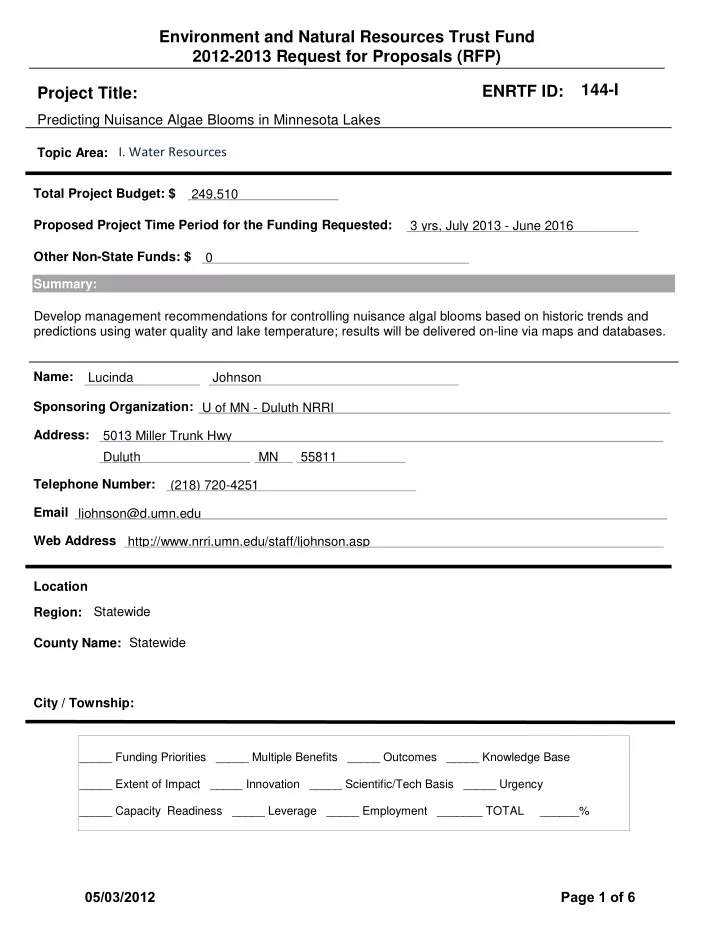
Environment and Natural Resources Trust Fund 2012-2013 Request for Proposals (RFP) 144-I ENRTF ID: Project Title: Predicting Nuisance Algae Blooms in Minnesota Lakes I. Water Resources Topic Area: Total Project Budget: $ 249,510 Proposed


slide-1
SLIDE 1

Environment and Natural Resources Trust Fund 2012-2013 Request for Proposals (RFP) Project Title:

Total Project Budget: $ Proposed Project Time Period for the Funding Requested: Other Non-State Funds: $ Name: Sponsoring Organization: Address: Telephone Number: Email Web Address County Name: City / Township: Region: Summary: Location

Predicting Nuisance Algae Blooms in Minnesota Lakes

249,510 3 yrs, July 2013 - June 2016 Develop management recommendations for controlling nuisance algal blooms based on historic trends and predictions using water quality and lake temperature; results will be delivered on-line via maps and databases. Lucinda U of MN - Duluth NRRI 5013 Miller Trunk Hwy Duluth MN 55811 (218) 720-4251 ljohnson@d.umn.edu http://www.nrri.umn.edu/staff/ljohnson.asp Statewide Statewide Johnson

_____ Funding Priorities _____ Multiple Benefits _____ Outcomes _____ Knowledge Base _____ Extent of Impact _____ Innovation _____ Scientific/Tech Basis _____ Urgency _____ Capacity Readiness _____ Leverage _____ Employment _______ TOTAL ______%

  • I. Water Resources

ENRTF ID: 144-I

Topic Area:

05/03/2012 Page 1 of 6

slide-2
SLIDE 2

Environment and Natural Resources Trust Fund (ENRTF) 2012‐2013 Main Proposal

1 PROJECT TITLE: Predicting nuisance algae blooms in Minnesota lakes Develop management recommendations for controlling nuisance algal blooms based on historic trends and predictions using water quality and lake temperature; results will be delivered on‐line via maps and databases.

  • I. PROJECT STATEMENT

Nuisance algal blooms are every lake shore owner’s nightmare. Historically, algal blooms in Minnesota lakes and reservoirs have been an indicator of nutrient enrichment, and are often the water quality trigger that leads to lake management efforts such as the TMDL process. Excessive algal growth in lakes along the shoreline and offshore interferes with recreational uses such as swimming and boating, and can impact sport fisheries by reducing dissolved oxygen in a lake as the bloom dies and decays. Nuisance blue-green algae blooms can concentrate in surface waters and some can produce toxins that can cause sickness in humans and mortality of fish, wildlife, and pets. There have been numerous studies of algal blooms in individual lakes, but no systematic, regional characterizations of algal blooms in Minnesota lakes or studies to see whether their frequency has changed over time. While blooms are generally attributed to excessive nutrient loading from urban and agricultural sources, there are other factors that can also affect the magnitude, frequency, algal composition, and 'noxiousness' of the blooms. Water temperature is an important determinant of algal growth rates, and blue-green algae generally grow best at water temperatures above 20°C, and often appear become a dominant group in lakes in mid to late summer when temperature is highest. Previous LCCMR-funded research (led by L. Johnson) showed a positive trend in water temperature in some regions of the state. This suggests that, in the future, nuisance blooms may appear in more lakes and may become a bigger problem over a longer portion of the year. Lake size and shape, and winds also need to be considered. Small lakes with higher wind sheltering may tend to experience more nuisance blooms, because blue-greens can float and concentrate in calm surface waters, whereas wind mixing in larger, unsheltered lakes tends to mix the algae to depths where lower light levels reduce their growth. Alternatively, wind mixing of higher nutrient bottom waters can then re-stimulate algal growth after the wind calms down. These effects are regular features of areas of Lake Minnetonka, for example. No single data source currently exists for tracking the frequency and distribution of algal blooms because most lake monitoring cannot detect those ephemeral events. We propose to conduct a statewide study of water quality and factors leading to algal blooms in Minnesota lakes, to quantify past and current regional trends and determine the relative importance of nutrient loading, water temperature, and wind mixing in determining excessive algal growth. These data, along with satellite images of algal blooms, will be used to characterize spatial and temporal trends across the state. Statistical models will then be developed to relate algal concentrations to land use, climate, and lake geometry to predict the lakes at greatest risk of blooms in response to changing land use and climate. Results will be help resource agencies as they develop future management options for controlling nuisance blooms and managing recreational fisheries in Minnesota’s lakes.

  • II. DESCRIPTION OF PROJECT ACTIVITIES

Activity 1: Minnesota lake water quality data compilation Budget: $ 84,568 In-situ lake water quality data (esp. water clarity and chlorophyll concentrations) from standard databases (e.g., EPA STORET; MPCA EDA and EQuIS), and additional data from watershed districts, the Met council, tribes, state and national parks, and academic scientists will be assembled and added to the Minnesota Lake Trends Analysis database and web site. Developed by NRRI under a previously funded LCCMR project, this database contains over 2 million data records for lake water quality data for > 4,000 lakes having a minimum of 5 or more years of data for any single water quality parameter; data were analyzed with respect to trends and results were output in map and database form (http://www.mnbeaches.org/gmap/trends/index.html). We will enhance the water quality database by including all available lake water quality data, and will update the Minnesota Lake Trends Analysis web

05/03/2012 Page 2 of 6

slide-3
SLIDE 3

Predicting nuisance algae blooms in Minnesota lakes 2 site to improve public data access and provide additional data visualization tools for interactively exploring the data on-line. Outcome Completion Date

  • 1. Expanded Minnesota water quality database

6/30/2014

  • 2. Updated online data access and trend analysis tool

6/30/2015 Activity 2: Regional trends in lake algal blooms and water transparency Budget: $78,830 We will analyze in-lake secchi and chlorophyll data along with public domain and commercial satellite images and aerial photos to identify and quantify historical algal bloom frequency across the state. Statewide maps of algal bloom frequency and relative intensity will be created. Regional trends in algal bloom frequency will be quantified for different lake types, e.g., size, and shallow versus deep. This information will be added to the Minnesota Lake Trends Analysis web site. Outcome Completion Date

  • 1. Methods for quantifying regional algal production

6/30/2014 2 State‐wide and regional maps of algal bloom frequency 6/30/2016 Activity 3: Physical/chemical drivers of lake algal blooms Budget: $ 86,111 In-lake nutrient concentration and temperature data will be combined with previously developed regional lake models and the results of Activity 2 to produce predictive regional models of lake algal blooms, in- lake nutrients, secchi transparency, water temperature, and bottom water oxygen depletion. Airport wind measurements, lake geometry, and topographic records will be used to estimate relative wind mixing

  • energy. Regional relationships between algal bloom frequency, nutrients, temperature, and wind mixing

will be developed. Results will be summarized by region and lake type, and lake management recommendations will be made in a final report. Outcome Completion Date

  • 1. Regional summaries of nutrient concentration and water temperature trends

6/30/2015

  • 2. Relationships of algal blooms to nutrients, water temperature, lake geometry

9/30/2015

  • 3. Projections of lake algal blooms under future land use and climate conditions

3/30/2016

  • 4. Recommendations for lake water quality management

6/30/2016

  • III. PROJECT STRATEGY
  • A. Project Team/Partners

Lucinda Johnson (NRRI-UMD), William Herb (SAFL-UM), Richard Axler (NRRI-UMD)

  • Drs. Johnson (PI), Herb, and Axler will lead the project and oversee development of the long-term algal

bloom database. Dr. Axler will assist in data compilation, analysis, and further development of the Minnesota Lake Trends Analysis web site. A NRRI research associate and computer scientist will work

  • n the data compilation, analysis, and website tasks. Dr. Herb will perform much of the water quality

trend modeling. All work by SAFL and NRRI staff will be funded by the ENRTF; however, Johnson and Axler will contribute one-half a month of salary-effort to this project.

  • B. Timeline Requirements

The proposed project is planned for three years, starting July 1, 2013 and ending June 30, 2016

  • C. Long‐Term Strategy and Future Funding Needs

This project is self-contained in its scope, and will contribute towards the long-term strategy of state agencies to maintain lake water quality for recreational and consumptive uses. The project builds on data and results from several projects, including; a USGS-funded project studying the impacts of land use and climate change on coldwater lake habitat in Minnesota, Wisconsin, and Michigan; and two Environmental Trust Fund projects led by L. Johnson (2005, 2007); and several EPA and NSF funded projects that developed on-line interactive data visualization tools for disseminating data and helping to the public and managers to better understand and interpret it. The data and results produced by this project will inform a wide variety of lake management efforts, and could lead to a larger, regional, or national scale project.

05/03/2012 Page 3 of 6

slide-4
SLIDE 4

Predicting nuisance algae blooms in Minnesota lakes

BUDGET ITEM Personnel: all personel UMD Johnson, manager, 36 months @ 4%=$22,741; $16,722 salary, $6,019 fringe (36%) Herb,co-manager, 36 months @ 25% year 1, 30% years 2 & 3=$76,227; $56,050 salary, $20 Axler, co-manager, 36 months @ 8% years 1 & 2, 4% year 3=$31,366; $23,064 salary, Will, programmer, 36 months @ 30% year 1, 20% year 2, 10% year 3 =$48,321; $34,198 sa Olker, research fellow, 30% year 1, 20% year 2, 25% year 3=$48,486; $35,652 salary, $12,8 Ruzycki, research fellow, 12 months @ 20%=$14,716; $10,821 salary, $3,895 fringe Equipment/Tools/Supplies: Software licenses; $500- Statistical package updates; website URL annual fees Computer hardware -server and back up drive Computer supplies - permanent memory drives and disc storage Travel: Project personnel travel between Duluth and Twin Cities to confer with project collaborators and with personnel in MPCA and other agencies that may have water quality

  • data. 4 trips per year, 325 miles roundtrip x $0.555 per mile=$180 x 4 trips =$721 per year x

3 year Additional budget items: NRRI GIS Lab fee, for use of lab (photo analysis & mapping) $4.10/hr x 300 hours per year TOTAL ENVIRONMENT AND NATURAL RESOURCES TRUST FUND $ REQUEST = SOURCE OF FUNDS AMOUNT Status Other Non-State $ Being Applied to Project During Project Period: Lucinda Johnson and Richard Axler will each contribute 10% effort to assist in the execution of this project. $ 70,811 (Separate but complimentary, not match or cost-sharing for this proposal.) 70,811 $ Other State $ Being Applied to Project During Project Period: In-kind Services During Project Period: Remaining $ from Current ENRTF Appropriation (if applicable): Funding History: LCCMR 2005 led by L. Johnson. Impacts on Minnesota's Aquatic Resources from Climate Change $250,000. Under this project, a database was assembled that included water quality from the STORET database for over 4,000 lakes. A lake trend analysis was developed and a web site was created to distribute results. $250,000. Funding History: LCCMR 2007 led by L. Johnson Minnesota's Water Resources: Impacts

  • f Climate Change - Phase II. $300,000. This project resulted in an expanded set of water

quality data and refinements to the data visualization and distribution tool. (http://www.mnbeaches.org/gmap/trends/index.html). Funding History: Managing the Nations Fish Habitat at Multiple Spatial Scales in a Rapidly Changing Climate, Kansas Cooperative Research Unit (U.S. Geological Survey, prime.) $2.25M total ($268,928 to LJohnson). PI: Craig Paukert, CO-PIs: L. Johnson and 11 others. 8/2009-12/2012. Johnson and Herb are predicting the distribution of cold water fishes in lakes across Minnesota, Wisconsin and Michigan based on land use and climate

  • projections. The models being used in this effort will be used to inform the development of

models predicting algal blooms in Minnesota's lakes. $268,928

  • V. OTHER FUNDS

76,227 $ 249,510 $

  • $

1,000 $ 300 $ 31,366 $ 2,163 $ 3,690 $ 500 $ 14,716 $ 48,321 $

2012-2013 Detailed Project Budget

  • IV. TOTAL ENRTF REQUEST BUDGET 3 years

AMOUNT 22,741 $ 48,486 $

I:\ML2013\RFP\proposals_recevied\johnson-lucinda_0412-2-176-Budget

05/03/2012 Page 4 of 6

slide-5
SLIDE 5

Processes Controlling Algal Growth in Lakes

  • Air temperature and solar radiation control water

temperature

Solar Radiation Air Temp

temperature

  • Nutrient inputs, water temperature, and wind mixing

control algal growth

Wind Wind‐mixed Radiation Water surface Temperature p External Nutrient Load Algal Wind mixed layer g Concentration

Case 1. Large, deep lake (Superior): ‐ deep mixed layer ‐ dilute nutrients ‐ dilute algal growth Case 2. Small, sheltered lake ‐ less wind mixing ‐ higher nutrient concentration ‐ denser algal growth Case 3. Large, shallow lake ‐ wind mixing events stirs up sediment, releasing nutrients to water column ‐ dense algal growth during calm periods Internal Nutrient Load 05/03/2012 Page 5 of 6 Predicting nuisance algae blooms in Minnesota lakes

slide-6
SLIDE 6

Predicting nuisance algae blooms in Minnesota lakes

LCCMR 2012 LCCMR Project Manager Qualifications and Organization Description Lucinda B. Johnson, Natural Resources Research Institute, University of Minnesota Duluth Key Qualifications

  • Dr. Johnson is a center director at the Natural Resources Research Institute. She is an aquatic and

landscape ecologist with broad expertise in quantifying interactions between terrestrial and aquatic ecosystems (including lakes, streams and wetlands). Her research focuses on indicator development in aquatic ecosystems, and the effects of multiple stressors, including land use change. Education Michigan State University, Zoology, Ph.D. 1999 State University of New York, College of Environmental Science and Forestry, Entomology, M.S. 1984 Duke University, Botany. B.A. 1976 Selected Grants (Total > $15M) Impacts on Minnesota’s aquatic resources from climate change. LCCMR, 2006 – 2009. PI with R. Axler,

  • V. Card, R. Newman, R. Skaggs, H. Stefan. $250,000.

Impacts of Land Development and Climate Change on Lake Superior’s North Shore Trout Habitat. Minnesota Department of Natural Resources. PI with W. Herb. 5/2011 – 6/2012. $79,930. Managing the Nations Fish Habitat at Multiple Spatial Scales in a Rapidly Changing Climate, Kansas Cooperative Research Unit (U.S. Geological Survey, prime.) $2.25M total ($268,928 to LBJ). PI: Craig Paukert, CO-PIs: L. Johnson and 11 others. 8/2009-12/2012. GLIC: GLEI-II Indicator Testing and Refinement. EPA’s Great Lakes Restoration Initiative. PI, with G. Niemi, V. Brady, G. Host, E. Reavie, R. Axler, J. Ciborowski. $1.67 M, 2010-2013. Prioritizing Wetland Restoration for Water Quality and Habitat Improvement. Minnesota Pollution Control Agency. PI, with V. Brady and T. Brown. $250 K, 3/2011-6/2013. Selected Publications: Host, G.E., T. Brown, T.P. Hollenhorst, L.B. Johnson, J.J.H. Ciborowski. 2011. High-resolution assessment and visualization of environmental stressors in the Lake Superior basin. Aquatic Ecosystem Management and Health. Johnson, L.B. and G. E. Host. 2010. Recent developments in landscape approaches for the study of aquatic ecosystems. Journal of the North American Benthological Society 25th Anniversary Issue 29(1): 41-66. Merten, E.C., Hemstad, N.A., Eggert, S.L., L.B. Johnson, R.K.Kolka, R.M. Newman, and B. Vondracek.

  • 2009. Relations between fish abundances, summer temperatures, and forest harvest in a northern

Minnesota stream system from 1997 to 2007. Ecology of Freshwater Fish19:63-73. Schomberg, J., Host, G.E. Johnson, L.B., and Richards, C. 2005. Evaluating the influence of landform, surficial geology, and land use on streams using hydrologic simulation modeling. Aquatic Sciences 67(4):528-540. The Natural Resources Research Institute is a part of the University of Minnesota Duluth. Its mission is to promote private sector employment based on natural resources, in an environmentally sensitive

  • manner. NRRI scientists have extensive experience in managing large, interdisciplinary projects which
  • bjectives include the development of tools for environmental assessment and resource management.

These tools promote citizen education leading to improved understanding of how human activities influence water quality and ecosystem health.

05/03/2012 Page 6 of 6