Overview Major ATPG algorithms Definitions ECE 553: TESTING AND - - PDF document

overview major atpg algorithms
SMART_READER_LITE
LIVE PREVIEW

Overview Major ATPG algorithms Definitions ECE 553: TESTING AND - - PDF document

9/30/2014 Overview Major ATPG algorithms Definitions ECE 553: TESTING AND D-Algorithm (Roth) -- 1966 TESTABLE DESIGN OF D-cubes Bridging faults DIGITAL SYSTES DIGITAL SYSTES Logic gate function change faults PODEM


slide-1
SLIDE 1

9/30/2014 1

ECE 553: TESTING AND TESTABLE DESIGN OF DIGITAL SYSTES DIGITAL SYSTES

Combinational ATPG

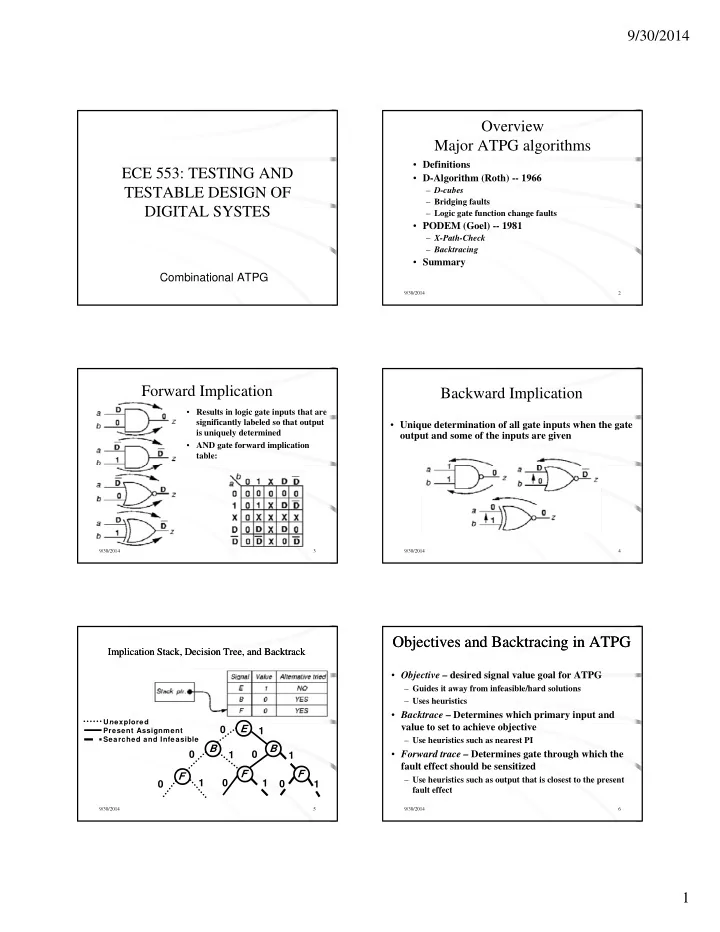
Overview Major ATPG algorithms

  • Definitions
  • D-Algorithm (Roth) -- 1966

– D-cubes – Bridging faults

9/30/2014 2

– Logic gate function change faults

  • PODEM (Goel) -- 1981

– X-Path-Check – Backtracing

  • Summary

Forward Implication

  • Results in logic gate inputs that are

significantly labeled so that output is uniquely determined

  • AND gate forward implication

table:

9/30/2014 3

Backward Implication

  • Unique determination of all gate inputs when the gate
  • utput and some of the inputs are given

9/30/2014 4

Implication Stack, Decision Tree, and Backtrack Implication Stack, Decision Tree, and Backtrack

Unexplored

9/30/2014 5

1 1 1 1 1 E F B B F F 1

Unexplored Present Assignment Searched and Infeasible

Objectives and Backtracing in ATPG Objectives and Backtracing in ATPG

  • Objective – desired signal value goal for ATPG

– Guides it away from infeasible/hard solutions – Uses heuristics

  • Backtrace – Determines which primary input and

l hi bj i

9/30/2014 6

value to set to achieve objective

– Use heuristics such as nearest PI

  • Forward trace – Determines gate through which the

fault effect should be sensitized

– Use heuristics such as output that is closest to the present fault effect

slide-2
SLIDE 2

9/30/2014 2

Branch-and-Bound Search

  • Efficiently searches binary search tree
  • Branching – At each tree level, selects which input

variable to set to what value

  • Bounding – Avoids exploring large tree portions by

artificially restricting search decision choices

– Complete exploration is impractical

9/30/2014 7

– Complete exploration is impractical – Uses heuristics

  • Backtracking – Search fails, therefore undo some of the

work completed and start searching from a location where search options still exist

D-Algorithm – Roth (1966) D-Algorithm – Roth (1966)

  • Fundamental concepts invented:

– First complete ATPG algorithm – D-Cube D Calculus

9/30/2014 8

– D-Calculus – Implications – forward and backward – Implication stack – Backtrack – Test Search Space

Singular Cover Example Singular Cover Example

  • Minimal set of logic signal assignments to represent a function

– show prime implicants and prime implicates of Karnaugh map (with explicitly showing the outputs too)

9/30/2014 9

Gate AND 1 2 3 Inputs A X 1 B X 1 Output d 1 Gate NOR 1 2 3 Inputs d 1 X e X 1 Output F 1

Primitive D-Cube of Failure

  • Models circuit faults:

– Stuck-at-0 – Stuck-at-1 – Other faults, such as Bridging fault (short circuit) – Arbitrary change in logic function

9/30/2014 10

Arbitrary change in logic function

  • AND Output sa0: “1 1 D”
  • AND Output sa1: “0 X D”

“X 0 D”

  • Wire sa0: “D”
  • Propagation D-cube – models conditions under

which fault effect propagates through gate

Construction of Primitive D-Cubes of Failure

  • 1. Make cube set α1 when good machine output

is 1 and set α0 when good machine output is 0

  • 2. Make cube set β1 when failing machine output

is 1 and β0 when it is 0

9/30/2014 11

  • 3. Change α1 outputs to 0 and D-intersect each

cube with every β0. If intersection works, change output of cube to D

  • 4. Change α0 outputs to 1 and D-intersect each

cube with every β1. If intersection works, change output of cube to D

Gate Function Change D-Cube of Failure Gate Function Change D-Cube of Failure

Cube-set a b c Cube-set a b c

9/30/2014 12

α0 α1 β0 β1 X 1 1 X X 1 X 1 1 1 1 PDFs for AND changing to OR 1 1 D D

slide-3
SLIDE 3

9/30/2014 3

Propagation D-Cube

  • Collapsed truth table entry to characterize logic
  • Use Roth’s 5-valued algebra
  • AND gate: use the rules given earlier using α and β

but in this case work with good circuit only

9/30/2014 13

Write all primitive Cubes of AND gate and then create propagation cubes A D 1 D D 1 D B 1 D D D D 1 d D D D D D D

D-Cube Operation of D-Intersection D-Cube Operation of D-Intersection

ψ – undefined (same as φ) µ or λ – requires inversion of D and D

  • D-intersection: 0 0 = 0 X = X 0 = 0

1 1 = 1 X = X 1 = 1

∩ ∩ ∩ ∩ ∩ ∩

9/30/2014 14

1 1 1 X X 1 1 X X = X

  • D-containment –

Cube a contains Cube b if b is a subset of a

1 X D D φ ψ ψ 1 φ 1 1 ψ ψ X 1 X D D D ψ ψ D µ λ D ψ ψ D λ µ

∩ ∩

Implication Procedure

  • 1. Model fault with appropriate primitive D-

cube of failure (PDF)

  • 2. Select propagation D-cubes to propagate fault

effect to a circuit output (D-drive procedure)

9/30/2014 15

effect to a circuit output (D drive procedure)

  • 3. Select singular cover cubes to justify internal

circuit signals (Consistency procedure)

  • Put signal assignments in test cube
  • Regrettably, cubes are selected very

arbitrarily by D-ALG

D-Algorithm – Top Level

  • 1. Number all circuit lines in increasing level
  • rder from PIs to POs;
  • 2. Select a primitive D-cube of the fault to be the

test cube;

9/30/2014 16

test cube; –

Put logic outputs with inputs labeled as D (D) onto the D-frontier;

  • 3. D-drive ();
  • 4. Consistency ();
  • 5. return ();

D-Algorithm – D-drive

while (untried fault effects on D-frontier)

select next untried D-frontier gate for propagation; while (untried fault effect fanouts exist)

select next untried fault effect fanout; generate next untried propagation D-cube; D-intersect selected cube with test cube;

9/30/2014 17

if (intersection fails or is undefined) continue; if (all propagation D-cubes tried & failed) break; if (intersection succeeded) add propagation D-cube to test cube -- recreate D-frontier; Find all forward & backward implications of assignment; save D-frontier, algorithm state, test cube, fanouts, fault; break; else if (intersection fails & D and D in test cube) Backtrack (); else if (intersection fails) break;

if (all fault effects unpropagatable) Backtrack ();

D-Algorithm -- Consistency

g = coordinates of test cube with 1’s & 0’s; if (g is only PIs) fault testable & stop; for (each unjustified signal in g)

Select highest # unjustified signal z in g, not a PI; if (inputs to gate z are both D and D) break; while (untried singular covers of gate z)

select next untried singular cover;

9/30/2014 18

if (no more singular covers) If (no more stack choices) fault untestable & stop; else if (untried alternatives in Consistency) pop implication stack -- try alternate assignment; else Backtrack (); D-drive ();

If (singular cover D-intersects with z) delete z from g, add inputs to singular cover to g, find all forward and backward implications of new assignment, and break; If (intersection fails) mark singular cover as failed;

slide-4
SLIDE 4

9/30/2014 4

Backtrack

if (PO exists with fault effect) Consistency (); else pop prior implication stack setting to try alternate assignment;

9/30/2014 19

if (no untried choices in implication stack)

fault untestable & stop;

else return;

Circuit Example 7.1 and Truth Table Circuit Example 7.1 and Truth Table

Inputs a b c 1 Output F

9/30/2014 20

1 1 1 1 1 1 1 1 1 1 1 1

Singular Cover & Propagation D-Cubes Singular Cover & Propagation D-Cubes

  • Singular cover –

Used for justifying lines A 1 B 1 1 C 1 d 1 1 e 1 1 1 F

9/30/2014 21

  • Propagation D-cubes

– Conditions under

which difference between good/failing machines propagates D 1 D 1 D D D 1 D 1 D D 1 D D D D D D D D D D 1 D D D

Steps for Fault d sa0 Steps for Fault d sa0

Step 1 A 1 B 1 C d D e F Cube type PDF of AND gate

9/30/2014 22

2 3 1 1 D 0 D Prop. D-cube for NOR

  • Sing. Cover of NAND

Example 7.3 – Fault u sa1

  • Primitive D-cube of Failure

1

9/30/2014 23

D sa1

Example 7.3 – Step 2 u sa1

  • Propagation D-cube for v

1

9/30/2014 24

D sa1 D

slide-5
SLIDE 5

9/30/2014 5

Example 7.3 – Step 2 u sa1

  • Forward and backward implications

1 1 1

9/30/2014 25

D sa1 D

Inconsistent

  • d = 0 and m = 1 cannot justify r = 1 (equivalence)

– Backtrack – Remove B = 0 assignment

9/30/2014 26

Example 7.3 – Backtrack

  • Need alternate propagation D-cube for v

1

9/30/2014 27

sa1 D

Example 7.3 – Step 3 u sa1

  • Propagation D-cube for v

1 1

9/30/2014 28

sa1 D 1 D

Example 7.3 – Step 4 u sa1

  • Propagation D-cube for Z

1 1 1

9/30/2014 29

D sa1 D 1 D 1 1

Example 7.3 – Step 4 u sa1

  • Propagation D-cube for Z and implications

1 1 1 1 1

9/30/2014 30

D sa1 D 1 D 1 1

slide-6
SLIDE 6

9/30/2014 6

PODEM -- Goel (1981) PODEM -- Goel (1981)

  • New concepts introduced:

– Expand binary decision tree only around

9/30/2014 31

p y y primary inputs – Use X-PATH-CHECK to test whether D- frontier still there – Objectives -- bring ATPG closer to propagating D (D) to PO – Backtracing

Motivation

  • IBM introduced semiconductor DRAM

memory into its mainframes – late 1970’s

  • Memory had error correction and translation

circuits – improved reliability

9/30/2014 32

circuits – improved reliability

– D-ALG unable to test these circuits

  • Search too undirected
  • Large XOR-gate trees
  • Must set all external inputs to define output

– Needed a better ATPG tool

PODEM High-Level Flow

  • 1. Assign binary value to unassigned PI
  • 2. Determine implications of all PIs
  • 3. Test Generated? If so, done.

9/30/2014 33

  • 4. Test possible with more assigned PIs? If

maybe, go to Step 1

  • 5. Is there untried combination of values on

assigned PIs? If not, exit: untestable fault

  • 6. Set untried combination of values on assigned

PIs using objectives and backtrace. Then, go to Step 2

  • Select path s – Y for fault propagation

sa1

Example 7.3 Again Example 7.3 Again

9/30/2014 34

sa1

  • Initial objective: Set r to 1 to excite fault

1 sa1

Example 7.3 -- Step 2 s sa1 Example 7.3 -- Step 2 s sa1

9/30/2014 35

sa1

Example 7.3 -- Step 3 s sa1

  • Backtrace from r

1 sa1

9/30/2014 36

sa1

slide-7
SLIDE 7

9/30/2014 7

Example 7.3 -- Step 4 s sa1

  • Set A = 0 in implication stack

1 sa1

9/30/2014 37

sa1

Example 7.3 -- Step 5 s sa1

  • Forward implications: d = 0, X = 1

1 sa1 1

9/30/2014 38

sa1

Example 7.3 -- Step 6 s sa1

  • Initial objective: set r to 1

1 sa1 1

9/30/2014 39

sa1

Example 7.3 -- Step 7 s sa1

  • Backtrace from r again

1 sa1 1

9/30/2014 40

sa1

Example 7.3 -- Step 8 s sa1

  • Set B to 1. Implications in stack: A = 0, B = 1

1 sa1 1 1

9/30/2014 41

sa1 1 D

Example 7.3 -- Step 9 s sa1

  • Forward implications: k = 1, m = 0, r = 1, q = 1, Y =

1, s = D, u = D, v = D, Z = 1

1 sa1 1 1 1

9/30/2014 42

D sa1 1 1 1 D D 1 1

slide-8
SLIDE 8

9/30/2014 8

Backtrack -- Step 10 s sa1

  • X-PATH-CHECK shows paths s – Y and s –

u – v – Z blocked (D-frontier disappeared)

1 sa1 1

9/30/2014 43

sa1

Step 11 -- s sa1

  • Set B = 0 (alternate assignment)

1 sa1

9/30/2014 44

sa1

Backtrack -- s sa1

1 sa1 1 1

  • Forward implications: d = 0, X = 1, m = 1, r = 0,

s = 1, q = 0, Y = 1, v = 0, Z = 1. Fault not sensitized.

9/30/2014 45

sa1 1 1 1 1

Step 13 -- s sa1

  • Set A = 1 (alternate assignment)

1 sa1 1

9/30/2014 46

sa1

Step 14 -- s sa1

  • Backtrace from r again

1 sa1 1

9/30/2014 47

sa1

Step 15 -- s sa1

  • Set B = 0. Implications in stack: A = 1, B = 0

1 sa1 1

9/30/2014 48

sa1

slide-9
SLIDE 9

9/30/2014 9

Backtrack -- s sa1

  • Forward implications: d = 0, X = 1, m = 1, r = 0.

Conflict: fault not sensitized. Backtrack

sa1 1 1 1 1

9/30/2014 49

sa1 1 1 1 1

Step 17 -- s sa1

  • Set B = 1 (alternate assignment)

1 sa1 1 1

9/30/2014 50

sa1 1

Fault Tested -- Step 18 s sa1

  • Forward implications: d = 1, m = 1, r = 1, q = 0, s =

D, v = D, X = 0, Y = D

1 sa1 1 1 1 1 D D

9/30/2014 51

sa1 1 D D X D

Backtrace (s, vs) Pseudo-Code

v = vs; while (s is a gate output)

if (s is NAND or INVERTER or NOR) v = v; if (objective requires setting all inputs)

9/30/2014 52

( j q g p ) select unassigned input a of s with hardest controllability to value v; else select unassigned input a of s with easiest controllability to value v; s = a;

return (s, v) /* Gate and value to be assigned */;

Objective Selection Code

if (gate g is unassigned) return (g, v); select a gate P from the D-frontier; select an unassigned input l of P;

9/30/2014 53

if (gate g has controlling value)

c = controlling input value of g;

else if (0 value easier to get at input of XOR/EQUIV gate)

c = 1;

else c = 0; return (l, c );

PODEM Algorithm

while (no fault effect at POs)

if (xpathcheck (D-frontier) (l, vl) = Objective (fault, vfault); (pi, vpi) = Backtrace (l, vl); Imply (pi, vpi); if (PODEM (fault, vfault) == SUCCESS) return (SUCCESS); (pi, vpi) = Backtrack ();

9/30/2014 54

(p , pi) (); Imply (pi, vpi); if (PODEM (fault, vfault) == SUCCESS) return (SUCCESS); Imply (pi, “X”); return (FAILURE); else if (implication stack exhausted) return (FAILURE); else Backtrack ();

return (SUCCESS);

slide-10
SLIDE 10

9/30/2014 10

Summary

  • D-ALG – First complete ATPG algorithm

– D-Cube – D-Calculus – Implications – forward and backward – Implication stack B k

9/30/2014 55

– Backup

  • PODEM

– Expand decision tree only around PIs – Use X-PATH-CHECK to see if D-frontier exists – Objectives -- bring ATPG closer to getting D (D) to PO – Backtracing

Appendices

9/30/2014 56

Implication Stack Implication Stack

  • Push-down stack. Records:

– Each signal set in circuit by ATPG – Whether alternate signal value already tried – Portion of binary search tree already searched

9/30/2014 57

Objectives and Backtracing in ATPG Objectives and Backtracing in ATPG

  • Objective – desired signal value goal for ATPG

– Guides it away from infeasible/hard solutions – Uses heuristics

  • Backtrace – Determines which primary input and

value to set to achieve objective

Use testability measures

9/30/2014 58

– Use testability measures

Bridging Fault Circuit Bridging Fault Circuit

9/30/2014 59

Bridging Fault D-Cubes of Failure Bridging Fault D-Cubes of Failure

Cube-set α0 1 a X 1 b X X a* X 1 b* X X Cube-set PDF f b a* 1 b* D

a 1

9/30/2014 60

α1 β0 β1 1 X X 1 X 1 1 X 1 X 1 1 X 1 1 1 PDFs for Bridging fault 1 1 D D 1

1

slide-11
SLIDE 11

9/30/2014 11

Example 7.2 Fault A sa0 Example 7.2 Fault A sa0

  • Step 1 – D-Drive – Set A = 1

9/30/2014 61

D 1 D

Step 2 -- Example 7.2 Step 2 -- Example 7.2

  • Step 2 – D-Drive – Set f = 0

9/30/2014 62

D 1 D D

Step 3 -- Example 7.2 Step 3 -- Example 7.2

  • Step 3 – D-Drive – Set k = 1

1

9/30/2014 63

D 1 D D D

Step 4 -- Example 7.2 Step 4 -- Example 7.2

  • Step 4 – Consistency – Set g = 1

1 1

9/30/2014 64

D 1 D D D

Step 5 -- Example 7.2 Step 5 -- Example 7.2

  • Step 5 – Consistency – f = 0 Already set

1 1

9/30/2014 65

D 1 D D D

Step 6 -- Example 7.2 Step 6 -- Example 7.2

  • Step 6 – Consistency – Set c = 0, Set e = 0

1 1

9/30/2014 66

D 1 D D D

slide-12
SLIDE 12

9/30/2014 12

D-Chain Dies -- Example 7.2 D-Chain Dies -- Example 7.2

X

  • Step 7 – Consistency – Set B = 0
  • D-Chain dies

1 1

9/30/2014 67

D 1 D D D

 Test cube: A, B, C, D, e, f, g, h, k, L

Example 7.3 – Fault s sa1

  • Primitive D-cube of Failure

1 D sa1

9/30/2014 68

sa1

Example 7.3 – Step 2 s sa1

  • Propagation D-cube for v

1 sa1 D 1 D

9/30/2014 69

D sa1 D 1

Example 7.3 – Step 2 s sa1

  • Forward & Backward Implications

1 D sa1 D 1 1 1 1

9/30/2014 70

sa1 D D 1

Example 7.3 – Step 3 s sa1

  • Propagation D-cube for Z – test found!

1 D sa1 D 1 1 1 1

9/30/2014 71

sa1 D D 1 1 D