UMBC A B M A L T F O U M B C I M Y O R T 1 - - PowerPoint PPT Presentation

umbc
SMART_READER_LITE
LIVE PREVIEW

UMBC A B M A L T F O U M B C I M Y O R T 1 - - PowerPoint PPT Presentation

VLSI Design Verification and Test Combo ATPG I CMPE 646 ATPG Automatic Test Pattern Generation has several purposes: It can generate test patterns (obviously) It can find redundant circuit logic. It can prove one implementation


slide-1
SLIDE 1

VLSI Design Verification and Test Combo ATPG I CMPE 646 1 (9/30/04)

UMBC

U M B C U N I V E R S I T Y O F M A R Y L A N D B A L T I M O R E C O U N T Y 1 9 6 6

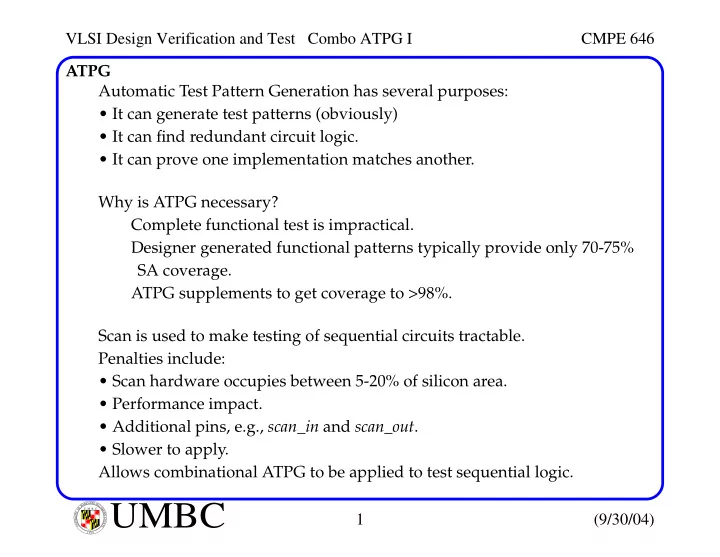
ATPG Automatic Test Pattern Generation has several purposes:

  • It can generate test patterns (obviously)
  • It can find redundant circuit logic.
  • It can prove one implementation matches another.

Why is ATPG necessary? Complete functional test is impractical. Designer generated functional patterns typically provide only 70-75% SA coverage. ATPG supplements to get coverage to >98%. Scan is used to make testing of sequential circuits tractable. Penalties include:

  • Scan hardware occupies between 5-20% of silicon area.
  • Performance impact.
  • Additional pins, e.g., scan_in and scan_out.
  • Slower to apply.

Allows combinational ATPG to be applied to test sequential logic.

slide-2
SLIDE 2

VLSI Design Verification and Test Combo ATPG I CMPE 646 2 (9/30/04)

UMBC

U M B C U N I V E R S I T Y O F M A R Y L A N D B A L T I M O R E C O U N T Y 1 9 6 6

Search Space Abstractions

  • Binary Search Trees.

The leaves represent the output of the good machine. All ATPG algorithms implicitly search this tree, and in the worst case, must examine the entire tree to prove a fault is untestable. Note that untestable faults do not affect the circuit’s logic function. Algorithms that are able to search the entire tree are called complete. A B C D A A B B B B C C C C C C C C 1 1 1 1 leaves 2num_PIs

slide-3
SLIDE 3

VLSI Design Verification and Test Combo ATPG I CMPE 646 3 (9/30/04)

UMBC

U M B C U N I V E R S I T Y O F M A R Y L A N D B A L T I M O R E C O U N T Y 1 9 6 6

Search Space Abstractions

  • BDDs (Binary Decision Diagrams)

The maxterms and minterms are the product of the visited nodes. Unfortunately, the order in which the PIs are expanded in the BDD dramati- cally effects the compute time of algorithms that use them. A B C D A A leaves 2 1 B B C C B C C B

slide-4
SLIDE 4

VLSI Design Verification and Test Combo ATPG I CMPE 646 4 (9/30/04)

UMBC

U M B C U N I V E R S I T Y O F M A R Y L A N D B A L T I M O R E C O U N T Y 1 9 6 6

ATPG Algebras Boolean set notation that is capable of representing both good and faulty machines simultaneously. Roth uses a 5-valued algebra. Muth later showed that testing FSMs required an expansion of X. Symbol Roth’s algebra Muth’s algebra Good Failing Good Failing D 1 1 D 1 1 1 1 1 1 1 X X X X X G0

  • X

G1

  • 1

X F0

  • X

F1

  • X

1

slide-5
SLIDE 5

VLSI Design Verification and Test Combo ATPG I CMPE 646 5 (9/30/04)

UMBC

U M B C U N I V E R S I T Y O F M A R Y L A N D B A L T I M O R E C O U N T Y 1 9 6 6

ATPG Algorithm Types

  • Exhaustive:

2n input patterns

  • Random Pattern Generation (RPG):

Fault simulation is essential in order to select useful patterns. RPG saturates at 60-80% fault coverage -- D-algo needed to improve this. Weighted random patterns: 0 and 1 are not equally likely. Start Set input probabilities (initially, p(0) and p(1) are 1/2) Generate a random vector Simulate faults Check coverage Change probabilities Inadequate No new fault tested discard vector Done

slide-6
SLIDE 6

VLSI Design Verification and Test Combo ATPG I CMPE 646 6 (9/30/04)

UMBC

U M B C U N I V E R S I T Y O F M A R Y L A N D B A L T I M O R E C O U N T Y 1 9 6 6

ATPG Algorithm Types

  • Symbolic (Boolean Difference):

Shannon’s Expansion Theorem: a Boolean function F(X1, X2, ..., Xn) can be expanded about any variable, say X2, as: Let g = G(X1, X2, ..., Xn) represent the function at the fault site: Let fj = Fj( g, X1, X2, ..., Xn), then the Boolean difference is: F X1 X2 … Xn , , , ( ) X2 F X1 1 … Xn , , , ( ) ⋅ X2 F X1 0 … Xn , , , ( ) ⋅ + = X1 X2 Xn g fault site fi fj g ∂ ∂F j F j 1 X ,

1 X2… Xn

, , ( ) F j 0 X ,

1 … Xn

, , ( ) ⊕ =

slide-7
SLIDE 7

VLSI Design Verification and Test Combo ATPG I CMPE 646 7 (9/30/04)

UMBC

U M B C U N I V E R S I T Y O F M A R Y L A N D B A L T I M O R E C O U N T Y 1 9 6 6

ATPG Algorithm Types

  • Symbolic (cont.):

Fault detection requirements are expressed as:

  • G(X1, X2, ..., Xn) = 1
  • Due to high complexity of Boolean difference, it is not efficient for large

circuits.

  • Path Sensitization Methods (preferred method):

Three steps: (a) Fault Activation: Force tested node to opposite of fault value. (b) Fault Propagation: Also called fault sensitization. Propagate the effect to one or more POs. (c) Line justification: Justify internal signal assignments made to acti- vate and sensitize faults. g ∂ ∂F j F j 1 X ,

1 X2… Xn

, , ( ) F j 0 X ,

1 … Xn

, , ( ) ⊕ 1 = =

slide-8
SLIDE 8

VLSI Design Verification and Test Combo ATPG I CMPE 646 8 (9/30/04)

UMBC

U M B C U N I V E R S I T Y O F M A R Y L A N D B A L T I M O R E C O U N T Y 1 9 6 6

ATPG Algorithm Types

  • Path Sensitization Methods (cont.):

Steps (b) and (c) may result in a conflict, i.e., different values assigned to the same signal, and require backtracking. If we target B SA0, fault activation requires B = 1, f = D and g = D. Fault propagation: Three scenarios are possible, paths f-h-k-L, g-i-j-k-L and both paths. Path f-h-k-L requires A=1, j=0 and E=1. Line justification: Only j needs to be justified. Backward logic simula- tion requires i=1. However, g is D so its not possible -- backtrack. A B C E SA0 f g h i j k L

slide-9
SLIDE 9

VLSI Design Verification and Test Combo ATPG I CMPE 646 9 (9/30/04)

UMBC

U M B C U N I V E R S I T Y O F M A R Y L A N D B A L T I M O R E C O U N T Y 1 9 6 6

ATPG Algorithm Types

  • Boolean Satisfiability and Implication Graph Methods:

xi and xi are literals, αk and βk are any two literals: Objective is to find a set of assignments for the xis that satisfy these sets

  • f Boolean clauses.

2-SAT problem (each clause has two literals) is solvable in polynomial time. 3-SAT problem takes exponential time. It is possible to formulate a Boolean product-of-sums expression, that if satisfied, indicates a test for the fault. These algorithms are now the fastest known for huge circuits. αkβk

= (non-tautology -- always false) αk βk + ( )

1 = (satisfiability)

slide-10
SLIDE 10

VLSI Design Verification and Test Combo ATPG I CMPE 646 10 (9/30/04)

UMBC

U M B C U N I V E R S I T Y O F M A R Y L A N D B A L T I M O R E C O U N T Y 1 9 6 6

ATPG Algorithm Types

  • Boolean Satisfiability and Implication Graph Methods (cont.):

The Boolean function for a logic gate is captured in equations, e.g., If a = 0 then z = 0 If b = 0 then z = 0 If z = 1 then a = 1 AND b = 1 If a = 1 AND b = 1 then z = 1 A cube is designed for each of these equations so that if the signals are consistently labeled, the cube is 0. Boolean false function: Only 0 when a, b and z take values consistent with the AND function. a b z az bz z ab ( ) abz + + + = simplifies az bz abz + + = FAND a b c , , ( ) z ab ( ) ⊕ az bz abz + + = =

slide-11
SLIDE 11

VLSI Design Verification and Test Combo ATPG I CMPE 646 11 (9/30/04)

UMBC

U M B C U N I V E R S I T Y O F M A R Y L A N D B A L T I M O R E C O U N T Y 1 9 6 6

ATPG Algorithm Types

  • Boolean Satisfiability and Implication Graph Methods (cont.):

Complement of fAND is the truth expression or satisfiability. An efficient way to find satisfying variable assignments for false or truth functions is the implication graph. Boolean variable x is represented by 2 literals x and x. If x = 1, x assumes a true state, if x = 0, x is true. if-then clauses can be represented with arcs from if literal to then literal: Conversion to a transitive closure graph. Here, if a node is set to true, e.g., a, all reachable nodes are also set to true. This allows very efficient global analysis of signal implications. a b z Implication graph

slide-12
SLIDE 12

VLSI Design Verification and Test Combo ATPG I CMPE 646 12 (9/30/04)

UMBC

U M B C U N I V E R S I T Y O F M A R Y L A N D B A L T I M O R E C O U N T Y 1 9 6 6

ATPG Algorithms Ibarra and Sahni in 1975 showed that ATPG is NP-complete, therefore no polynomial expression is known for the compute time. These algorithms employ heuristics that:

  • Find all necessary signal assignments for a test as early as possible.
  • Search as little of the above decision space as possible (worst case is

2num_PIs * 4num_ffs). Algorithm Estimated speedup

  • ver D-algorithm

Year D-ALG 1 1966 PODEM 7 1981 FAN 23 1983 TOPS 292 1987 SOCRATES 1574 (ATPG system) 1988 Waicukauski et. al. 2189 (ATPG system) 1990 EST 8765 (ATPG system) 1991 TRAN 3005 (ATPG system) 1993 Recursive learning 485 1995 Tafertshofer et. al. 25057 1997

slide-13
SLIDE 13

VLSI Design Verification and Test Combo ATPG I CMPE 646 13 (9/30/04)

UMBC

U M B C U N I V E R S I T Y O F M A R Y L A N D B A L T I M O R E C O U N T Y 1 9 6 6

ATPG Algorithms Since combinational fault simulation is O(n2), RPG and fault simulation is much more efficient. This is the driver for using RPG followed by ATPG for the hard-to-test faults. Common definitions:

  • Fault cone: The portion of a circuit whose signals are reachable by a forward

trace of the circuit topology starting at the fault site. X 1 A B C 1 SA0 D D D D X X E F 1 X D-frontier G

slide-14
SLIDE 14

VLSI Design Verification and Test Combo ATPG I CMPE 646 14 (9/30/04)

UMBC

U M B C U N I V E R S I T Y O F M A R Y L A N D B A L T I M O R E C O U N T Y 1 9 6 6

ATPG Algorithms

  • Forward implication: Results when the inputs to a logic gate are labeled so

that the output can be uniquely determined.

  • Backward implication: It is the unique determination of all inputs of a gate

for a given output and possibly some of the inputs. Backward implication is usually implemented procedurally since tables are cumbersome for gates with more than 2 inputs. a b z D a b z D 1 D a b D a b D 1 z D z D AND gate implication table a/b 1 X D D 1 1 X D D X X X X X D D X D D D X D

slide-15
SLIDE 15

VLSI Design Verification and Test Combo ATPG I CMPE 646 15 (9/30/04)

UMBC

U M B C U N I V E R S I T Y O F M A R Y L A N D B A L T I M O R E C O U N T Y 1 9 6 6

ATPG Algorithms

  • Backward implication (cont.):
  • Implication Stack: Used to efficiently track that portion of the binary decision

tree has already been traversed. a b z 1 1 a b D z D a b 1 z Signal Value Alternative tried A 1 NO C 1 NO E 1 NO B YES Stack ptr Here, the PIs were set in order A, C, E and B. Also, B was set to 1 but failed.

slide-16
SLIDE 16

VLSI Design Verification and Test Combo ATPG I CMPE 646 16 (9/30/04)

UMBC

U M B C U N I V E R S I T Y O F M A R Y L A N D B A L T I M O R E C O U N T Y 1 9 6 6

ATPG Algorithms

  • D-frontier: The set of all gates with D or D at the inputs and X at the output.

Divides the circuit into a portion with faults effects and one without.

  • Backtrack: ATPG algorithm backtracks if:

(a) The D-frontier becomes empty (fault effect cannot propagate further). (b) A signal is inconsistently assigned both 0 and 1 in order to satisfy the testing conditions. Alternatives are tried using the implication stack, which causes the tree to be searched in a depth-first fashion. Signal Value Alternative tried E 1 NO B YES F YES Stack ptr Here, 1 on F blocks fault propagation, so 0 is tried. Also, B was set to 1 but failed earlier.

slide-17
SLIDE 17

VLSI Design Verification and Test Combo ATPG I CMPE 646 17 (9/30/04)

UMBC

U M B C U N I V E R S I T Y O F M A R Y L A N D B A L T I M O R E C O U N T Y 1 9 6 6

ATPG Algorithms

  • Objectives: Goals to be achieved during ATPG.

Intermediate signal assignments may make it impossible to achieve the

  • bjective.

Many of the improvements to ATPG algorithms have focused on improving the selection of the objectives, coupled with reduction in backtracks.

  • Backtrace: An operation designed to determine which PI should be set to

achieve an objective. Most frequently directed by combinational controllability and observ- ability measures. E (1,1) A (1,1) B C D (1,1) (1,1) (1,1) (3,3) (5,2) J = 1 (2,3) (CC0, CC1) Objective: J = 1 Setting D = 1 satisfies this objective easiest. J = 0 Objective: J = 0 Start with hardest:Top input of G1 and bottom input of G2 => G1 G2 A = 1 and B = 1.

slide-18
SLIDE 18

VLSI Design Verification and Test Combo ATPG I CMPE 646 18 (9/30/04)

UMBC

U M B C U N I V E R S I T Y O F M A R Y L A N D B A L T I M O R E C O U N T Y 1 9 6 6

ATPG Algorithms

  • Branch-and-bound search: An efficient search procedure of binary decision

trees. Branch involves determining which input variable will be set to what value (0 or 1). Bounding avoids searching large portions of the decision tree by restrict- ing the search decision choices. The bounding operation is important since it avoids complete explora- tion. However, decisions about bounding often need to be made with limited information. Heuristics are used to bound the tree search.