UMBC A B M A L T F O U M B C I M Y O R T 1 - - PowerPoint PPT Presentation

umbc
SMART_READER_LITE
LIVE PREVIEW

UMBC A B M A L T F O U M B C I M Y O R T 1 - - PowerPoint PPT Presentation

VLSI Design Verification and Test Combo ATPG II CMPE 646 ATPG Algorithms Characteristics of the three main algorithms: Roths D-Algorithm (D-ALG) defined the calculus and algorithms for ATPG using D-cubes. Goels PODEM used path


slide-1
SLIDE 1

VLSI Design Verification and Test Combo ATPG II CMPE 646 1 (10/21/04)

UMBC

U M B C U N I V E R S I T Y O F M A R Y L A N D B A L T I M O R E C O U N T Y 1 9 6 6

ATPG Algorithms Characteristics of the three main algorithms:

  • Roth’s D-Algorithm (D-ALG) defined the calculus and algorithms for

ATPG using D-cubes.

  • Goel’s PODEM used path propagation constraints to limit the ATPG search

space and introduced backtrace.

  • Fujiwara’s FAN efficiently constrained the backtrace to speed up search

and further limited the search space. D-Calculus and D-Algorithm Definitions:

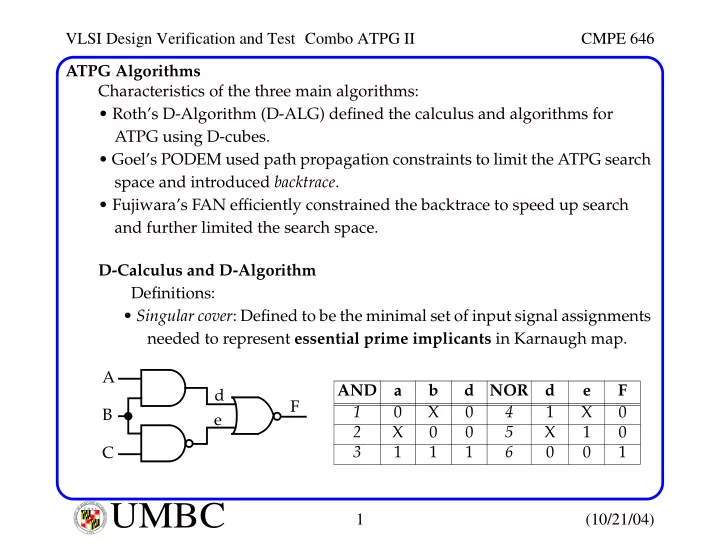
  • Singular cover: Defined to be the minimal set of input signal assignments

needed to represent essential prime implicants in Karnaugh map. A C B d e F AND a b d NOR d e F 1 X 4 1 X 2 X 5 X 1 3 1 1 1 6 1

slide-2
SLIDE 2

VLSI Design Verification and Test Combo ATPG II CMPE 646 2 (10/21/04)

UMBC

U M B C U N I V E R S I T Y O F M A R Y L A N D B A L T I M O R E C O U N T Y 1 9 6 6

D-Calculus and D-Algorithm

  • D-cube: A collapsed truth table entry.

For example, combine rows 3 and 1 of the AND gate singular cover, and express it in Roth’s 5-valued algebra (row 3 is good machine). D 1 D Rows 3 and 2 yield the propagation D-cube: 1 D D A third is D D D. Inverting D to D in each of these yields the 6 D-cubes for the AND gate. 3 of the NOR gate D-cubes are: D 0 D 0 D D D D D

  • D-intersection: Define how different D-cubes can coexist for different gates in

a logic circuit. ∩ X ∩ X ∩ = = = 1 1 ∩ 1 X ∩ X 1 ∩ 1 = = = X X ∩ X = Rule: If one cube assigns a specific signal value, the other cubes must assign either the same signal or X

slide-3
SLIDE 3

VLSI Design Verification and Test Combo ATPG II CMPE 646 3 (10/21/04)

UMBC

U M B C U N I V E R S I T Y O F M A R Y L A N D B A L T I M O R E C O U N T Y 1 9 6 6

D-Calculus and D-Algorithm

  • D-intersection (cont.):

For example, "0 X X" intersect "1 X X" is the empty cube (incompatible). The greek symbols φ and ψ represent incompatible assignments. If the values are incompatible during propagation or implications, the assignment is called inconsistent and backtracking is necessary. Greek symbols µ and λ indicate incompatibilities if both are present in D-cubes with multiple input D and D. For example, if only λ occurs, invert the Ds in the second cube and perform intersection. D-intersection 1 X D D φ ψ ψ 1 φ 1 1 ψ ψ X 1 X D D D ψ ψ D µ λ D ψ ψ D λ µ

slide-4
SLIDE 4

VLSI Design Verification and Test Combo ATPG II CMPE 646 4 (10/21/04)

UMBC

U M B C U N I V E R S I T Y O F M A R Y L A N D B A L T I M O R E C O U N T Y 1 9 6 6

D-Calculus and D-Algorithm

  • D-contains: A cube A D-contains cube B if the set of A cube vertices contains

(is a superset of) the B cube vertices.

  • Primitive D-cubes of failure (PDF): These model faults including:

(a) SA0 (represented by D) (b) SA1 (represented by D) (c) Bridging faults (short circuits) (d) Arbitrary change in logic gate function (e.g., from AND to OR). For the AND gate, the PDF for output SA0 is "1 1 D" Here the good machine generates a 1 when both inputs are 1, while the bad machine generates a 0. The PDFs for the AND gate output SA1 are "0 X D" and "X 0 D". Note the PDF are distinct from the propagation D-cubes. The former models a failure at the gate. The latter models the conditions for fault effect propagation.

slide-5
SLIDE 5

VLSI Design Verification and Test Combo ATPG II CMPE 646 5 (10/21/04)

UMBC

U M B C U N I V E R S I T Y O F M A R Y L A N D B A L T I M O R E C O U N T Y 1 9 6 6

D-Calculus and D-Algorithm

  • Implication procedure: Consists of the following steps:

(a) Model the fault with the appropriate PDF. (b) Select propagation D-cubes to propagate fault-effect to PO(s)(D-drive). (c) Select singular cover cubes to justify internal circuit signals (consis- tency procedure). The D-algorithm’s main problem is that it selects cubes and singular covers arbitrarily during test generation.

slide-6
SLIDE 6

VLSI Design Verification and Test Combo ATPG II CMPE 646 6 (10/21/04)

UMBC

U M B C U N I V E R S I T Y O F M A R Y L A N D B A L T I M O R E C O U N T Y 1 9 6 6

D-ALG Start

Select a fault Generate a PDF Is there D

  • r D on PO?

Propagate D-cube and intersect Inconsistency? no no yes Alt gate for propagation? yes Backup one level select another path yes no no Options exhausted? No pattern exists yes

D-Drive

Pattern More lines to justify? Select a line to justify. yes no Inconsistency? Alt path for justification? no yes yes

Consistency

Mark the lines to be justified Backup one level select another path no Revisiting a node? no yes

slide-7
SLIDE 7

VLSI Design Verification and Test Combo ATPG II CMPE 646 7 (10/21/04)

UMBC

U M B C U N I V E R S I T Y O F M A R Y L A N D B A L T I M O R E C O U N T Y 1 9 6 6

D-ALG Examples A C B d e F A B C F 1 1 1 1 1 1 1 1 1 1 1 1 1 Truth Table A B C d e F 1 1 1 1 1 1 1 1 1 1 A B C d e F D 1 D 1 D D D D D D 1 D 1 D D D D D D D D D D D D Singular Cover Propagation D-cubes SA0 1 Assign PDF 1 1 D 2 Propagate D 1 3 Consistency

slide-8
SLIDE 8

VLSI Design Verification and Test Combo ATPG II CMPE 646 8 (10/21/04)

UMBC

U M B C U N I V E R S I T Y O F M A R Y L A N D B A L T I M O R E C O U N T Y 1 9 6 6

D-ALG Examples The following procedure is carried out for d SA0 in the previous circuit: Example #2: Step A B C d e F Type of cube 1 1 1 D PDF for AND gate 2 D D Propagation D-cube for NOR gate 3 1 1 Singular cover of NAND gate A D C B D D X e f g 1 k h D 1 SA0 1 Assign PDF D 2 Propagate 4 Consistency 3 5 6 7

slide-9
SLIDE 9

VLSI Design Verification and Test Combo ATPG II CMPE 646 9 (10/21/04)

UMBC

U M B C U N I V E R S I T Y O F M A R Y L A N D B A L T I M O R E C O U N T Y 1 9 6 6

D-ALG Examples Steps followed to generate test cube (tc): This example and table is given in Roth’s paper. Several other examples are covered in the paper. Note that all implications are performed in the consistency procedure here. A later example by our authors indicates the implications are carried out after each D propagation step in the D-drive? Step A B C D e f g h k L D-drive 1 D 2 D D 3 D D 1 D Consistency 4

  • r

1 1 5 not 1 6

  • r

7 and tc D 1 D 1 D D-chain dies

slide-10
SLIDE 10

VLSI Design Verification and Test Combo ATPG II CMPE 646 10 (10/21/04)

UMBC

U M B C U N I V E R S I T Y O F M A R Y L A N D B A L T I M O R E C O U N T Y 1 9 6 6

D-ALG Examples Example #3: 1 Assign PDF F E C B A D 2 Propagate D 1 1 D 4 Consistency 1 1 SA0 1 1 5 3 6

slide-11
SLIDE 11

VLSI Design Verification and Test Combo ATPG II CMPE 646 11 (10/21/04)

UMBC

U M B C U N I V E R S I T Y O F M A R Y L A N D B A L T I M O R E C O U N T Y 1 9 6 6

D-ALG Examples Example #4: A B X Y Z C h k i e f r t q p u v n s d g SA1 1 Assign PDF D 1 2 Propagate D Consistency 1 1 1 m 1 3 5 4 6 D 7 1 D 8 9

slide-12
SLIDE 12

VLSI Design Verification and Test Combo ATPG II CMPE 646 12 (10/21/04)

UMBC

U M B C U N I V E R S I T Y O F M A R Y L A N D B A L T I M O R E C O U N T Y 1 9 6 6

D-ALG Examples Example #5: The B = 0 choice is eventually discovered as a bad choice. One backtrack to step 2, which sets B = 1 and leads to the successful gen- eration of a test. Note here that implications carried out before the D-drive is completed. A B X Y Z C h k i e f r t q p u v n s d g 1 Assign PDF D 1 Propagate Implications m 3 D 2 SA1 1 4 FAIL (backtrack) 5 6 7

slide-13
SLIDE 13

VLSI Design Verification and Test Combo ATPG II CMPE 646 13 (10/21/04)

UMBC

U M B C U N I V E R S I T Y O F M A R Y L A N D B A L T I M O R E C O U N T Y 1 9 6 6

PODEM In late ’70s, IBM introduced error correction and translation (ECAT) to their DRAM to increase reliability. D-ALG fails on attempts to generate tests for these circuits because the search is not directed. D-ALG will eventually determine that n = q is not realizable by this circuit. A B C E F G H j k l m p R SA1 n q 3 choice 1 5 6 4 D 2 1 D 1 D 1 3 choice 1 1 1 1 1 FAIL The only valid tests require that these are opposite.

slide-14
SLIDE 14

VLSI Design Verification and Test Combo ATPG II CMPE 646 14 (10/21/04)

UMBC

U M B C U N I V E R S I T Y O F M A R Y L A N D B A L T I M O R E C O U N T Y 1 9 6 6

PODEM PODEM (Path-Oriented Decision-Making) introduced several standard ATPG concepts:

  • PODEM expands the binary decision tree around the PIs and not around

all circuit signals. This reduces the size of the tree from 2n to 2num_PIs.

  • D-ALG tended to continue intersecting D-cubes even when the D-frontier

disappeared. PODEM introduced a subroutine to test if D-frontier still existed.

  • PODEM introduced objectives and realized that choosing PIs to set was

important in efficiently realizing objectives. Backtracing was used to obtain a PI assignment given an initial objective. PODEM considered the length of the path between the objective and the POs and used controllability measures to guide the ATPG algorithm.

slide-15
SLIDE 15

VLSI Design Verification and Test Combo ATPG II CMPE 646 15 (10/21/04)

UMBC

U M B C U N I V E R S I T Y O F M A R Y L A N D B A L T I M O R E C O U N T Y 1 9 6 6

PODEM PODEM starts at the PIs instead of at faulty line like D-ALG.

Start

Assign a binary value to an unassigned PI Pattern no Determine implications

  • f all PIs

Is there a D

  • r D on any PO?

yes Test possible with additional assigned PIs? maybe no Is there any untried combo on assigned PIs? No Pattern no exists yes Set untried combo

  • n assigned PIs.

Involves choosing objectives and performing backtrace.

slide-16
SLIDE 16

VLSI Design Verification and Test Combo ATPG II CMPE 646 16 (10/21/04)

UMBC

U M B C U N I V E R S I T Y O F M A R Y L A N D B A L T I M O R E C O U N T Y 1 9 6 6

FAN Fujiwara and Shimono introduced several novel concepts to further limit the ATPG search space and accelerate backtracing:

  • Immediate Implications: PODEM misses opportunities to immediately assign

values that are uniquely determined to signals. Given objective L = 0, PODEM would backtrace and assign k=1, g=0 and B=0. This is unfortunate since B=1 => h=1 and j=0 which prevents objective. A C B h j L k 1 E g 1 A C B h j L=D k E g 1 1 1 FAN instead sets j, k and E to 1 since they must all be set to justify L=D. 1 1 This leads to unique A and B=1, C=0.

slide-17
SLIDE 17

VLSI Design Verification and Test Combo ATPG II CMPE 646 17 (10/21/04)

UMBC

U M B C U N I V E R S I T Y O F M A R Y L A N D B A L T I M O R E C O U N T Y 1 9 6 6

FAN and Other Advanced ATPG Algorithms Test book describes other novel features of the FAN algorithm.

  • Dominator ATPG Programs: TOPS (Kirkland and Mercer)
  • Learning ATPG Programs:

SOCRATES (Schulz et al.) EST (Giraldi and Bushnell) Recursive Learning (Kunz and Pradhan)

  • Implication Graph ATPG Algorithms:

NNATPG (Chakradhar et al.) TRAN (Chakradhar et al.) GRASP NEMESIS TEGUS A program by Tafertshofer et al.

  • BDD-Based ATPG Algorithms (performance poor on multipliers):

CATAPULT (Gaede at al.) TSUNAMI (Stanion Bhattacharya)

slide-18
SLIDE 18

VLSI Design Verification and Test Combo ATPG II CMPE 646 18 (10/21/04)

UMBC

U M B C U N I V E R S I T Y O F M A R Y L A N D B A L T I M O R E C O U N T Y 1 9 6 6

Test Generation Systems An ATPG system may contain:

  • Fault generator/collapsing program
  • RPG program
  • Fault simulator
  • ATPG program
  • Test compactor

Performance criteria include:

  • Fault coverage
  • Fault efficiency
  • Vector set size
  • CPU time

Fault coverage Number of detected faults Total number of faults

  • =

Fault efficiency Number of detected faults Total number of faults Number of undetectable faults –

  • =
slide-19
SLIDE 19

VLSI Design Verification and Test Combo ATPG II CMPE 646 19 (10/21/04)

UMBC

U M B C U N I V E R S I T Y O F M A R Y L A N D B A L T I M O R E C O U N T Y 1 9 6 6

Test Generation Systems SOCRATES: Starts with RPG (optionally with weighted pattern probabili- ties), concurrent fault simulation and fault dropping. 32 random patterns are generated in parallel and one concurrent fault simu- lation is carried out. The process terminates when no faults are detected after 64 random pat- terns have been tried. This is followed with several passes of ATPG. Pass one is done usually with only 10 backtracks allowed per fault. Each pattern is then fault simulated against all remaining faults and detected faults are dropped. Later passes increase the number of backtracks to 50, 100 and finally 10,000. This process outputs a test vector file, a list of undetected faults, a list of redun- dant faults, a list of aborted faults and a backtrack distribution file.

slide-20
SLIDE 20

VLSI Design Verification and Test Combo ATPG II CMPE 646 20 (10/21/04)

UMBC

U M B C U N I V E R S I T Y O F M A R Y L A N D B A L T I M O R E C O U N T Y 1 9 6 6

Test Compaction Many ATPG systems use RPG to get 60% fault coverage, followed by ATPG. However, many of the RPG patterns may not be as effective at providing "high" fault coverage. At the end of ATPG, all patterns are fault simulated in reverse order of their generation. Once fault coverage reaches 100%, the remaining RPG patterns are dis- carded. This type of compaction greatly reduces the size of the test set. An additional static compaction method is suitable for the ATPG generated patterns, where unassigned inputs are left at X. Two patterns can be combined if they are compatible, as defined by the D- intersection operator given earlier.

slide-21
SLIDE 21

VLSI Design Verification and Test Combo ATPG II CMPE 646 21 (10/21/04)

UMBC

U M B C U N I V E R S I T Y O F M A R Y L A N D B A L T I M O R E C O U N T Y 1 9 6 6

Test Compaction The degree of compaction possible depends on the order in which the vectors are processed. Optimal static compaction algorithms are impractical, so heuristic algorithms are used. Dynamic compaction immediately assigns 1’s and 0’s to the unassigned PIs after the ATPG program generates them. The secondary faults detected allows additional fault dropping. t1 = 01X t2 = 0X1 t3 = 0X0 t4 = X01 t13 = 010 t24 = 001