
Our Our Place Place in in the the Cosmos Cosmos
Lecture 17 The Expanding Universe
The Cosmological Principle
- Contradicting early beliefs that the Earth is at the
centre of the Universe, the cosmological principle posits that there is nothing special about our location and that the same rules of physics apply everywhere
- We now known that the Earth orbits the Sun, one of
hundreds of billions of stars forming the Milky Way
- The Milky Way itself is just one of hundreds of
billions of galaxies scattered throughout a Universe vastly larger than our ancestors might have imagined
Cosmology
- Cosmology is the study of the entire Universe,
including its structure, history, origins and fate
- The cosmological principle makes the testable
prediction that any conclusions we reach about the Universe are independent of our location
- In other words observers everywhere should see the
same Universe
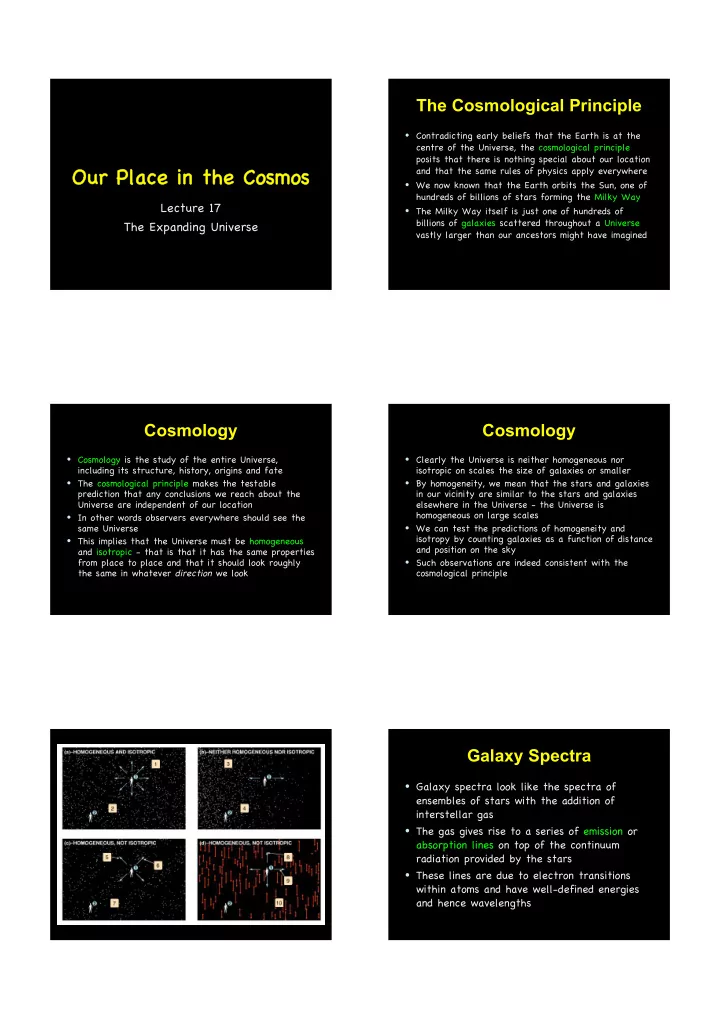
- This implies that the Universe must be homogeneous
and isotropic - that is that it has the same properties from place to place and that it should look roughly the same in whatever direction we look
Cosmology
- Clearly the Universe is neither homogeneous nor
isotropic on scales the size of galaxies or smaller
- By homogeneity, we mean that the stars and galaxies
in our vicinity are similar to the stars and galaxies elsewhere in the Universe - the Universe is homogeneous on large scales
- We can test the predictions of homogeneity and
isotropy by counting galaxies as a function of distance and position on the sky
- Such observations are indeed consistent with the
cosmological principle
Galaxy Spectra
- Galaxy spectra look like the spectra of
ensembles of stars with the addition of interstellar gas
- The gas gives rise to a series of emission or
absorption lines on top of the continuum radiation provided by the stars
- These lines are due to electron transitions