
SLIDE 1
Our Our Place Place in in the the Cosmos Cosmos
Lecture 18 The Big Bang
The Big Bang
- We saw in the last lecture that the Universe
is expanding
- Following that expansion backward in time,
the Universe must have been much smaller in the past
- We believe the Universe was created in an
event called the Big Bang about 13.6 billion years ago
- This is an empirical model - does it make any
testable predictions?
Predictions of The Big Bang
- When a gas is compressed it gets hotter
- It thus seems reasonable to assume that the
young Universe contained an extremely hot, dense gas, filled with high energy radiation with a Planck spectrum
- In the 1940s, Ralph Alpher and Robert
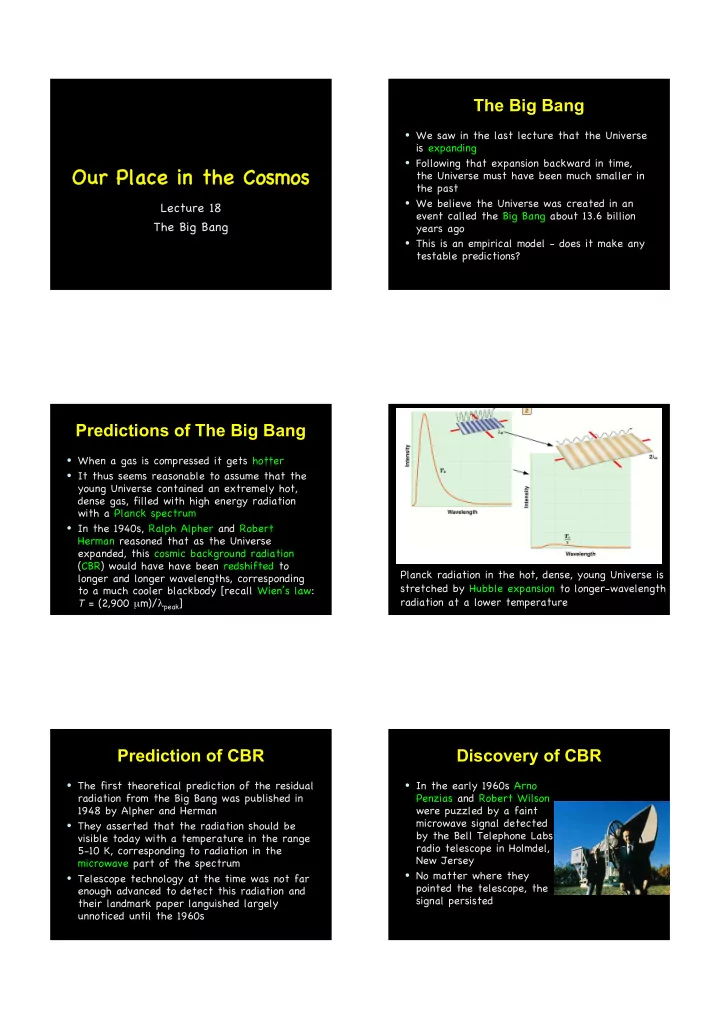
Herman reasoned that as the Universe expanded, this cosmic background radiation (CBR) would have have been redshifted to longer and longer wavelengths, corresponding to a much cooler blackbody [recall Wien’s law: T = (2,900 µm)/peak] Planck radiation in the hot, dense, young Universe is stretched by Hubble expansion to longer-wavelength radiation at a lower temperature
Prediction of CBR
- The first theoretical prediction of the residual
radiation from the Big Bang was published in 1948 by Alpher and Herman
- They asserted that the radiation should be
visible today with a temperature in the range 5-10 K, corresponding to radiation in the microwave part of the spectrum
- Telescope technology at the time was not far
enough advanced to detect this radiation and their landmark paper languished largely unnoticed until the 1960s
Discovery of CBR
- In the early 1960s Arno
Penzias and Robert Wilson were puzzled by a faint microwave signal detected by the Bell Telephone Labs radio telescope in Holmdel, New Jersey
- No matter where they