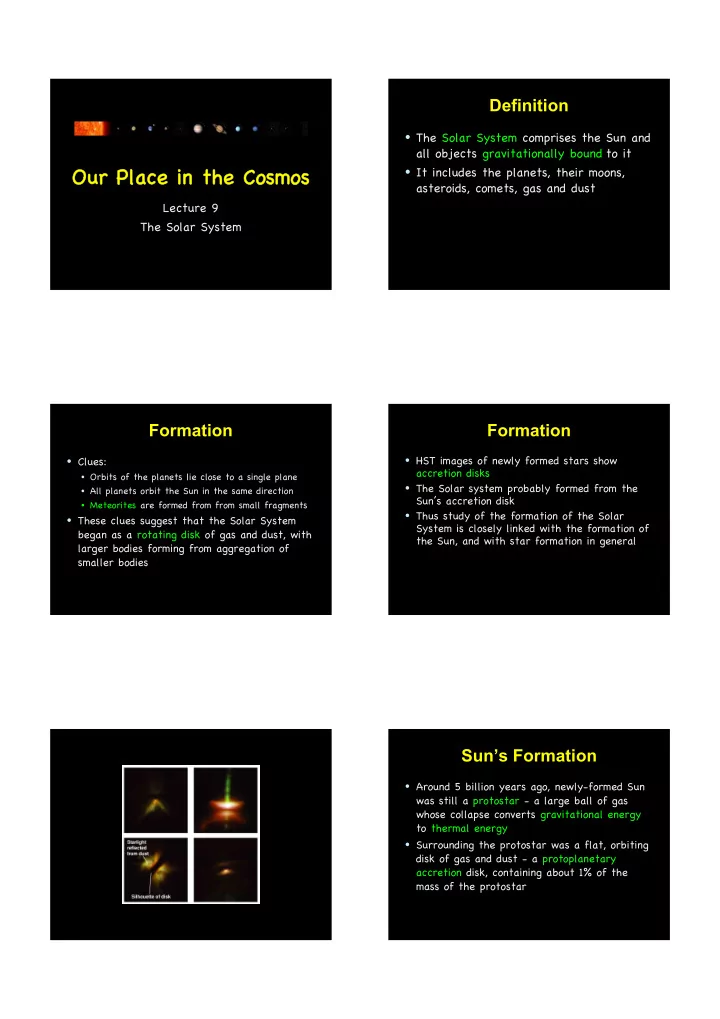
SLIDE 4 Marbles released together fall with little relative motion but have large relative motions after bouncing off a rough surface Similarly, a cold cloud of infalling gas is heated when it collides with the accretion disk
Types of Energy
- Energy can take several forms
- Anything moving possesses kinetic energy
- Heat is a form of kinetic energy due to random
motions of the constituent particles
- Anything that feels a gravitational force possesses
gravitational potential energy (GPE)
- GPE is increased by separating two massive
- bjects; it is lost as objects fall towards each
- ther and is converted into kinetic energy
- Total energy is conserved, but may be freely
converted from one form to another
Disk Temperature
- The inner part of the disk (that part closer to the
protostar) will be hotter than the outer disk since:
- Material has had further to fall and so has lost
more GPE and gained more kinetic energy
- Inner disk is radiated by hot protostar
- Here only solids that can withstand high temperatures
before melting or being vapourized (refractory materials, eg. rocks and metals) can exist
- Volatile materials (eg. water and organic molecules)
can only exist in solid form in the outer parts of the disk
Planet composition
- The composition of planets at different radii is
expected to reflect these differences
- The inner planets will be made up mostly of
rocks and metals
- Outer planets can also contain refractory
materials, but also contain large quantities
- f ices and organic materials
- This trend in composition with distance from
the Sun is found in our Solar System
Atmospheres and Moons
- A solid planet can capture gas from the accretion
disk but must act quickly as young stars are sources
- f “winds” and intense radiation that can disperse
gaseous remains of accretion disk
- Giant planets such as Jupiter have an advantage in
attracting and keeping a primary atmosphere - a mini-accretion disk will form around them
- Moon’s can then form from this mini-disk
- In the case of small planets such as Earth, the
primary atmosphere is lost, but a secondary atmosphere forms from the later release of carbon dioxide and other gases from volcanic activity
Brief Solar System History
- Around 5 billion years ago the Sun was a protostar
surrounded by a protoplanetary disk of gas and dust
- Over a few hundred thousand years dust collected
into planetessimals comprising rocks and metals close to the Sun with the addition of ice and organic compounds further away
- About six planetessimals within a few AU of the Sun
grew to become dominant masses
- Their growing gravitational fields either captured
the remaining planetessimals or ejected them from the inner part of the disk