
SLIDE 1
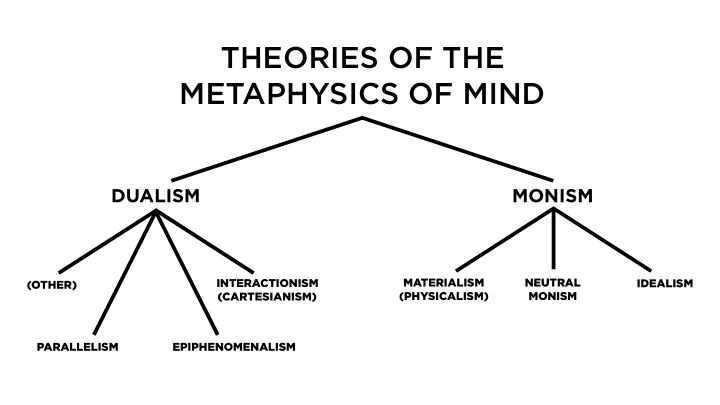
MONISM DUALISM
THEORIES OF THE METAPHYSICS OF MIND
MATERIALISM (PHYSICALISM) IDEALISM NEUTRAL MONISM INTERACTIONISM (CARTESIANISM) EPIPHENOMENALISM PARALLELISM (OTHER)
THEORIES OF THE METAPHYSICS OF MIND DUALISM MONISM MATERIALISM - - PowerPoint PPT Presentation
THEORIES OF THE METAPHYSICS OF MIND DUALISM MONISM MATERIALISM NEUTRAL INTERACTIONISM IDEALISM (OTHER) (PHYSICALISM) MONISM (CARTESIANISM) PARALLELISM EPIPHENOMENALISM ANTI-DUALISM ARGUMENTS 1. Conflict with physical laws (79)
MONISM DUALISM
THEORIES OF THE METAPHYSICS OF MIND
MATERIALISM (PHYSICALISM) IDEALISM NEUTRAL MONISM INTERACTIONISM (CARTESIANISM) EPIPHENOMENALISM PARALLELISM (OTHER)
ANTI-DUALISM ARGUMENTS
3.Materialism is simpler (13–15) 4.(Others?) ANTI-MATERIALISM ARGUMENTS
3.Something about blue experiences (??) (3–4) 4.(Others?)
COMPATIBILISM INCOMPATIBILISM
THEORIES OF THE WILL
DETERMINISM VOLUNTARISM
I will suppose, then, that everything I see is fictitious. I will believe that my memory tells me nothing but lies. I have no senses. Body, shape, extension, movement and place are illusions. So what remains true? Perhaps just the one fact that nothing is certain! … Hopeful: …how do I know that there isn’t something…about which there is no room for even the slightest doubt? Isn’t there a God (call him what you will) who gives me the thoughts I am now having? Doubtful: But why do I think this, since I might myself be the author of these thoughts? Hopeful: But then doesn’t it follow that I am, at least, something?
Descartes, p.4
Doubtful: But there is a supremely powerful and cunning deceiver who deliberately deceives me all the time! Hopeful: Even then, if he is deceiving me I undoubtedly exist: let him deceive me all he can, he will never bring it about that I am nothing while I think I am
proposition, I am, I exist, must be true whenever I assert it or think it.
Descartes, p.4
Well, then, what am I? A thing that thinks. What is that? A thing that doubts, understands, affirms, denies, wants, refuses, and also imagines and senses.
Descartes, p.5
1. It is possible to know all of the physical facts about an experience (e.g., of seeing the color red) without knowing what it is like to have the experience. 2. If you then have the experience, you would learn something new (e.g., what it is like to see red). 3. So, at least some knowledge is knowledge of non-physical facts.
The Knowledge Argument
(See, e.g., Frank Jackson, “What Mary Didn’t Know”)
How could our conscious experiences be made out of physical stuff?
Consciousness poses the most baffling problems in the science
we know more intimately than conscious experience, but there is nothing that is harder to explain.
—David Chalmers, ‘Facing Up to the Hard Problem of Consciousness’
The easy problems of consciousness include those of explaining the following phenomena:
environmental stimuli;
—David Chalmers, ‘Facing Up to the Hard Problem of Consciousness’
—David Chalmers, ‘Facing Up to the Hard Problem of Consciousness’
As [Thomas] Nagel has put it, there is something it is like to be a conscious
aspect is experience.
—David Chalmers, ‘Facing Up to the Hard Problem of Consciousness’
When we see, for example, we experience visual sensations: the felt quality of redness, the experience of dark and light, the quality of depth in a visual field. Other experiences go along with perception in different modalities: the sound of a clarinet, the smell of
to orgasms; mental images that are conjured up internally; the felt quality of emotion, and the experience
states is that there is something it is like to be in them.
—David Chalmers, ‘Facing Up to the Hard Problem of Consciousness’
It is widely agreed that experience arises from a physical basis, but we have no good explanation of why and how it so arises. Why should physical processing give rise to a rich inner life at all? It seems objectively unreasonable that it should, and yet it does.
—David Chalmers, ‘Facing Up to the Hard Problem of Consciousness’