SLIDE 1
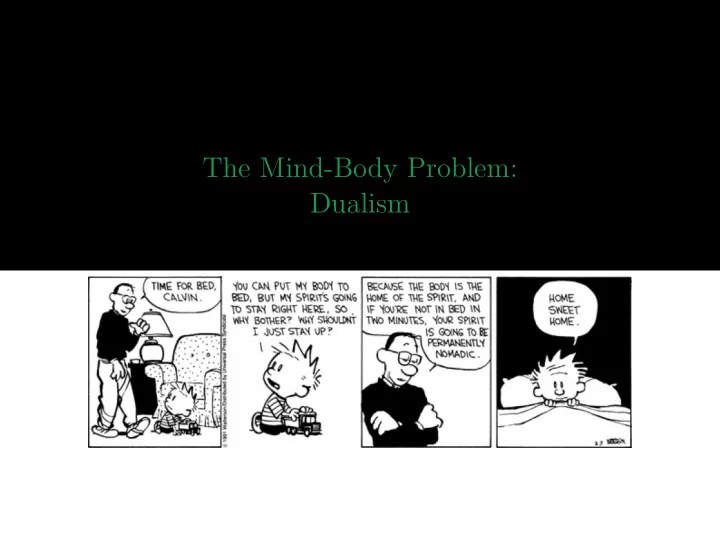
The Mind-Body Problem: Dualism
SLIDE 2
The Mind-Body Problem
While the mind-body problem can be stated in many ways, a helpful way to think through it is to consider the relationship between the following pairs of sentences: ◮ I hear the sound of planes flying by ◮ Hair fibers of the cochlea sent an electrical signal to my superior temporal gyrus.
◮ I am happy that Notre Dame beat Michigan. ◮ Dopamine was released in my brain when an electrical signal from my eyes was interpeted as Notre Dame beat Michigan.
◮ I have unrealistic expectations as to how my life should go. ◮ My brain has neural pathways that process information in way X.
◮ I focus on the negative things in my life more often than the positive things. ◮ The lack of the neurotransmitter serotonin causes my cortico-limbic system to be less active than in others.
SLIDE 3
The Mind-Body Problem
◮ The point is, for anything that goes on mentally, there seems to be a complete description of that thing in terms of mental language−the language of beliefs, desires, fears, hopes, feelings, perceptions, etc.−and a complete description of that thing in terms of physical language−the language of neurons, regions of the brain, electrical signals, etc. ◮ The mind-body problem is this: what is the relationship between these two descriptions?
SLIDE 4 Four Theories:
While not strictly exhaustive, we will look at 4 theories as to what is going on with respect to the mind and body and build a paradox out of problems for those theories Dualism Mental and physical sentences are talking about two different parts of you that are causally linked (e.g. your heart and lungs) Mind-Brain Identity Mental and physical sentences are two ways of saying the same thing; they can be substituted for each other (e.g. the way we could use “water” or “H2O”; “average kinetic energy” or“heat”) Functionalism Mental and physical sentences are talking about the same thing but do not share meaning (e.g. the way we could talk about software or the hardware that encodes that software;
- r “The President” and “Trump”)
Epiphenom- enalism Mental and physical sentences are talking about different features of the same thing; the mental features hold in virtue
- f the physical features, but not vice-versa; hence, mental
features are causally uninvolved in the world.
SLIDE 5
Dualism
◮ Dualism is the view that there are two different kinds of things in reality: minds and material things. ◮ Minds have mental properties like “is thinking about cheese”, “is feeling sad”, “is reasoning through an argument” ◮ Bodies have physical properties like “is made of matter”, “has a mass of 22kg”, “is extended in 3 dimensions” ◮ Thus, according to dualism, the mind is not spatial, or material and is therefore distinct from the brain/body ◮ Given that we know we are thinking things, dualists typcially say either that a person is identical to the mind (Cartesian Dualism), or to the mind-body composite (Thomistic Dualism). ◮ Despite being unpopular in scientific circles, dualism can in many ways be seen as the default view throughout human history (continuing on to this day).
SLIDE 6
Arguments for Dualism
◮ Dualism claims that the mind and the brain/body are distinct things. ◮ Arguments for this thesis almost always rely on a principle called Leibniz’s Law−identical things are indiscernible ◮ If A=B, then Leibniz’s Law says that anything true of A is true of B: A is an elephant if and only if B is an elephant; A weighs 10lbs if and only if B weighs 10lbs ◮ Thus, the easiest way to show that the mind and the brain are not identical is to show that there is something true of one that is not true of the other ◮ There are many, many candidates for differences between minds and brains; we will look at 5 to get a sampling of them
SLIDE 7 Argument 1: Certainty
- 1. I can be certain that the mind exists.
- 2. I cannot be certain that the body exists.
- C. Therefore, the mind is distinct from (not identical to)
the body. ◮ It is not clear how much we can infer from certainty, as it merely seems to be a property of us and our knowledge ◮ Compare this argument to someone 1000 years ago saying “I know there is water in the lake but I don’t know if there is H2O in the lake” ◮ In general, it is not clear that co-referring terms can be substituted in belief contexts
SLIDE 8 Argument 2: Conceivability
- 1. I can clearly conceive of my mind existing and my body
not existing (or vice versa).
- 2. If I can clearly conceive of something, it is possible.
- 3. Therefore, it is possible for my mind to exist without
my body.
- C. Therefore, the mind is distinct from the body.
◮ Unlike Argument 1, one object existing when the other doesn’t does seem to be sufficient for them to be two distinct
◮ Premise 2 seems to be the most controversial ◮ On the one hand, conceivability seems to be how we figure
- ut possibility claims (consider how you would figure out if it
was possible for you to not come to class today) ◮ On the other hand, we might be able to conceive some physically impossible things, like going faster than the speed
◮ In response, the defender of the argument might concede that we don’t know if separation is physically possible, but it might be (metaphysically) possible nonetheless.
SLIDE 9 Argument 3: Divisibility
- 1. Every spatially extended thing is divisible.
- 2. The mind is not divisible.
- C. The mind is not a spatially extended thing.
◮ At first glance, it might seem like the mind can be divided into reason, emotions, perception, etc. ◮ However, in all these things there seems to be a certain sort of unity in the mind still: it is the same center of consciousness that feels, thinks, perceives, etc. ◮ The different things the mind does are different abilities, not different parts
SLIDE 10 Argument 4: Privacy
- 1. It is possible to perceive someone’s brain activity.
- 2. It is not possible to perceive (directly) someone else’s
thoughts.
- C. Therefore, a person’s thoughts are not identical to their
brain activity. ◮ It may be the case that at some point in the future, electrodes hooked up to someone’s head can tell us what they are thinking ◮ Still at best it will be inferring thoughts from seeing certain brainwave activity (the same way we can infer someone has angry thoughts by looking at their face) and this seems to be fundamentally different than the direct observation we can have of physical process, and different than the direct observation we can have of our
SLIDE 11 Argument 5: Intentionality
- 1. Thoughts can be about things.
- 2. Physical things cannot be about things.
- C. Therefore, thoughts are not physical things.
◮ One of the most fundamental marks of mental content is that it has things it is about ◮ My belief that it is not snowing, has as its object a sentenced (or proposition) “it is snowing”, which it denies ◮ My desire for tacos, is about tacos ◮ My fear of spiders, is about spiders ◮ Physical objects, like the table, or a neuron, are not “about” anything−they just are
SLIDE 12
Argument 5: Intentionality
◮ But perhaps this is too fast; after all, can’t physical words like “taco” be about tacos; can’t maps be about certain regions; can’t paintings or pictures be about their objects (it isn’t just a picture, it is a picture of the golden dome) ◮ While it definitely seems like pictures, maps, and words can be representational, the way thoughts can, there seems to be some sense in which their ability to represent derives from the minds ability to represent. ◮ It seems like a word “taco” only represents tacos in virtue of our using it when we have certain mental things going on−the same sound or the same marks on a page could have represented something else ◮ Similarly, a picture is just an arrangement of colored pixels; we interpret it as being about something because the pixels are arranged in a way so as to represent something; they are intimately connected to the intentions of humans that created them
SLIDE 13 Argument 5: Intentionality
◮ Thus, we might distinguish this derivative intentionality/aboutness/representationalness from
- riginal intentionality/aboutness/representationalness
- 1. Thoughts can be originally about things.
- 2. Physical things cannot be originally about things.
- C. Therefore, thoughts are not physical things.
◮ Can we come up with similar exceptions to these premises?
SLIDE 14
The Objection to Dualism
◮ There are many different objections to dualism, but the most powerful ones center around one issue: causal interaction ◮ We know that the body can influence the mind; for instance, if your body gets slapped, your mind will experience pain; if your body has light waves hit its eyes, your mind will perceive objects around you ◮ Similarly, we know that your mind can influence your body; for instance, when you intend to raise your hand, your hand rises; when you intend to speak, your mouth and vocal chords do various things. ◮ This then raises the question, how do these two things−the mind and the body−interact?
SLIDE 15 The Objection to Dualism
The
posing
this
comes from Princess Elisabeth: I ask you please to tell me how the soul of a human being (it being only a thinking substance) can determine the bodily spirits, in order to bring about voluntary actions. For it seems that all determination of move- ment happens through the impulsion of the thing moved, by the manner in which it is pushed by that which moves it, or else by the particular qualities and shape of the surface of the latter. Physical contact is re- quired for the first two conditions, extension for the third. You entirely exclude the one [extension] from the notion you have of the soul, and the
- ther [physical contact] appears to me incompatible with an immaterial
thing. ◮ One of the points Princess Elisabeth makes is that, being non-spatial, the mind cannot be adjacent to or in contact with the body, so the type of causation is utterly unlike the physical pushing and pulling we are most familiar with. ◮ A second point is that physical causation seems to require sharing some physical properties. A signet ring makes a certain impression based on its shape; gravity affects things based on proximity and relative size. Thus, how can we make sense of the mind having physical effects when it has no physical properties?
SLIDE 16 The Objection to Dualism ◮ A third point can also be made (though this was less in keeping with the science of Princess Elisabeth’s day)−the world is a closed causal system ◮ We have several rules of physics which tell us physical properties are
- conserved. But, how could the mind start a certain impulse in the
brain without imparting some energy? And if it imparts some energy, why is this never measured? ◮ Whenever a physical event occurs, such as raising your hand, physics demands that a physical thing be the immediate prior cause (such as a neuron). But if each neuron firing is explained by prior neuron firings, where can the immaterial mind come in? ◮ We could sum up the argument thus:
- 1. All physical effects are fully caused by purely physical prior causes.
(Causal Closure)
- 2. Mental occurrences have physical effects.
- 3. The physical effects of mental causes aren’t overdetermined by distinct
causes.
- C. Therefore, mental occurrences are identical to physical occurrences.