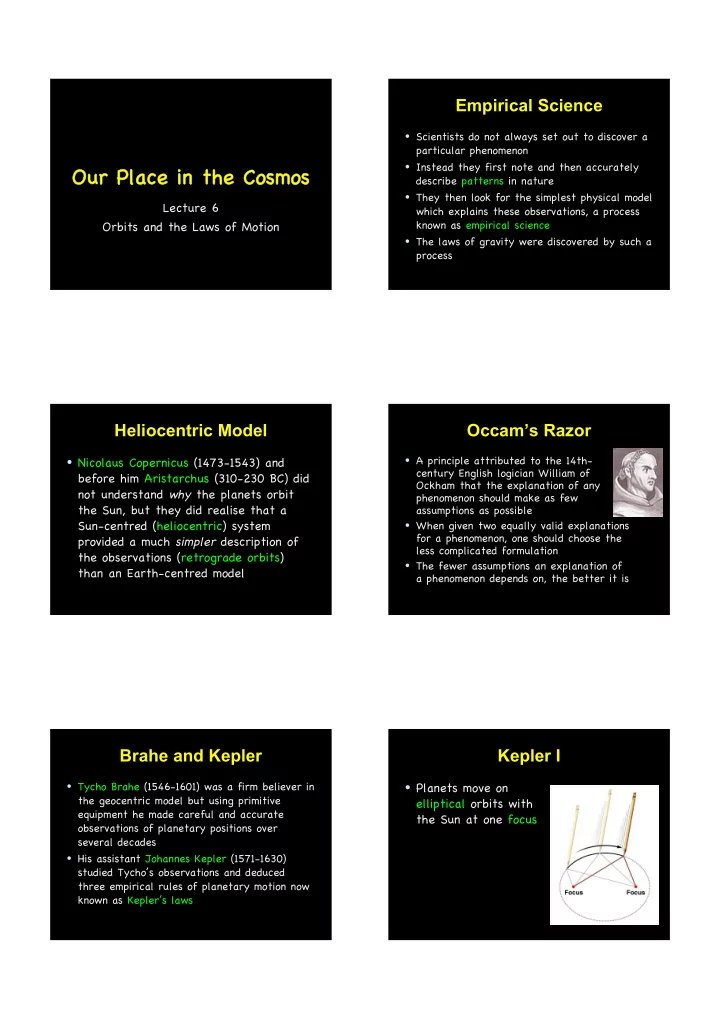

SLIDE 1
Our Our Place Place in in the the Cosmos Cosmos
Lecture 6 Orbits and the Laws of Motion
Empirical Science
- Scientists do not always set out to discover a
particular phenomenon
- Instead they first note and then accurately
describe patterns in nature
- They then look for the simplest physical model
which explains these observations, a process known as empirical science
- The laws of gravity were discovered by such a
process
Heliocentric Model
- Nicolaus Copernicus (1473-1543) and
before him Aristarchus (310-230 BC) did not understand why the planets orbit the Sun, but they did realise that a Sun-centred (heliocentric) system provided a much simpler description of the observations (retrograde orbits) than an Earth-centred model
Occam’s Razor
- A principle attributed to the 14th-
century English logician William of Ockham that the explanation of any phenomenon should make as few assumptions as possible
- When given two equally valid explanations
for a phenomenon, one should choose the less complicated formulation
- The fewer assumptions an explanation of
a phenomenon depends on, the better it is
Brahe and Kepler
- Tycho Brahe (1546-1601) was a firm believer in
the geocentric model but using primitive equipment he made careful and accurate
- bservations of planetary positions over
several decades
- His assistant Johannes Kepler (1571-1630)
studied Tycho’s observations and deduced three empirical rules of planetary motion now known as Kepler’s laws
Kepler I
- Planets move on