Our Place Our Place in in the the Cosmos Cosmos following - - PDF document

our place our place in in the the cosmos cosmos
SMART_READER_LITE
LIVE PREVIEW

Our Place Our Place in in the the Cosmos Cosmos following - - PDF document

Understanding Stars We saw in the last lecture that by measuring the brightness, distance (via parallax) and spectrum of a star, we can determine the Our Place Our Place in in the the Cosmos Cosmos following physical properties


slide-1
SLIDE 1

Our Our Place Place in in the the Cosmos Cosmos

Lecture 11 Understanding Stars - the H-R Diagram

Understanding Stars

  • We saw in the last lecture that by measuring

the brightness, distance (via parallax) and spectrum of a star, we can determine the following physical properties

  • Surface temperature
  • Radius
  • Luminosity
  • Mass (for binary stars)
  • Just knowing these properties does not mean

that we understand stars

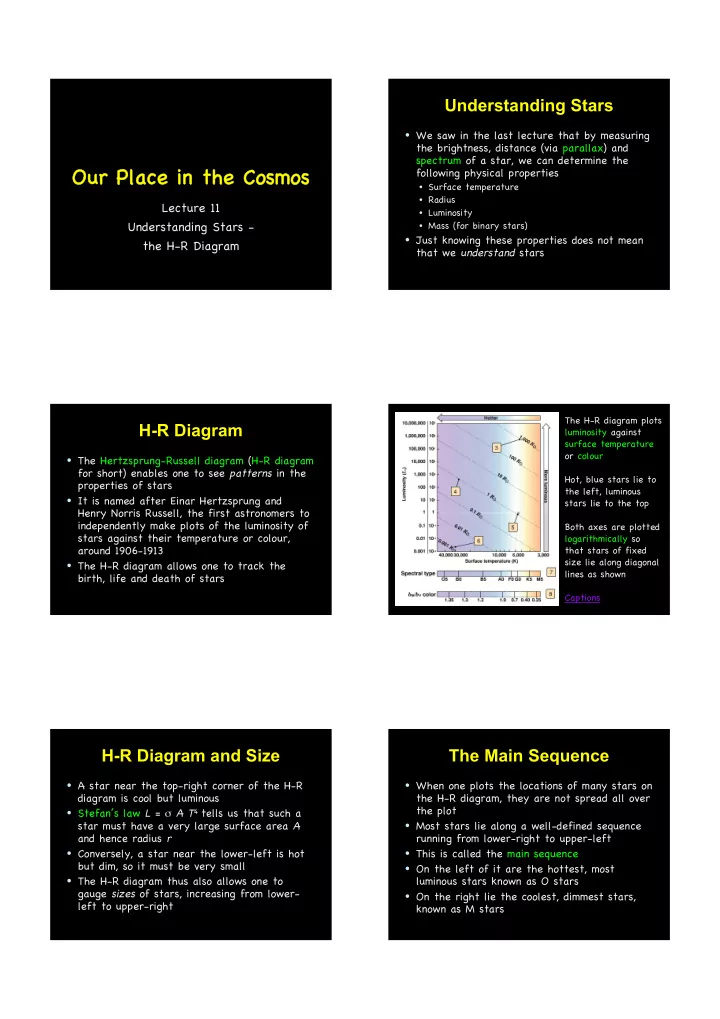
H-R Diagram

  • The Hertzsprung-Russell diagram (H-R diagram

for short) enables one to see patterns in the properties of stars

  • It is named after Einar Hertzsprung and

Henry Norris Russell, the first astronomers to independently make plots of the luminosity of stars against their temperature or colour, around 1906-1913

  • The H-R diagram allows one to track the

birth, life and death of stars

The H-R diagram plots luminosity against surface temperature

  • r colour

Hot, blue stars lie to the left, luminous stars lie to the top Both axes are plotted logarithmically so that stars of fixed size lie along diagonal lines as shown Captions

H-R Diagram and Size

  • A star near the top-right corner of the H-R

diagram is cool but luminous

  • Stefan’s law L = A T4 tells us that such a

star must have a very large surface area A and hence radius r

  • Conversely, a star near the lower-left is hot

but dim, so it must be very small

  • The H-R diagram thus also allows one to

gauge sizes of stars, increasing from lower- left to upper-right

The Main Sequence

  • When one plots the locations of many stars on

the H-R diagram, they are not spread all over the plot

  • Most stars lie along a well-defined sequence

running from lower-right to upper-left

  • This is called the main sequence
  • On the left of it are the hottest, most

luminous stars known as O stars

  • On the right lie the coolest, dimmest stars,

known as M stars

slide-2
SLIDE 2

Hipparcos sample of 16,600 stars Brightest Closest

Distance Estimates

  • The Main Sequence is of great practical use in

estimating distances to stars too far away to measure a trigonometric parallax

  • We can determine a star’s colour or surface

temperature independent of distance via photometry

  • r spectroscopy respectively
  • If it lies on the main sequence than we can read its

approximate luminosity off the H-R diagram

  • Comparing apparent brightness with luminosity then

yields an estimate of distance

  • This distance estimate is known as photometric

parallax or spectroscopic parallax

Selection Effects

  • The distribution of stars on the H-R diagram depends

strongly on how they are selected

  • The stars very close to the Sun are mostly dimmer

and cooler than the Sun

  • The (apparently) brightest stars in the sky are mostly

more luminous and hotter than the Sun

  • There are more cool, dim stars in the Galaxy than hot

luminous stars, and these dominate the small volume

  • f space near the Sun
  • By selecting stars by apparent brightness rather than

distance, we preferentially select the most luminous stars

Stellar Mass

  • Stellar mass increases from lower-right to

upper-left along main sequence

  • Stars less massive than the Sun are cooler,

redder, smaller and dimmer

  • Stars more massive than the Sun are hotter,

bluer, larger and more luminous

  • The mass of a star determines its position on

the main sequence and its ultimate fate

  • Mass is the primary determining characteristic
  • f any main sequence star

More massive main sequence stars are … more luminous… …larger… …and hotter (Note logarithmic axes) Mass determines location of a star

  • n the main

sequence High-mass stars are hot and luminous Low mass stars are cool and dim

slide-3
SLIDE 3

Non-Main Sequence Stars

  • Although the majority of stars lie on the main

sequence (MS), some do not

  • Some stars lie above and to the right of the

MS - these are bloated, luminous, cool giants with radii 100s-1000s times larger than the Sun

  • In the lower-left of the H-R diagram lie tiny

(and hence dim) but very hot stars

  • Before studying these non-MS stars, we will

first study a prototypical MS star - the Sun

The Structure of the Sun

  • Being so close, we can study the Sun - a

prototypical MS star - in much greater detail than any other star

  • Our understanding of the Sun comes from

many decades of careful observation, theory and computer modelling

  • The Sun is a huge ball of hot gas, held in

balance by hydrostatic equilibrium

  • Gravity, which unopposed would cause the Sun

to collapse, is balanced by pressure

  • The Sun’s surface is thus in equilibrium

At each point within the Sun the

  • utward force of

pressure is balanced by the inward force

  • f gravity

The energy radiated from the Sun’s surface balances the energy produced in its interior

Hydrostatic Equilibrium Hydrostatic Equilibrium

  • Towards the centre of the Sun, the weight of

the material above becomes greater and so the pressure must increase

  • Gases at higher pressure become denser and

hotter

  • Thus density and temperature also increase

towards the centre of the Sun

  • Energy must also balance to maintain Sun’s

luminosity - just enough energy must be produced in the interior to provide the energy radiated away at the surface

NB same data plotted twice… logarithmic linear

Sun’s Energy Source

  • The only source of energy efficient enough to

provide Sun’s luminosity is nuclear fusion

  • Hydrogen nuclei (single protons) are fused

together to make helium nuclei (two protons plus two neutrons) - a process known as hydrogen burning or hydrogen fusion

  • All main sequence stars get their energy from

hydrogen fusion

slide-4
SLIDE 4

Hydrogen Fusion

  • According to Einstein’s famous equation E = mc2, mass

and energy are equivalent

  • The mass of four hydrogen atoms is 1.007 times

greater than the mass of a single helium atom

  • In hydrogen fusion, the excess mass is converted to

energy

  • Fusing 1 gramme of hydrogen into helium releases

about 600 billion Joules of energy - enough to boil the water in about 10 swimming pools

  • The Sun converts roughly 600 million tonnes of

hydrogen into helium each second, releasing 3.85 x 1026 Watts [Joules per second]

Hydrogen Fusion

  • Why is hydrogen fusion so hard to achieve on Earth?
  • The reason is that hydrogen nuclei (protons) have a

positive electric charge

  • Two like charges experience a force known as

electrostatic repulsion, this makes it extremely difficult to get two hydrogen nuclei close enough to bind (a separation of around 10-15 metres)

  • Extremely high densities and temperatures are

required to overcome electrostatic repulsion - conditions that are ordinarily only found in the cores (central regions) of stars

  • In the Sun’s core the density is about 150 times that
  • f water and the temperature is about 15 million K

Slow-moving protons are repelled by electrostatic repulsion The faster they move, the closer together they can get At high enough temperatures protons move fast enough that they may overcome electrostatic repulsion and fuse together

Why Hydrogen Fusion?

1.

Hydrogen is the most abundant element in the Universe

  • 2. Hydrogen fusion is the most efficient nuclear fusion

process, converting a larger fraction of mass to energy than any other process

  • 3. Hydrogen nuclei have a charge of +1 (in units of the

electron’s charge) - there is a much greater electrostatic repulsion for other nuclei such as carbon, which contains six protons and so has a nuclear charge of +6

  • Cannot directly fuse hydrogen into helium - reaction

proceeds by a number of chains - the most common

  • f which is the proton-proton chain

Proton-Proton Chain

Colliding protons first create deuterium (2H), then helium-3 (3He) and then helium-4 (4He)

Testing the Model

  • Starting with just the mass of the Sun and its

chemical composition, our Solar model correctly predicts all other observed properties - size, temperature and luminosity

  • For example, if the Sun were larger than it in fact is,

it would radiate energy faster

  • However core density would be less and hydrogen

fusion would slow down

  • Core would thus cool, pressure decrease and Sun

would shrink back to its equilibrium size

  • If Sun were compressed, fusion rate would increase

causing Sun to expand back to its equilibrium size

slide-5
SLIDE 5

Captions

Solar Neutrinos

  • Hydrogen fusion as Sun’s energy supply is confirmed

by the observation of neutrinos produced as part of the proton-proton chain

  • Neutrinos are incredibly weakly-interacting and can

escape from the core of the Sun much faster than photons of radiation

  • A small fraction can however be detected on Earth in

underground labs

  • The rate at which neutrinos are detected agrees with

the Solar model assuming that neutrinos have some mass, and are not massless as previously thought

Summary

  • Most stars lie in a region of the H-R diagram

known as the main sequence

  • Main sequence stars, of which the Sun is a

proto-typical example, exist in a state of hydrostatic equilibrium

  • Energy is generated in the core of these stars

by the fusion of hydrogen nuclei into helium, accompanied by the release of energy and solar neutrinos

  • Energy is transported to the star’s surface

and is radiated away