
SLIDE 1
Our Our Place Place in in the the Cosmos Cosmos
Lecture 15 Quasars and Active Galactic Nuclei
Quasars
- Galaxies shine with the luminosity of hundreds
- f billions of stars
- However, even galaxies pale beside quasars,
the most luminous objects in the Universe
- Quasar is a contraction of the term quasi-
stellar radio source, so-called because they were first identified in the 1950s-60s as unresolved points at radio wavelengths
- Quasars radiate with a luminosity of a trillion
to a thousand trillion (1012 - 1015) Suns
Quasars
- Due to their luminosity, quasars can be seen to huge
distances - currently the most distant known object in the Universe is a quasar at redshift 6.4
- The nearest quasar is approximately 1 billion light
years away - there are billions of galaxies closer to us than that
- Quasars are thus objects of the distant Universe
- Finite travel speed of light means that we see more
distant objects when they were younger
- Quasars were common in the early Universe but are
rare today Universe is evolving
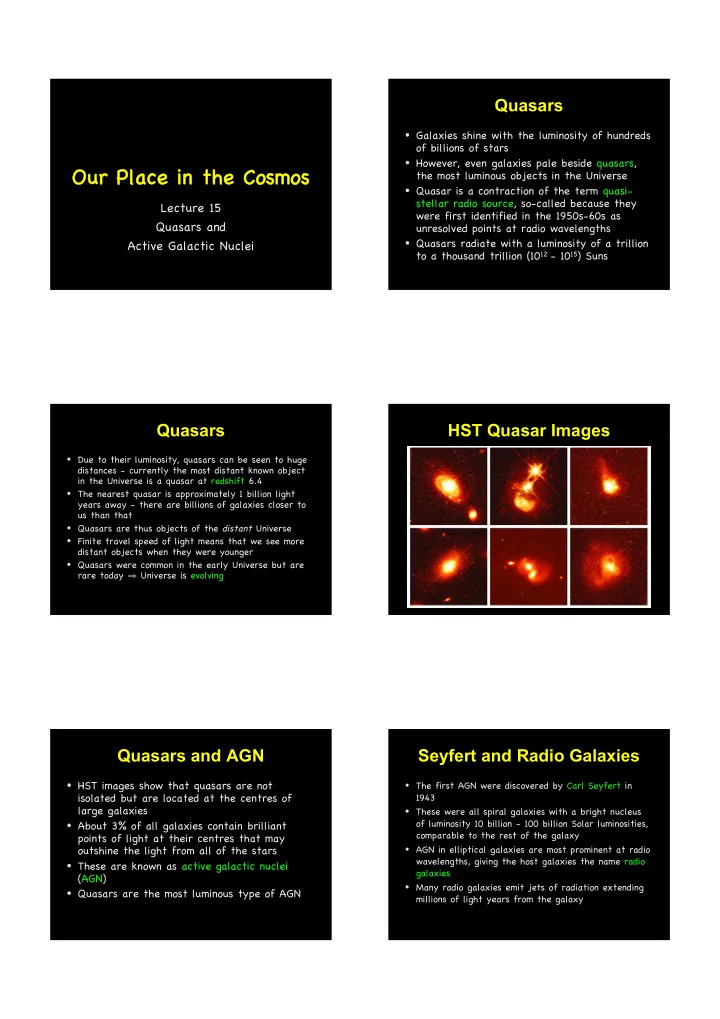
HST Quasar Images Quasars and AGN
- HST images show that quasars are not
isolated but are located at the centres of large galaxies
- About 3% of all galaxies contain brilliant
points of light at their centres that may
- utshine the light from all of the stars
- These are known as active galactic nuclei
(AGN)
- Quasars are the most luminous type of AGN
Seyfert and Radio Galaxies
- The first AGN were discovered by Carl Seyfert in
1943
- These were all spiral galaxies with a bright nucleus
- f luminosity 10 billion - 100 billion Solar luminosities,
comparable to the rest of the galaxy
- AGN in elliptical galaxies are most prominent at radio
wavelengths, giving the host galaxies the name radio galaxies
- Many radio galaxies emit jets of radiation extending
millions of light years from the galaxy