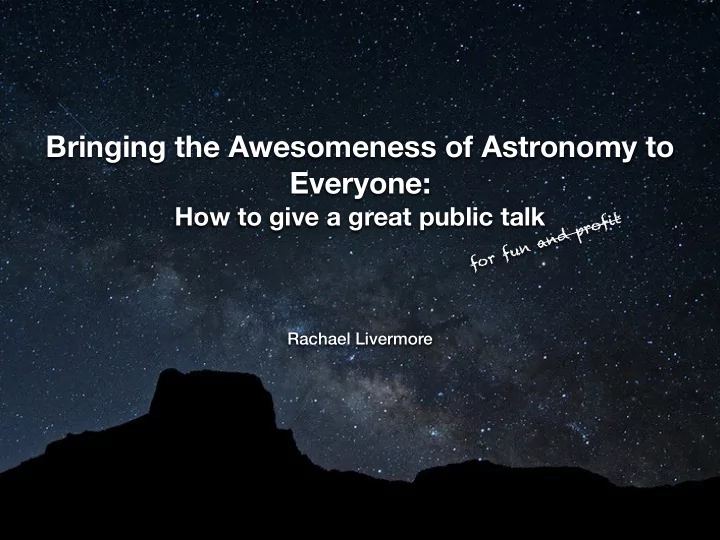
Bringing the Awesomeness of Astronomy to Everyone: How to give a - - PowerPoint PPT Presentation

bringing the awesomeness of astronomy to everyone
SMART_READER_LITE
LIVE PREVIEW

Bringing the Awesomeness of Astronomy to Everyone: How to give a - - PowerPoint PPT Presentation

Bringing the Awesomeness of Astronomy to Everyone: How to give a great public talk t i f o r p d n a n u f r o f Rachael Livermore Why give public talks? Why give public talks? Lots of research is taxpayer-funded Why give


slide-1
SLIDE 1

Bringing the Awesomeness of Astronomy to Everyone:

How to give a great public talk

Rachael Livermore

f

  • r

f u n a n d p r

  • f

i t

slide-2
SLIDE 2

Why give public talks?

slide-3
SLIDE 3

Why give public talks?

  • Lots of research is taxpayer-funded
slide-4
SLIDE 4

Why give public talks?

  • Lots of research is taxpayer-funded
  • Scientific illiteracy is a real threat
slide-5
SLIDE 5

Why give public talks?

  • Lots of research is taxpayer-funded
  • Scientific illiteracy is a real threat
  • It reinforces your own knowledge about your field
slide-6
SLIDE 6

Why give public talks?

  • Lots of research is taxpayer-funded
  • Scientific illiteracy is a real threat
  • It reinforces your own knowledge about your field
  • It’s fun!
slide-7
SLIDE 7

Points to consider when giving public talks

slide-8
SLIDE 8

Points to consider when giving public talks

  • Science content
slide-9
SLIDE 9

Points to consider when giving public talks

  • Science content
  • Interacting with your audience
slide-10
SLIDE 10

Points to consider when giving public talks

  • Science content
  • Interacting with your audience
  • The Q&A
slide-11
SLIDE 11

Points to consider when giving public talks

  • Science content
  • Interacting with your audience
  • The Q&A
  • General presentation habits (apply to research talks

too!)

slide-12
SLIDE 12

Science content

slide-13
SLIDE 13

Science content

  • You cannot underestimate your audience’s

background knowledge!

slide-14
SLIDE 14

Actual questions from public talks

slide-15
SLIDE 15

Actual questions from public talks

  • “Where does the Sun go at night?”
slide-16
SLIDE 16

Actual questions from public talks

  • “Where does the Sun go at night?”
  • 50-something
slide-17
SLIDE 17

Actual questions from public talks

  • “Where does the Sun go at night?”
  • 50-something
  • “Wait, so does it go planet - galaxy - Universe - star? Or planet - star - Universe - galaxy?”
slide-18
SLIDE 18

Actual questions from public talks

  • “Where does the Sun go at night?”
  • 50-something
  • “Wait, so does it go planet - galaxy - Universe - star? Or planet - star - Universe - galaxy?”
  • 30-something
slide-19
SLIDE 19

Actual questions from public talks

  • “Where does the Sun go at night?”
  • 50-something
  • “Wait, so does it go planet - galaxy - Universe - star? Or planet - star - Universe - galaxy?”
  • 30-something
  • “If gravity keeps the Moon around the Earth, and the Earth around the Sun, is the Sun also
  • rbiting the centre of the Milky Way?”
slide-20
SLIDE 20

Actual questions from public talks

  • “Where does the Sun go at night?”
  • 50-something
  • “Wait, so does it go planet - galaxy - Universe - star? Or planet - star - Universe - galaxy?”
  • 30-something
  • “If gravity keeps the Moon around the Earth, and the Earth around the Sun, is the Sun also
  • rbiting the centre of the Milky Way?”
  • 6 year-old
slide-21
SLIDE 21

Actual questions from public talks

  • “Where does the Sun go at night?”
  • 50-something
  • “Wait, so does it go planet - galaxy - Universe - star? Or planet - star - Universe - galaxy?”
  • 30-something
  • “If gravity keeps the Moon around the Earth, and the Earth around the Sun, is the Sun also
  • rbiting the centre of the Milky Way?”
  • 6 year-old
  • “Where did the Big Bang happen?”
slide-22
SLIDE 22

Actual questions from public talks

  • “Where does the Sun go at night?”
  • 50-something
  • “Wait, so does it go planet - galaxy - Universe - star? Or planet - star - Universe - galaxy?”
  • 30-something
  • “If gravity keeps the Moon around the Earth, and the Earth around the Sun, is the Sun also
  • rbiting the centre of the Milky Way?”
  • 6 year-old
  • “Where did the Big Bang happen?”
  • everyone
slide-23
SLIDE 23

Actual questions from public talks

  • “Where does the Sun go at night?”
  • 50-something
  • “Wait, so does it go planet - galaxy - Universe - star? Or planet - star - Universe - galaxy?”
  • 30-something
  • “If gravity keeps the Moon around the Earth, and the Earth around the Sun, is the Sun also
  • rbiting the centre of the Milky Way?”
  • 6 year-old
  • “Where did the Big Bang happen?”
  • everyone

(See also: “What came before the Big Bang?” “What is the Universe expanding into?”

slide-24
SLIDE 24

Science content

slide-25
SLIDE 25

Science content

  • You cannot underestimate your audience’s background

knowledge!

slide-26
SLIDE 26

Science content

  • You cannot underestimate your audience’s background

knowledge!

  • Not understanding is FAR more boring than hearing things

you already know!

slide-27
SLIDE 27

Science content

  • You cannot underestimate your audience’s background

knowledge!

  • Not understanding is FAR more boring than hearing things

you already know!

  • Repeat, repeat, repeat!
slide-28
SLIDE 28

Science content

  • You cannot underestimate your audience’s background

knowledge!

  • Not understanding is FAR more boring than hearing things

you already know!

  • Repeat, repeat, repeat!
  • Use analogies to convey ideas about scale
slide-29
SLIDE 29

Science content

  • You cannot underestimate your audience’s background

knowledge!

  • Not understanding is FAR more boring than hearing things

you already know!

  • Repeat, repeat, repeat!
  • Use analogies to convey ideas about scale
  • Try to form a story, rather than a deluge of facts
slide-30
SLIDE 30

Science content

  • You cannot underestimate your audience’s background

knowledge!

  • Not understanding is FAR more boring than hearing things

you already know!

  • Repeat, repeat, repeat!
  • Use analogies to convey ideas about scale
  • Try to form a story, rather than a deluge of facts
  • Memorise your take-home message
slide-31
SLIDE 31

Using plots in talks

slide-32
SLIDE 32

Using plots in talks

WTF?!

slide-33
SLIDE 33

Using plots in talks

WTF?!

(No offense to Alice Danielson, who includes a perfectly reasonable explanation of this plot in her caption)

slide-34
SLIDE 34

Using plots in talks

slide-35
SLIDE 35

Using plots in talks

slide-36
SLIDE 36

Using plots in talks

constant speed

slide-37
SLIDE 37

Using plots in talks

constant speed

f a s t e r

slide-38
SLIDE 38

Using plots in talks

constant speed

f a s t e r s l

  • w

e r

slide-39
SLIDE 39

Using plots in talks

slide-40
SLIDE 40

Using plots in talks

slide-41
SLIDE 41

Using plots in talks

slide-42
SLIDE 42

Interacting with your audience

slide-43
SLIDE 43

Interacting with your audience

slide-44
SLIDE 44

Interacting with your audience

  • Be confident (pretend!)
slide-45
SLIDE 45

Interacting with your audience

  • Be confident (pretend!)
  • If possible, film yourself and watch for annoying habits
slide-46
SLIDE 46

Interacting with your audience

  • Be confident (pretend!)
  • If possible, film yourself and watch for annoying habits
  • Consider how you present yourself
slide-47
SLIDE 47

Interacting with your audience

  • Be confident (pretend!)
  • If possible, film yourself and watch for annoying habits
  • Consider how you present yourself
  • Watch for reactions
slide-48
SLIDE 48

Interacting with your audience

  • Be confident (pretend!)
  • If possible, film yourself and watch for annoying habits
  • Consider how you present yourself
  • Watch for reactions
  • Remember people have given up time (and money?) to

hear you speak

slide-49
SLIDE 49

Types of audiences

slide-50
SLIDE 50

Types of audiences

  • General public
slide-51
SLIDE 51

Types of audiences

  • General public
  • assume no science background
slide-52
SLIDE 52

Types of audiences

  • General public
  • assume no science background
  • Astronomy or science-themed event, e.g. star party, science fiction convention
slide-53
SLIDE 53

Types of audiences

  • General public
  • assume no science background
  • Astronomy or science-themed event, e.g. star party, science fiction convention
  • Self-selected, but don’t assume science training
slide-54
SLIDE 54

Types of audiences

  • General public
  • assume no science background
  • Astronomy or science-themed event, e.g. star party, science fiction convention
  • Self-selected, but don’t assume science training
  • School groups
slide-55
SLIDE 55

Types of audiences

  • General public
  • assume no science background
  • Astronomy or science-themed event, e.g. star party, science fiction convention
  • Self-selected, but don’t assume science training
  • School groups
  • can actually be more technical - children are more accustomed to

hearing new information?

slide-56
SLIDE 56

Types of audiences

  • General public
  • assume no science background
  • Astronomy or science-themed event, e.g. star party, science fiction convention
  • Self-selected, but don’t assume science training
  • School groups
  • can actually be more technical - children are more accustomed to

hearing new information?

  • Amateur astronomical societies
slide-57
SLIDE 57

Types of audiences

  • General public
  • assume no science background
  • Astronomy or science-themed event, e.g. star party, science fiction convention
  • Self-selected, but don’t assume science training
  • School groups
  • can actually be more technical - children are more accustomed to

hearing new information?

  • Amateur astronomical societies
  • Another self-selected group. Range in backgrounds can be HUGE.
slide-58
SLIDE 58

The Q&A

slide-59
SLIDE 59

The Q&A

slide-60
SLIDE 60

The Q&A

  • Remember you know more than the audience
slide-61
SLIDE 61

The Q&A

  • Remember you know more than the audience
  • Allow LOTS of time
slide-62
SLIDE 62

The Q&A

  • Remember you know more than the audience
  • Allow LOTS of time
  • Expect completely unrelated questions
slide-63
SLIDE 63

The Q&A

  • Remember you know more than the audience
  • Allow LOTS of time
  • Expect completely unrelated questions
  • Don’t be afraid to say you don’t know
slide-64
SLIDE 64

The Q&A

  • Remember you know more than the audience
  • Allow LOTS of time
  • Expect completely unrelated questions
  • Don’t be afraid to say you don’t know
  • But memorize useful scales/ analogies, answers to

common questions, etc.

slide-65
SLIDE 65

General Presentation Habits

slide-66
SLIDE 66

General presentation habits

slide-67
SLIDE 67

General presentation habits

  • Keep all fonts > 20pt
slide-68
SLIDE 68

General presentation habits

  • Keep all fonts > 20pt
  • Large blocks of text like this are difficult to read, and will distract the

audience when they should be watching you. Chances are they will jump ahead of you (reading is faster than talking!) and therefore zone out of what you’re saying. Use the slides to help you demonstrate your points, not to tell the entire story. This is a talk, not a paper!

slide-69
SLIDE 69

General presentation habits

  • Keep all fonts > 20pt
  • Large blocks of text like this are difficult to read, and will distract the

audience when they should be watching you. Chances are they will jump ahead of you (reading is faster than talking!) and therefore zone out of what you’re saying. Use the slides to help you demonstrate your points, not to tell the entire story. This is a talk, not a paper!

  • Sans serif fonts (Arial, Helvetica) are easier to read at a distance than serif

fonts like Times New Roman

slide-70
SLIDE 70

General presentation habits

  • Keep all fonts > 20pt
  • Large blocks of text like this are difficult to read, and will distract the

audience when they should be watching you. Chances are they will jump ahead of you (reading is faster than talking!) and therefore zone out of what you’re saying. Use the slides to help you demonstrate your points, not to tell the entire story. This is a talk, not a paper!

  • Sans serif fonts (Arial, Helvetica) are easier to read at a distance than serif

fonts like Times New Roman

  • Use contents, summary and transition slides to break up content
slide-71
SLIDE 71

General presentation habits

  • Keep all fonts > 20pt
  • Large blocks of text like this are difficult to read, and will distract the

audience when they should be watching you. Chances are they will jump ahead of you (reading is faster than talking!) and therefore zone out of what you’re saying. Use the slides to help you demonstrate your points, not to tell the entire story. This is a talk, not a paper!

  • Sans serif fonts (Arial, Helvetica) are easier to read at a distance than serif

fonts like Times New Roman

  • Use contents, summary and transition slides to break up content
  • On color choice: I usually prefer dark text on light background, BUT…
slide-72
SLIDE 72
slide-73
SLIDE 73

Ptolemy, ¡100-­‑170 ¡AD

…“the natural motion of the Earth ….is towards the center of the universe; that is the reason it is now lying at the center.”


Aristotle, On the Heavens

slide-74
SLIDE 74

General relativity is a metric theory of gravitation. At its core are Einstein's equations, which describe the relation between the geometry of a four-dimensional, pseudo-Riemannian manifold representing spacetime, and the energy–momentum contained in that spacetime. Phenomena that in classical mechanics are ascribed to the action of the force of gravity (such as free-fall, orbital motion, and spacecraft trajectories), correspond to inertial motion within a curved geometry of spacetime in general relativity; there is no gravitational force deflecting objects from their natural, straight paths. Instead, gravity corresponds to changes in the properties of space and time, which in turn changes the straightest-possible paths that

  • bjects will naturally follow. The curvature is, in turn, caused by the energy–momentum of matter.

Paraphrasing the relativist John Archibald Wheeler, spacetime tells matter how to move; matter tells spacetime how to curve.

  • While general relativity replaces the scalar gravitational potential of classical physics by a symmetric rank-

two tensor, the latter reduces to the former in certain limiting cases. For weak gravitational fields and slow speed relative to the speed of light, the theory's predictions converge on those of Newton's law of universal gravitation.

  • As it is constructed using tensors, general relativity exhibits general covariance: its laws—and further laws

formulated within the general relativistic framework—take on the same form in all coordinate systems. Furthermore, the theory does not contain any invariant geometric background structures, i.e. it is background independent. It thus satisfies a more stringent general principle of relativity, namely that the laws of physics are the same for all observers. Locally, as expressed in the equivalence principle, spacetime is Minkowskian, and the laws of physics exhibit local Lorentz invariance.

slide-75
SLIDE 75

Everything about this slide is terrible

General relativity is a metric theory of gravitation. At its core are Einstein's equations, which describe the relation between the geometry of a four-dimensional, pseudo-Riemannian manifold representing spacetime, and the energy–momentum contained in that spacetime. Phenomena that in classical mechanics are ascribed to the action of the force of gravity (such as free-fall, orbital motion, and spacecraft trajectories), correspond to inertial motion within a curved geometry of spacetime in general relativity; there is no gravitational force deflecting objects from their natural, straight paths. Instead, gravity corresponds to changes in the properties of space and time, which in turn changes the straightest-possible paths that

  • bjects will naturally follow. The curvature is, in turn, caused by the energy–momentum of matter.

Paraphrasing the relativist John Archibald Wheeler, spacetime tells matter how to move; matter tells spacetime how to curve.

  • While general relativity replaces the scalar gravitational potential of classical physics by a symmetric rank-

two tensor, the latter reduces to the former in certain limiting cases. For weak gravitational fields and slow speed relative to the speed of light, the theory's predictions converge on those of Newton's law of universal gravitation.

  • As it is constructed using tensors, general relativity exhibits general covariance: its laws—and further laws

formulated within the general relativistic framework—take on the same form in all coordinate systems. Furthermore, the theory does not contain any invariant geometric background structures, i.e. it is background independent. It thus satisfies a more stringent general principle of relativity, namely that the laws of physics are the same for all observers. Locally, as expressed in the equivalence principle, spacetime is Minkowskian, and the laws of physics exhibit local Lorentz invariance.

slide-76
SLIDE 76
slide-77
SLIDE 77
slide-78
SLIDE 78

General presentation habits

  • Use graphics! Just don’t make them distracting

Credit: NASA/ESA

slide-79
SLIDE 79

Tools for making shiny movies

  • mencoder - command line tool to convert images into

movie

  • Celestia - lots of built-in astronomical images, can

script your own flight paths

  • Blender - good for custom animations
  • Partiview - excellent for fly-throughs
slide-80
SLIDE 80
slide-81
SLIDE 81
slide-82
SLIDE 82

Tools for making shiny movies

  • mencoder - command line tool to convert images into

movie

  • Celestia - lots of built-in astronomical images, can

script your own flight paths

  • Blender - good for custom animations
  • Partiview - excellent for fly-throughs
slide-83
SLIDE 83
slide-84
SLIDE 84
slide-85
SLIDE 85
slide-86
SLIDE 86
slide-87
SLIDE 87

Tools for making shiny movies

  • mencoder - command line tool to convert images into

movie

  • Celestia - lots of built-in astronomical images, can

script your own flight paths

  • Blender - good for custom animations
  • Partiview - excellent for fly-throughs
slide-88
SLIDE 88
slide-89
SLIDE 89
slide-90
SLIDE 90

Tools for making shiny movies

  • mencoder - command line tool to convert images into

movie

  • Celestia - lots of built-in astronomical images, can

script your own flight paths

  • Blender - good for custom animations
  • Partiview - excellent for fly-throughs
slide-91
SLIDE 91
slide-92
SLIDE 92
slide-93
SLIDE 93

Summary

slide-94
SLIDE 94

Summary

  • Give public talks! They’re great!
slide-95
SLIDE 95

Summary

  • Give public talks! They’re great!
  • Assume NO prior knowledge
slide-96
SLIDE 96

Summary

  • Give public talks! They’re great!
  • Assume NO prior knowledge
  • Watch your audience
slide-97
SLIDE 97

Summary

  • Give public talks! They’re great!
  • Assume NO prior knowledge
  • Watch your audience
  • Prepare quick answers for the Q&A
slide-98
SLIDE 98

Summary

  • Give public talks! They’re great!
  • Assume NO prior knowledge
  • Watch your audience
  • Prepare quick answers for the Q&A
  • Make your slides engaging and easy to read (do what I

say, not what I do)

slide-99
SLIDE 99

Summary

  • Give public talks! They’re great!
  • Assume NO prior knowledge
  • Watch your audience
  • Prepare quick answers for the Q&A
  • Make your slides engaging and easy to read (do what I

say, not what I do)

  • What is your take-home message?